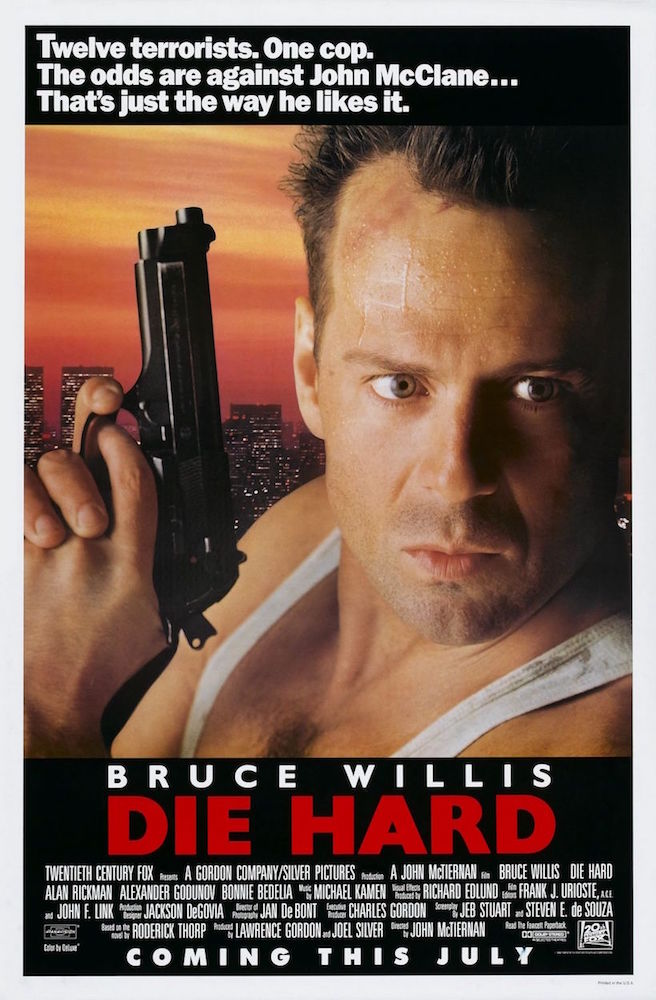
Thanks to my Die Hard poster for letting me paraphrase some promotional copy. It seemed an appropriate way to open this most auspicious of posts—WordPress tells me this is #100!
When I began this venture in 2015, I had no idea what would fill this digital space. From then to now, I’ve never worried too much about it. (Any regular visitor here has probably figured that out by now. Bless your heart.) My intention with all this remains the same as it ever was: to give my writing ambitions a public face. And, essentially, to let anyone who may be interested know that I am a fiction writer.
Posting once a week for the past two years, I’m hitting 100 right on pace. While I just wrote that I’ve never worried too much about the content, I’ll admit it hasn’t always been easy to meet my self-imposed weekly Wednesday deadline. There have been times when I’ve concocted something in the wee hours of a Wednesday, or used my phone’s data to post something from an airport. Or written something in a hotel bathroom because I was sharing the room and didn’t want to disturb my sleeping roommate.
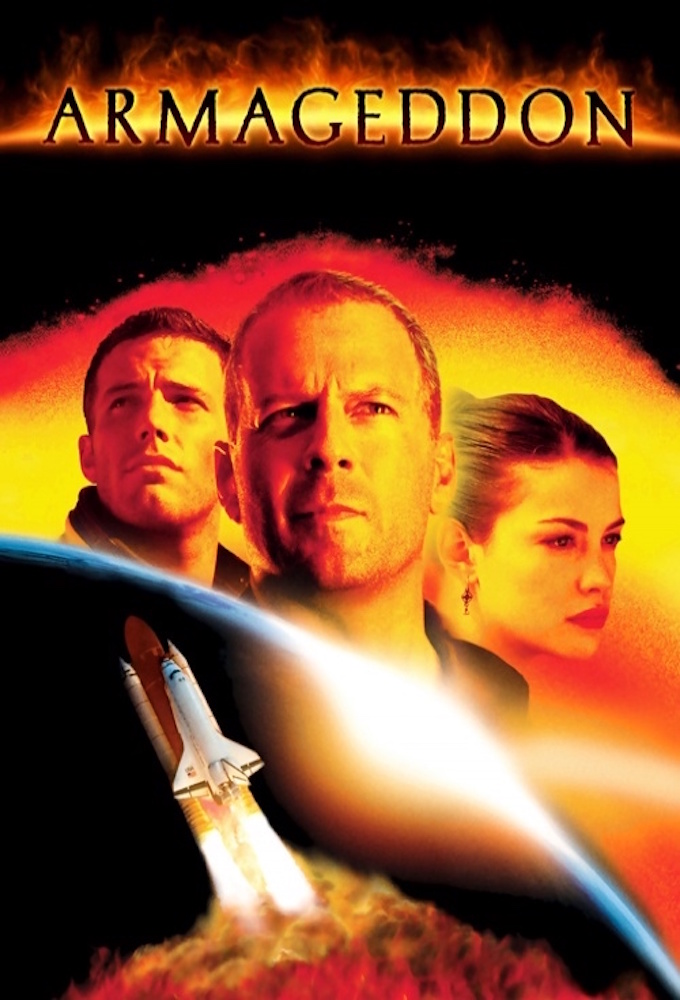
Since I haven’t missed a Wednesday yet, I feel inclined to reference another Bruce Willis character, and another great, preposterous, movie: Harry Stamper in Armageddon. In the scene where he’s fighting with Colonel Willie Sharp (played by William Fichtner), trying to get him to turn off a nuclear bomb, this is what Harry Stamper says:
“I have been drilling holes in the earth for 30 years. And I have never, NEVER missed a depth that I have aimed for. And by God, I am not gonna miss this one, I will make 800 feet.”
Okay, so, I haven’t been at this for 30 years, and the fate of the planet definitely does NOT depend on my blog posts. But for those times when I think of skipping, I think of this scene, and it gives me just enough fire to put something together.
In keeping with the number theme and my “come what may” attitude, here are a few stats:
Total views over the lifetime of this blog: 7,550
Only time I’ve ever topped 100 views in a day: my 2nd post, about a prescient letter my father wrote eighteen years before Katrina hit New Orleans
Post where I explained the whole Anne McClane / Die Hard thing: post #3
Tags I’ve used the most: Writing (20 times), New Orleans (13 times), paranormal romance (6 times), Star Wars and Lent are tied at 4 times apiece (go figure)
So, there you have it. Post #100. Hopefully I won’t be writing #101 in a bathroom.
*12 million blogs is completely fictitious. I have no idea how many blogs there are in the world.
The fountain murmuring of sleep,
A drowsy tune;
The flickering green of leaves that keep
The light of June;
Peace, through a slumbering afternoon,
The peace of June.
A waiting ghost, in the blue sky,
The white curved moon;
June, hushed and breathless, waits, and I
Wait too, with June;
Come, through the lingering afternoon,
Soon, love, come soon.
–“In Fountain Court” by Arthur Symons
June is a magical time in New Orleans. But the magic is not in the temperature. June is definitely not the best weather month—it’s when the air becomes really laden; June 1 marks the start of hurricane season; and don’t get me started on either the mosquitos or flying cockroaches. (Some call them Palmetto bugs, but I prefer to get straight to the point—these things are giant roaches that fly.)
So maybe part of the magic is this: the promise of something beautiful amidst these more miserable aspects. Arthur Symons wrote about “the flickering green of leaves that keep / The light of June.” For me, the light of June in New Orleans is a big piece of its magic puzzle. Now, Symons was a Welsh poet who died in 1945. I have to guess the light of the Junes he knew was a little different from mine—more northern, I suppose. But I also have to believe that there’s something universal about June in the Northern hemisphere, those days leading up to and away from the summer solstice.
Symons also wrote about waiting. “June, hushed and breathless, waits, and I / Wait too, with June.” Was he referring to something specific, or maybe just the quality of waiting in and of itself? Maybe he was referring to the solstice—the one day a year when light gets the best of darkness.
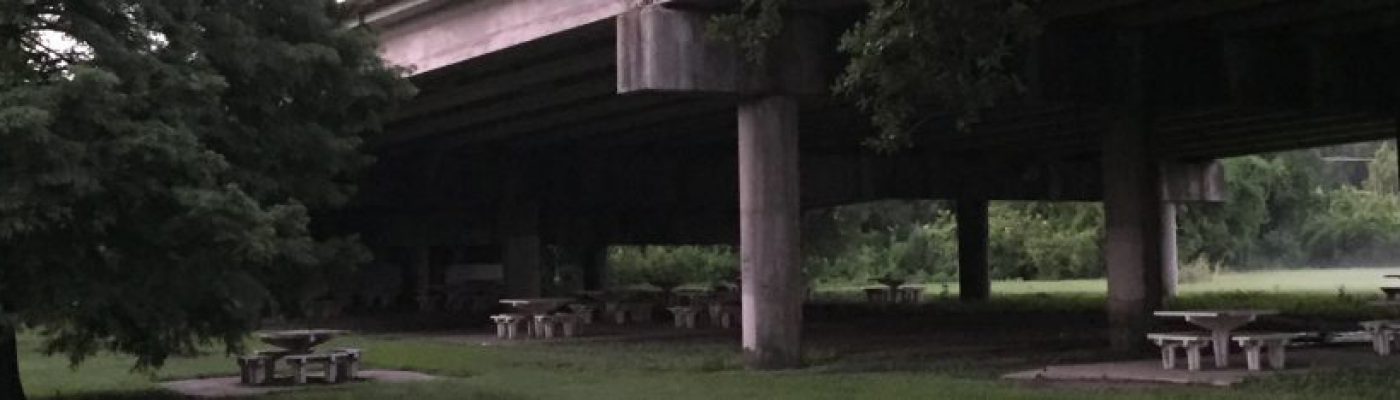
There’s something about June’s magic that had me set The Incident Under the Overpass during this month. Maybe it was because of the light, or maybe it was because the quality of waiting can help the “build” in a narrative sense. Or maybe it was just because it gave me an excuse to write about Maxfield Parrish skies, and the abundant, colorful, crape myrtle that bloom all throughout New Orleans this time of year.
June is also a challenge—if you haven’t figured it out yet, there’s something about the appeal of this month I find hard to articulate. Thus I explore it in fiction, in a blog post. Maybe if I keep trying, elucidation will come soon, love; come soon.
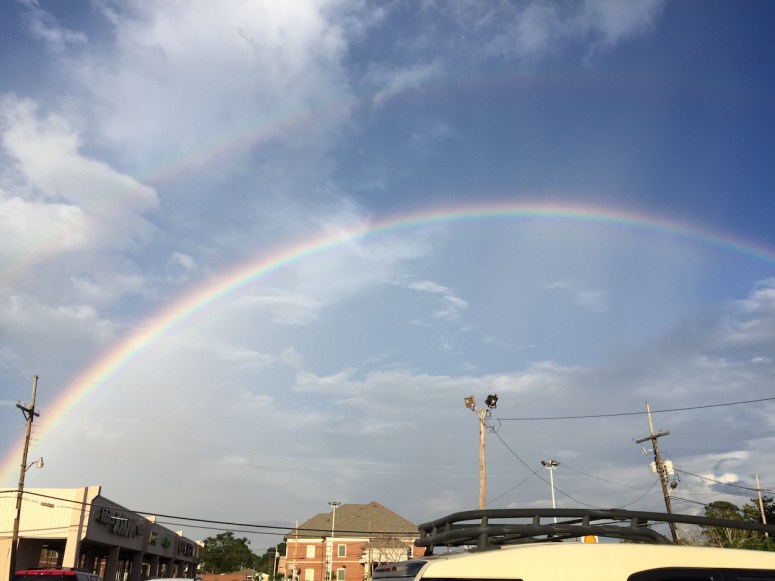
Alas, I’ve spent what time I had to spare today on those attempted articulations. Sorry for the disjointedness. But since I’ve heard a picture is worth a thousand words, here are some photos I’ve taken over the past four years, all within a month of the summer solstice. All in New Orleans, except the one with the water/beach. That was in Pensacola, which is not so far from here, and less than half a degree north in latitude. 🙂
Oh, also, the picture at the top of this post: if you look closely, it even has “the white curved moon,” like Symons’s poem.
There is a theater company here in New Orleans called The NOLA Project. They’ve been around for more than ten years now, so they don’t really qualify as “newcomers.” But I’ve seen many of their productions over the years, and I’m always struck by how they manage to keep things fresh.
Case in point, there’s their annual spring production in the New Orleans Museum of Art’s sculpture garden. A (sort-of) quick aside: the Sydney and Walda Besthoff Sculpture Garden is one of my favorite places in the city. There is something transcendent about the way the sculptures are seamlessly woven into the five acre landscape of mature oak and pine.
And an aside to the aside: the name itself features a bit of New Orleans history. Sydney Besthoff was one of the principals in Katz and Besthoff, or K&B—a pharmacy that dominated the New Orleans cityscape for most of the twentieth century. People of a certain age in this city will still describe a particular color as “K&B purple.”
I’m so inspired by the sculpture garden, I set the final scene of The Incident Under the Overpass there. But I guess I’m not the only one inspired by it. I have to believe The NOLA Project’s latest production, The Spider Queen, was at least partially inspired by some of its sculptures. It’s an original play, written by James Bartelle and Alex Martinez Wallace. James Bartelle is the Associate Artistic Director of The NOLA Project.
I saw The Spider Queen with two nieces on Friday. The play was staged on the patch of ground in front of a sculpture called “Spider” by Louise Bourgeois. It’s the one pictured at the top of this post. (That photo was taken about four years ago, during one of the three cold-ish months we have in New Orleans.)
The most remarkable thing about The Spider Queen was, hands-down, the puppets. There was a bird operated by two puppeteers, and a dragon that (I think) had five puppeteers. The ogres had just one puppeteer apiece:
And the production saved the best for last. Here’s the Spider Queen herself. I think she had six puppeteers:
So, back to the original point I was attempting to make, about The NOLA Project keeping things fresh. The spring production in the sculpture garden is an annual thing, and it’s something I’ve done with an assortment of nieces over the years.
For several years in a row, it was Shakespeare in the garden. It was during Much Ado About Nothing, as I recall, when we had messy crepes filled with speculoos and had to fend off a termite swarm. (The two things are not related. Termites swarm in New Orleans every May, regardless of what’s in your crepe. If swearing off speculoos would keep the termites away, I would do it. Reluctantly.)
As timeless as Shakespeare can be, I’m glad The NOLA Project hasn’t felt compelled to stage the Bard every spring in the sculpture garden. While I’m sure some of the universal human foibles that inspired Shakespeare are still around, it was a lot of fun to see a contemporary composition, inspired by one of the very same places that inspires me.
Not to mention, niece Kate can do a spot-on imitation of the ogres. Much better than I bet Shakespeare himself could have done.
I’ve spent a fair amount of time this month squirreled away, focused on writing, getting Lacey’s story down and out of my head. But it was time to take a break this past Saturday, for my family’s annual crawfish boil.
I can’t tell you who first decided to pick up one of these little crustaceans and put them in a boiling pot full of spices. But apparently, they’ve always been plentiful in the swamplands of southern Louisiana. I figure some hungry, early denizen of these parts must have figured they were worth a shot.
By the late 1800s, crawfish were being sold commercially. This, according to the Louisiana Crawfish Promotion and Research Board. In those 100 plus years gone by, crawfish have grown into a pretty big deal down here. This time of year, not a weekend goes by where someone isn’t boiling crawfish somewhere.
With our mild winters and really (really) long summers, some clever folks have claimed that our seasons are different in Southern Louisiana. Instead of Winter, Spring, Summer and Fall, we have: Mardi Gras, Crawfish, Hurricane, and Football. (I’ll sometimes see Hunting instead of Mardi Gras, and Sno-ball instead of Hurricane, but Crawfish and Football are constants.)
To give you some idea of the scope of crawfish boils down here: as of this year, Louisiana has a crawfish “pardoning event.” Yes, like the pardon some lucky Thanksgiving turkey receives from the POTUS each year. On March 7, Louisiana’s Lieutenant Governor pardoned Emile the Crawfish to live out the rest of his days in Bayou Segnette. (Emile was named after Emile Zatarain [1866-1959], the guy who first packaged all the spices together. Seems a little ironic.)
The crawfish boil tradition in my family only goes back six or seven years. It’s definitely tied to the next generation—several of my nieces and nephews have birthdays in March. Since March/April is the height of crawfish season, it makes sense. It’s also a great excuse to get people to come visit, since all but one of those March birthday holders live outside Louisiana.
There’s a lot I like about this family event. I like that it’s something that’s been forged recently—it’s not some holdover from our family’s past. I like to see Husband Tim and Brother Jerry working together like Matt Damon and Greg Kinnear in Stuck on You. I like that it gets distant family and friends into New Orleans for a visit.
I could go on, but I won’t. There’s a quote from A Knight’s Tale that sums up my feelings nicely. (Uttered by Paul Bettany, from his brilliant portrayal of Geoffrey Chaucer): Days like these are far too rare to cheapen with heavy-handed words.
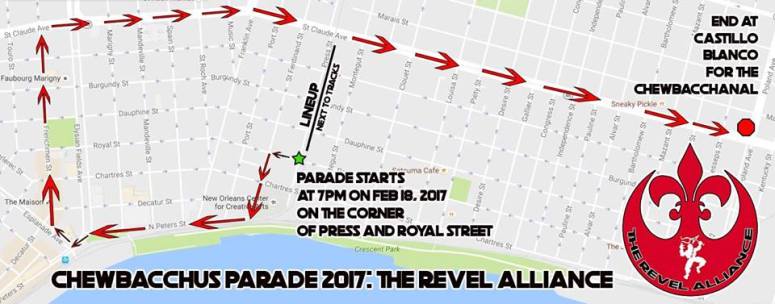
So, this past Saturday, I had a blast participating in The Intergalactic Krewe of Chewbacchus Mardi Gras parade. It was my third year marching with The Leijorettes, a subkrewe of Chewbacchus; this is my second year writing about it.
For those of you not from around these parts, here’s the interpretation of that first paragraph. The name of the parade is an amalgam of Chewbacca, the legendary Wookiee warrior of Star Wars fame, and Bacchus, the Greco-Roman god of wine. The organization that pulls a Mardi Gras parade together is called a “Krewe;” so if a parade consists of many different marching groups, like Chewbacchus, those groups are called subkrewes. The Leijorettes are a subkrewe honoring Princess Leia Organa of Alderaan (also of Star Wars fame).
I think I saw Chewbacchus listed as an “alternative” parade in the official Mardi Gras guide. It’s been around for less than a decade…I’m not sure how much time it takes in the eyes of the official Mardi Gras guide to no longer be alternative. It sure felt bigger than alternative. This is from Chewbacchus’s website: “Chewbacchus has grown from a scrappy band of a couple hundred Science Fiction lovers into a walking super krewe of a couple thousand enthusiastic freaks and geeks representing the vast spectrum of pop culture fandom.” Judging by the thick crowds we marched through, Chewbacchus seems to resonate with a lot of people.
But I’m sure the crowds gathered for Chewbacchus pale in comparison to those who come out for Bacchus, the huge parade that rolls through the streets of New Orleans the Sunday before Fat Tuesday. Bacchus the parade has been around for nearly fifty years, and it’s likely what most folks in New Orleans think of when they hear the word “Bacchus.” It’s the opposite of alternative parade.
It’s kind of interesting, because according to Wikipedia, Bacchus the deity has a more comprehensive title than just god of wine. He’s listed as “god of the vine, grape harvest, winemaking, wine, ritual madness, religious ecstasy, and theatre.”
I can’t think of a more perfect descriptor for Mardi Gras than “ritual madness.” Truth be told, that madness is one of the reasons I’m very picky about how and when I partake in Mardi Gras. At my age, I’ve grown to dislike standing around in a crowd, much less a rowdy crowd. In any given year, I might be a spectator at two parades, and that’s only if I have immediate access to a nearby establishment where I can sit down, eat, take a respite from the noise (and use the facilities, if necessary).
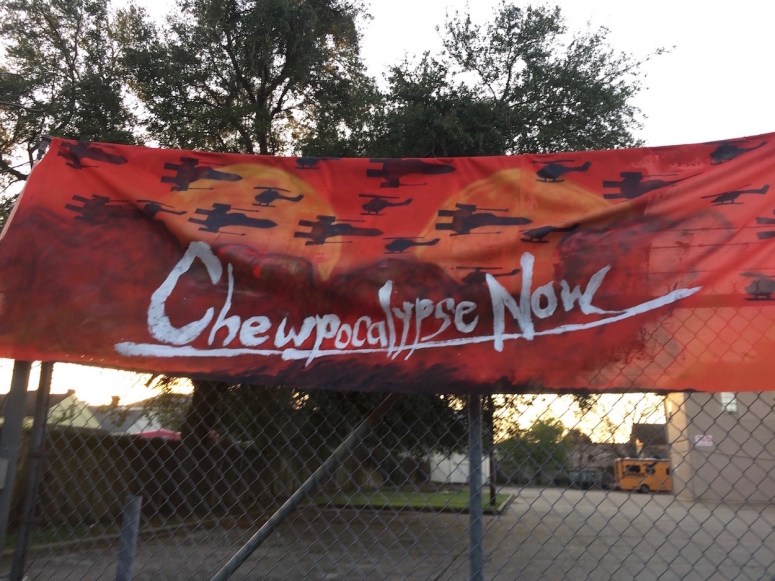
Which brings me back around to why I thoroughly enjoy participating in the Intergalactic Krewe of Chewbacchus. The theme of this year’s parade was “The Revel Alliance.” Walking to The Leijorettes’ spot in the lineup, I got to see some fantastic costumes, banners, and themes. I loved the 1984-themed subkrewe (picture featured at the top of this post.)
And then when the parade rolls, I don’t have to worry about standing around in a rowdy crowd. Instead, I get to see the crowd’s reaction when they hear the taps on the boots of nearly one hundred Princess Leias, or see those same Leias dancing to Whitney Houston’s “I Wanna Dance With Somebody.”
Chewbacchus’s brand of ritual madness is, for me, especially cathartic.
King cakes are one of the things I love about living in New Orleans. For those of you not from around these parts, here’s the Wikipedia definition… Read more “King Cakes”
So, I participated in ARC NOLA 2017 this past weekend. ARC NOLA was an Author & Reader Convention held at the Holiday Inn New Orleans–Downtown Superdome. It was kind of surreal for me, talking to readers about The Incident Under the Overpass, sitting at a table behind a stack of books (that I wrote!)
The organizer is V.A. Dold, best-selling author of the award-winning Le Beau series. She does a great job of pulling both the event, and a great group of authors, together. As I followed the preparation for ARC NOLA on Facebook, I noticed some of the participating authors showcasing their swag. Swag?!? What kind of giveaways could I throw together—quickly—to promote the book?
I make a living preparing for trade shows, mostly business-to-business affairs, so I’m no stranger to swag. As a matter of fact, I’ve just returned from a few days in Atlanta (I left the day after ARC NOLA), where I helped to set up my company’s booth at a trade show. Highly sought after swag in years past at this show (it targets meat and poultry processors) have included a purse in the shape of a chicken, and something that is really called Chicken Poop™ Lip Junk.
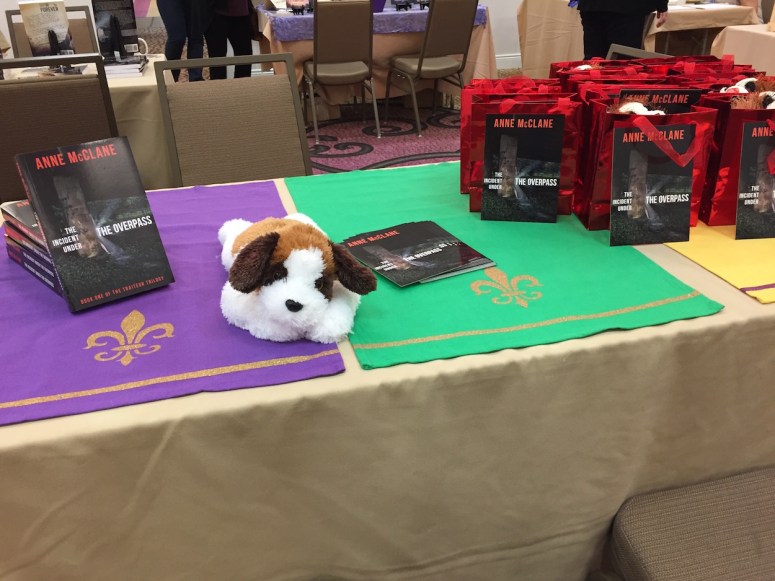
Again, it was kinda heady, to be in a position to come up with swag for my very own product. But I was pretty late to the game, since I decided I needed to have swag at my ARC NOLA table about three weeks prior to the event. It was Ambrose to the rescue! I figure, he’s such a steady presence in Lacey’s life, (Lacey is the heroine of The Incident Under the Overpass), why not craft a little giveaway to celebrate him?
After all, if people will clamor for a lip balm called “Chicken Poop,” I figure a cute little plush St. Bernard should draw some attention.
I crafted some nametags for the small assortment of Ambroses, and put my website address on the back. It’s a start, and I’ve learned some tricks and thought up some improvements for the next batch. I don’t know when my next Reader Con will be, but hopefully I’ll have more than three weeks to implement.
Because I’d certainly do another Reader Con again. V.A. Dold was a pleasure to work with. I also met several authors who provided much inspiration. I have to thank Tamara McHatton for her guidance and for being such a kind and helpful table neighbor. And I also have to thank Dionne Charlet, who first told me about ARC NOLA. And who continues to be so gracious in connecting me with other New Orleans writers. And, ultimately, it was great to meet and chat with readers in that environment—readers I might never have encountered otherwise. To those of you who picked up The Incident Under the Overpass, I hope you enjoy!
“Talking about slavery and race is awkward, and the museum stands a chance of becoming the rare place where this discomfort can be embraced.” – The New… Read more “Whitney Plantation”
So, I spent this past Saturday evening at a monastery. No, I’m not considering a change in lifestyle. I was there for a fundraiser, and the amount of food and drink available felt decidedly un-monastic.
Saint Joseph Abbey and Seminary College is about forty miles north of New Orleans. It’s been around since 1889, when a group of Benedictine Monks from Saint Meinrad Abbey in Indiana came down to Southern Louisiana to establish a monastery. In addition to the monastic life, the Abbey also houses Seminarians from across the Gulf South as they begin their journey to the priesthood or religious life.
I’ve known the place since I was very small. My father used to take us on picnics there, on the Bogue Falaya River, which runs along the outer perimeter of the Abbey. He eventually bought some land in the woods nearby, that became his personal retreat, The Point.
My Dad attended high school at the Abbey, back when they offered secondary education. He loved it, and he never lost his affinity for the place—I think that’s the reason he bought property nearby. He wanted to write a book about the Abbey and his time there. That’s what he was working on when he died.
The Abbey Cemetery is one of the most beautiful in Southern Louisiana, in my opinion. It’s different from the cemeteries New Orleans is famous for, because it doesn’t have the abundance of above-ground tombs. I’ve known the Cemetery since I was small, too—my paternal grandfather is buried there (he died many years before I was born). My Mom and Dad are also there now. The writer Walker Percy is just a few plots away from them.
There’s something else about the Abbey, which has left a distinct impression on me from a very young age: the murals by Benedictine artist Dom Gregory de Wit. I’ve always known the ones from the Abbey church, but I just got to see the ones in the Monks’ Refectory for the first time.
My Godfather (who was with us at this fundraiser) pointed out an interesting fact: de Wit liked to put some sort of anachronistic element in his paintings. This is from a mural of the Last Supper from the Monks’ Refectory:
Can you pick out the anachronism? (It’s sorta center frame)
Finally, the fundraiser is called Deo Gratias (thanks be to God). They have it every year, but this year, it took on special meaning. The Abbey was inundated when the Bogue Falaya flooded earlier this year, in March. (Yes, five months before the flooding that devastated the Baton Rouge area. This has been a terrible year for floods, and not just in Louisiana). The damage to the Abbey was worse than what it suffered during Katrina.
The recovery is well under way, but there is still a long way to go. That’s why I was really glad to take part in Deo Gratias (thanks be to my sister for her generosity). There is something truly transcendent about the Abbey—in its peacefulness, its solitude, and its reverence. It has stood for generations, and I need to believe that it will be there for generations to come.
What follows is a very early posting on this blog, from one year ago:
I am a New Orleans native, and a New Orleans-based writer. I had been back here (from Los Angeles) just shy of two years when Katrina hit ten years ago. I wasn’t writing much, back then.
It feels a bit obligatory to do a Katrina post marking the tenth anniversary. And as my second post ever. But if I had started this blog back in June, then maybe this would have been the tenth post. The truth of the matter is, I stumbled across what I’m about to share in April. Sharing it now (as opposed to then) feels more timely.
My dad died fifteen years ago, in October of 2000. Five years before Katrina. Mom just died, nine months ago. My siblings and I have been going through their house in Metairie. Back in April, my sister Julie and I spent a long weekend going through the office (a former bedroom converted into an office).
Dad, circa 1950
This one filing cabinet in that room had reams of my father’s stuff still in it. Drafts of the book he wrote about his advocacy efforts on behalf of my brother Stephen, who has autism. Articles and references of his military service. Pre-World War 1 flight logs belonging to my grandfather. And this: a letter he wrote after finishing a tour of duty with the New Orleans Office of Emergency Management. My dad was, among many other things, a Colonel in the Louisiana National Guard.
We found this letter in a folder with a hand-written label, “1987 Hurricane Exercise.” I suspect he saved it, thinking that a Katrina-like storm was an eventuality, not a remote possibility. I remember Mom saying, in the fall of 2005, that she was glad Dad was spared being witness to it all.
So, here’s the letter. (Thank you, niece Cece, for making it digital.) The bold formatting is my doing, in case you want to skim through to the really salient bits.
May 4, 1987
CAO | Room 9E01, City Hall | New Orleans, Louisiana 70112
Dear :
My tour of duty as an Army Reserve Individual Mobilization Augmentee to the city’s Office of Emergency Management ended on April 19. On that day, I was transferred to the Retired Reserve.
However, I cannot leave my assignment in good conscience without sharing with you some of my thoughts and recommendations. These are generally based on my observations during the past three years and specifically on the recently completed hurricane exercise.
Our citizens are woefully unprepared for the devastation of a major disaster. We can greatly assist them by coordinating a city sponsored education program to teach them to make personal preparation and/or evacuation plans. This could be done with minimal expense using city prepared public service announcements, interviews, news releases, appearances on radio and television talk shows, providing speakers at civic club meetings (Rotary Club, Chamber of Commerce, etc.), neighborhood organizations, and schools. The potential is limitless for educating the public and personal preparedness is the key to survival in an emergency. We can do much in this area.
I was shocked to learn that not all the Sewerage and Water Board’s pumping stations have 100% independent back up electrical power. I urge the city to use whatever persuasion it has over the agency to encourage S & WB to include failsafe back up power for all its facilities in its capital budget as soon as possible.
During these past three years, I have observed both examples of outstanding cooperation and appalling disinterest on the part of city agencies during actual emergencies and exercises. The lack of full participation by the New Orleans Police Department during the recent exercise is symptomatic of what I perceive as a longstanding attitude of that organization.
It is my opinion that the Police Department wants to “do its own thing.” However, it is the responsibility of OEM to coordinate the activities of the many and varied municipal and non-city organizations during an emergency, including the Police Department. Any organization acting on its own is a waste of resources and counterproductive. The Police Department is a major player in any emergency; it is imperative that they join the city’s team.
The recent exercise demonstrated how vulnerable the city is if we rely solely on telephone communication. A state of the art radio communication center with the capability to network with all city, state, and nine parishes is essential.
The Office of Emergency Management is woefully understaffed. To function at an acceptable level, at least two additional staff members are needed – a communications specialist and a planner. I have pointed out the need for communication equipment in the preceding paragraph. The same need applies to personnel.
A planner is essential to write, revise, review, update, and coordinate the emergency plans of all city agencies and other, as well as the integration of plans within the nine parish area.
I want to thank you and the city for the opportunity to have been of service in Emergency Management. As a native of the city, I consider it a privilege to have helped in some small way. Emergency Management has made progress and I am proud to have been a part of it.
Respectfully yours,
Gerard J. Mialaret
It was very much like my father, to not go quietly into retirement and remain silent. And to be the gadfly in this manner, via a letter. And save it in a folder to be unearthed during the archaeological digs his children would conduct once he was gone.
He received a reply within a week, from the City’s Chief Administrative Officer. It was short, a few paragraphs. This one paragraph captures the gist of it:
“I appreciate you sharing your concerns with me. I have shared your communication with many other individuals in City Hall and have requested their careful review of the matters that you have called to our attention.”
History bears out that their “careful review,” and whatever action it spurred, was inadequate. And Dad picked his battles. If he didn’t have other, bigger items on his agenda, he might not have let this rest with one letter.
But the lesson I take from this, really the way of being I learned from my father, is don’t be silent. Especially when you can see the potential harm in doing nothing. The world needs gadflies.





 And an aside to the aside: the name itself features a bit of New Orleans history. Sydney Besthoff was one of the principals in Katz and Besthoff, or K&B—a pharmacy that dominated the New Orleans cityscape for most of the twentieth century. People of a certain age in this city will still describe a particular color as “K&B purple.”


 To give you some idea of the scope of crawfish boils down here: as of this year, Louisiana has a crawfish “pardoning event.” Yes, like the pardon some lucky Thanksgiving turkey receives from the POTUS each year. On March 7, Louisiana’s Lieutenant Governor pardoned Emile the Crawfish to live out the rest of his days in Bayou Segnette. (Emile was named after Emile Zatarain [1866-1959], the guy who first packaged all the spices together. Seems a little ironic.)



 Anne McClane