Does every picture tell a story?

There’s more to this thistle than meets the eye…

On a run through New Orleans City Park this past Saturday, something caught my eye. My runs these days are a sorta walk-run combo, so I’m not opposed to breaking my stride to satisfy my curiosity. I’m at a point in my life where finding the unexpected is more important to me than reaching some particular cardiovascular fitness milestone.

I was pleased to find a few thistles blooming, right at the shoreline of the lagoon. When you think of New Orleans flora, “thistle” is not one of the first plants to come to mind. Not for me, at least. So these prickly, lilac-colored-bloom beauties were a pleasant surprise.

They were in a fairly secluded area of City Park, set back about fifty yards from the nearest roadway, but only a few feet off the paved walking path. I don’t like to run with my phone, so I made an intention to return the next day for a more leisurely picture-taking expedition.

That’s where the story comes in.

I was out and about early on Sunday morning, so I cheated and drove to the thistle spot. Or rather, I parked near there as I made my way back home. Traipsing the fifty yards across the grass and fallen oak leaves, I could see someone was already there ahead of me. I first thought it was a photographer, setting up to get their own thistle pic. (Photographers are definitely not a rare sight in City Park.)

As I approached, I could see it was a man closing up a backpack. It looked like a nice, solid backpack, not something cobbled together. And he seemed pretty intent on his task—striking camp, I assumed—and not so interested in the nearby runners and / or amateurish iPhone photographers.

But still, I had to do one of those instant threat/need assessments. You know, all the questions and answers that run through your head in a split second. “Does this person look dangerous?” Maybe, but he’s behind and bent over his pack, so it’s not like he’s lying in wait. “Does this person look like they need help?” He does not look like he needs or wants help. “Is this person supposed to be camping here?” Probably not, but I’m not about to call him out on it.

So in that instant, I decided to proceed with a few quick thistle pictures, but not dally doing it. I told him “Good morning” as I approached the lagoon’s edge. He looked up, but didn’t respond. (That’s when I got the idea that he neither needed or wanted any kind of attention). I took the photos, and then hightailed it out of there.

Being a fiction writer, I’ve had nothing but possibilities running through my head ever since. Daylight savings time had begun just about seven hours earlier, so did backpack man think he was striking his camp earlier than he actually was? Was he wondering why so many runners, walkers, and just general people were out so blooming early?

And then, don’t get me started on the thistles. Are they a sign for off-the-grid backpackers, “Here You May Camp”? Kind of like the scarlet pimpernel? Or does some scout come and seed them for off-the-grid backpackers? Is there a Secret Society of the Thistle?

Reality still creeps in. I don’t want it to seem like I am making light of this person’s circumstances. I get the gravitas. Outdoor living is tough, and especially so if it’s not by choice. My sense was his was mostly by choice. But my sense has been wrong before.

Which brings me to one of those things I’ve learned about writing, my writing, in the eight or so years I’ve been at it. And here it is: ideas for fiction—even the zaniest ideas, especially the zaniest ideas—are rarely worth pursuing if they aren’t backed up somehow by the weight and gravity of the real world.


Back to Running

Photo credit: S.M. Frost

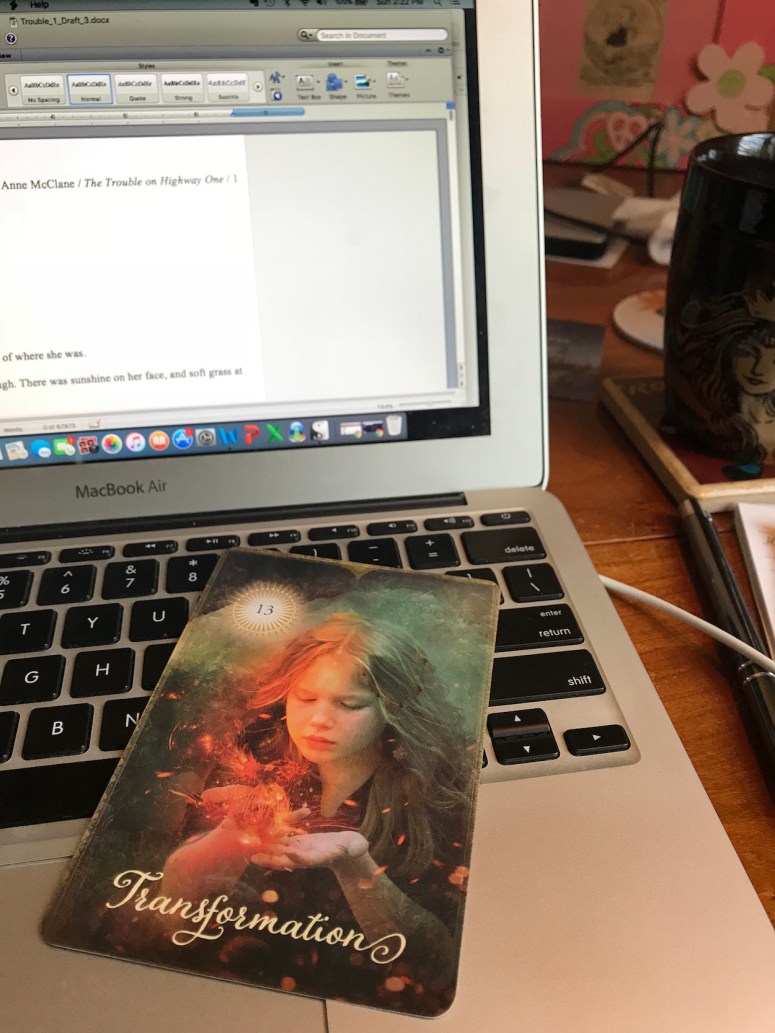
So, I’ve still been hard at work, putting the finishing touches on the manuscript for The Trouble on Highway One, my second novel, and the follow-up to The Incident Under the Overpass. That’s how I spent the bulk of this past weekend, except for two breaks.

On Sunday, Husband Tim and I saw Black Panther. I really enjoyed it, and found it to be one of the better offerings in the Marvel movie franchise. And the character T’Challa as portrayed by Chadwick Boseman is a definite favorite. (I like to root for the good guys with a sense of humility. And for the record, I’m Team Cap all the way.)

On Saturday, I (mostly) ran the 504k race in Crescent Park. (504 is the area code for New Orleans. And this race is 5.04 kilometers long). For me, having run this race is worth noting for several reasons:

  • It’s the first race I’ve run in over two years. I really don’t remember the last race I ran. The years started catching up with my legs and lower back roughly two years ago, and I followed an orthopedist’s advice and took a break from running.
  • Strike that, I do remember the last race I ran. I (mostly) ran one of the two-mile races they hold in City Park over the summer. But that turned out to be an anomaly. Legs or knees or something started bothering me shortly thereafter.
  • This time around, I followed a physical therapist’s advice and got back into running s-l-o-w-l-y. Like build the miles slowly. Like try running for five minutes, then add a minute a week at a time.

Okay, didn’t mean to go so far into my wonky physiology. What I really wanted to say was how good it feels to be running again, and how much I missed it. And how much fun it was to run a race I’d never run before, in a park I had not yet been to.

Many thanks to my friend Samantha for the entry to the race. She’s on the Board of Directors for Youth Run NOLA, the organizers of the 504k. Youth Run NOLA partners with schools and the community to “help youth develop healthy habits for life through distance running.” All photo credits in this post go to Samantha, too.

Interestingly enough, it’s been about two years since I’ve written about running in this space (I think swimming has made more entries.) Take a look, if you’re interested, it still rings true for me: Writing and Running

Photo credit: S.M. Frost

The Second Time Around

The second time is
So much better, baby
(The second time around)
And I make it better
Than the first time

—Lyrics from “The Second Time Around” by Shalamar

I remember this song from my youth. It’s from Shalamar’s album Big Fun, which Wikipedia tells me was released the day after my tenth birthday. Like a lot of songs from that era, if they received radio airplay, there’s a good chance those lyrics and melodies are lodged somewhere deep in my cerebrum. Just waiting for the right catalyst to release them to get stuck in my current brain.

In this instance, the catalyst has been the work I’m pouring into my second full-length novel. I’m into the final edits, and I remember being at a similar stage with my first one, exactly twenty-four months ago. February 2016.

Shalamar sings “the second time is so much better.” Related to my own efforts, I agree—but on balance. The pressure’s higher this time around, so that has leavened my joy a bit. I guess stress has a way of doing that. But the reason the pressure’s higher is an absolute positive—my publisher has asked me to submit this manuscript. No one was asking first time around. Here are some other ways I agree with Shalamar:

  • Some readers have indicated they want to read the continuation of the story I began in the first one. That’s pretty cool.
  • Working with a developmental editor this time around was a HUGE improvement to the writing process.
  • I’m a touch more confident in my abilities. But just a touch, because I still struggle daily with anxiety, and “am I worthy”-type thoughts.

And finally, there’s the last bit of lyric quoted above. “I make it better than the first time.” On that point, I’m unequivocal. That is my intent, 100%. For every novel and short story I write to improve upon the previous.

There’s a quote I’ll see on social media from time to time, I think it’s from writer and editor David Schlosser: “The only writer to whom you should compare yourself is the writer you were yesterday.”

I think that sums up my thoughts nicely. Enjoy Shalamar’s catchy song, and their super-sparkly outfits:

Symmetry

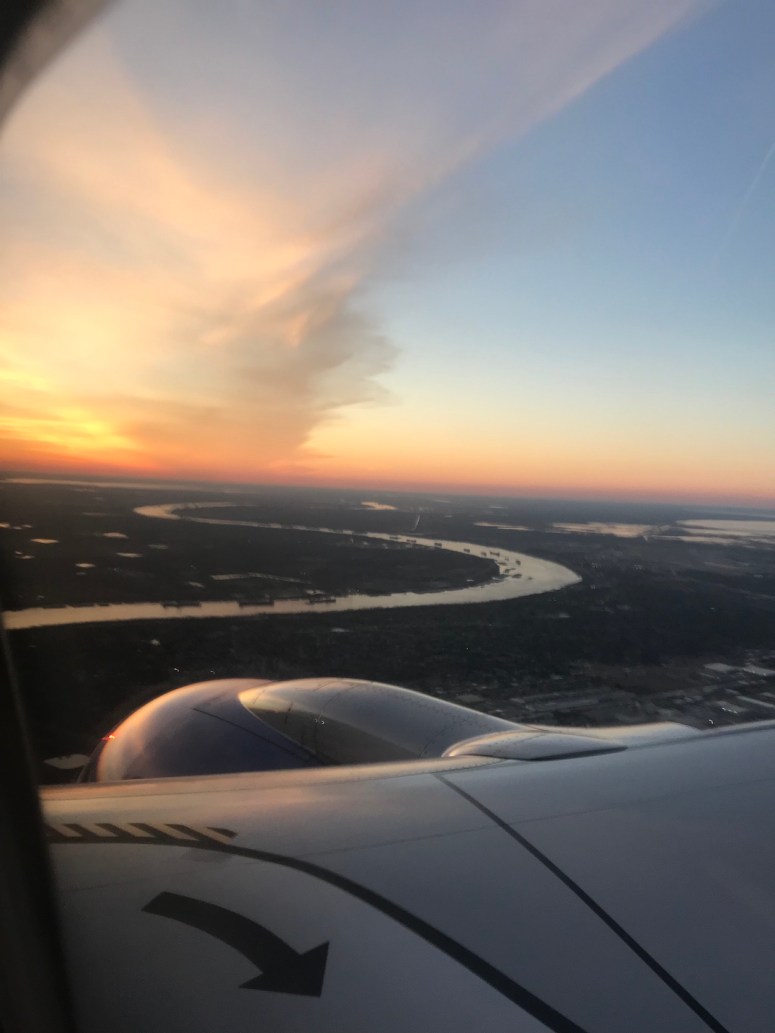
January 30, 2018. Returning home from Atlanta.

I did not post in this space last week. But it wasn’t because I was unprepared; I had something ready to go. It still sits as a draft in my WordPress workspace—where it will likely remain as long as I have this WordPress.com account.

It was titled “Symmetry (and other random thoughts).” And when my usual posting time rolled around—early Wednesday morning, Central Time—my heart was no longer in it. The words felt crass, and shallow, and not what I wanted to put out in the world at that time.

Something devastating had transpired in between the time when I wrote that post, and last Wednesday morning. I was with a very close friend in the wee hours of that Tuesday, just after she’d learned that her beloved thirteen-year-old son had died.

My friend and I were both away from home, in Atlanta, for work. We had dinner together Monday evening. She had told me how her son was being treated for depression. A very active and bright young man, he had just started to show signs of struggle. My friend and her husband had wasted no time in seeking help for him. No one involved in his treatment thought he was in imminent danger of harming himself.

I went to sleep in my hotel room that evening, thinking of her son, and how hard it is to just grow up. And how overwhelming it must be when the demons of depression interject themselves into the turmoil of adolescence.

When I awakened around 3am, and saw several missed calls from my friend, I knew something terrible had happened. By the time I padded down to her hotel room in pajamas and work shoes, she had already booked the first available flight back to her home in Wisconsin. I stayed with her for a while, went back to my room to shower and dress, and returned to her room around 5:30am to drive her to the airport.

By Tuesday night, I was back home in New Orleans. And feeling profoundly empty. Or useless. Or all of the above. My friend and I speak often, but only see each other a few times a year. I was glad I was able to provide what small support I could—getting her to the airport—but it feels insignificant compared to the depth of her, and her husband’s, pain.

Or the magnitude of their loss.

When Wednesday morning rolled around, if I had published what I originally wrote, it would have meant me ignoring how close I had been to this tragedy, so soon after it had happened. And I knew that wasn’t the right thing to do. Silence felt more appropriate.

Not to mention that my friend is one of a handful of people who regularly reads what I write. It would have been a disservice to her friendship, dishonoring of her grief, and, essentially, contrary to every reason why I choose to express myself via writing.

I’m floundering at this very moment. I still don’t know whether this is “right to write.” But I am compelled by something. Maybe something beyond reason.

And ultimately, obviously, I’ve chosen to put this out there. Also, to salvage two items from that original post. I’ve left out the “other random thoughts,” and focused on two things that hopefully, adequately convey both feeling and depth.

First, the inspiration for the title of this post (and also, the unpublished one). It’s a song called “Shore,” performed by the Danish String Quartet, from their album “Last Leaf.” I couldn’t find the song on YouTube, but I did find a promotional piece about the group and this album here.

I downloaded “Last Leaf” sometime in December, and I keep coming back to “Shore.” It’s roughly three minutes long, and I’m always struck by the mid-point of the song. It bridges the two halves in perfect symmetry. To my ear, at least. And it’s nestled thoughts of symmetry into the back of my brain for the past two months.

I can see no symmetry to the hole that has been left in my friends’ lives. I can’t even pretend to.

But I can still be moved, and centered, all at the same time, when I listen to this composition. As only music can do, for us imperfect and imbalanced humans.

And there might be some symmetry to the one other thing worth mentioning from that other post. A symmetry between the unpublished and published, perhaps.

I had cheekily mentioned Bruce Willis’s character from Armageddon, Harry Stamper. I had watched the tail end of the movie in my hotel room Sunday night. I had drawn a comparison, as I’ve done in this space before, between Harry Stamper’s record of always reaching his drilling target, and my consistency in posting for the past two and a half years.

For the last several days, I’ve thought about the actual words, the line of dialogue that inspired the comparison. Harry Stamper never missed a depth that he aimed for.

If I had published last week, I would have definitely missed my target depth. And that’s not the writer I’ve ever intended to be.

2017 Look Back

City Park, New Orleans, January 1, 2017

The years teach much which the days never know. — Ralph Waldo Emerson

As I think back just twelve months ago, I remember a whole lot of uncertainty. We (the U.S.) had just completed one of the most surprising election cycles in recent history, and certainly in my history. My posts from a year ago reflect that state of uncertainty, to a degree. There was talk of Alfonso Cuarón’s Children of Men, some angst on my part over missing a #WritersResist event in New York.

I’m relieved to write that I feel a modest degree less uncertain now. The Republic still stands, the government still functions. (You can read into “functions” what you will, it’s a broad term.) On a personal level, I’m still employed, I still have some savings for the future, and I’m still writing.

This post completes the second full calendar year of this blog. On the “published writer” front, I signed a publishing contract with After Glows Publishing in the first quarter of 2017, and re-released The Incident Under the Overpass with them in September. I hope that the follow-up to TIUTO will release in the first half of 2018.

I had an essay published in OUTSIDE IN MAKES IT SO: 174 New Perspectives on 174 Star Trek TNG Stories by 174 Writers. I will have a short story appear in the sci-fi anthology Just a Minor Malfunction, issue #4, in late February 2018.

My progress in the published realm feels slow, but at least I can state that there is progress. And while I’m glad to be putting 2017 to bed, the year definitely had its highlights. I thought it would be nice to reflect on the new places I saw this past year:

  • Whitney Plantation: a sobering start to the new year, as I learned more about the role my ancestors played in the life of this once-successful sugar plantation. While not happy times for me, any occasion where my eyes are truly opened is worth remembering.
  • Düsseldorf: I saw a city in Germany I’d never seen before. Also of note, this is the only new place I encountered with my job—every other new place was of my own volition.
  • New Smyrna Beach: vacation with husband Tim on Florida’s Atlantic coast.
  • Murfreesboro, Tennessee: my first total solar eclipse!
  • Greece: a happier occasion to have my eyes opened, on vacation in one of the planet’s cradles of civilization.

So once again, Ralph Waldo Emerson states it best. The last days of 2016 certainly did not have places like Greece or things like a total solar eclipse in their sights. I’m grateful for the cumulative learning offered by this past year.


The Star

Our local star rises over City Park in New Orleans, December 3, 2017

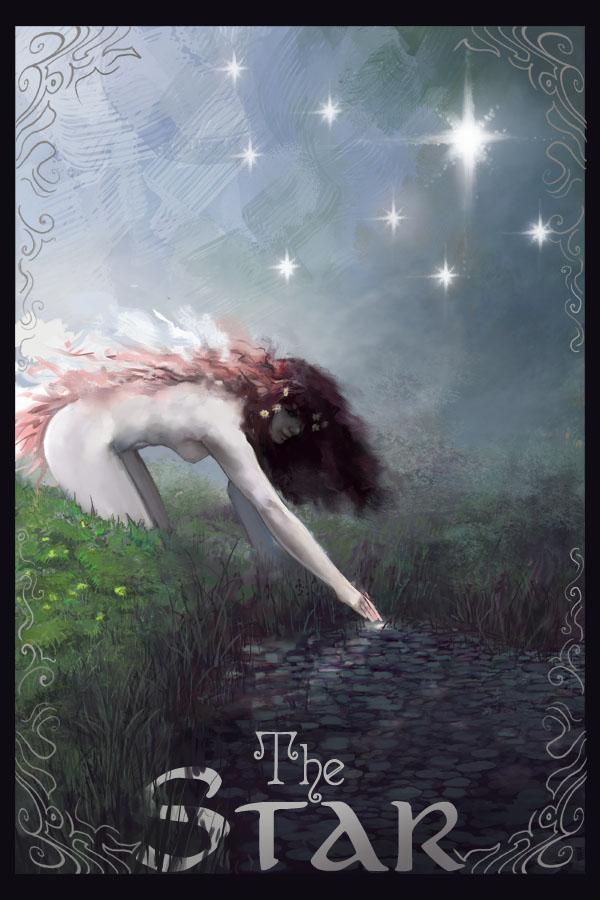
I recently read about the 17th card of the Tarot deck, the Star. It’s a pretty hopeful one, coming after the Fool has emerged from his encounters with Death, the Devil, and a creepy Tower with people falling from it. I couldn’t help but draw the comparison between the Star being the 17th card in the Major Arcana, and this being 2017…

The book I was reading was Juliet Sharman-Burke’s The Complete Book of Tarot; I’ve had this book for decades, but have referenced it more and more these past few years as I focus on my writing. Regarding the Star, she writes: “The Star has always been an emblem of hope and promise; a light to steer by.” She goes on to reference the Magi following a star to Bethlehem. It seemed another interesting coincidence that I just happened to read about the Star on the first Sunday of Advent.

And I got to thinking, I realized I am personally feeling more hopeful in December 2017 than I was in December 2016, for several reasons. First, I feel a lot more confident about my fiction writing than I did a year ago. It seems I spent the better part of ’16 consumed with and worried about the publishing part of authorship. Truth be told, it felt like a distraction. I couldn’t see how I could keep all the plates spinning and finish the trilogy I had begun in anything resembling a timely manner.

Fast forward to now: book 2 is written, and I’m in the midst of editing and re-writes. Book 3 is outlined, and I’ve begun writing it. Working with After Glows Publishing has made a world of difference—they’re who I have to thank for the confidence boost.

Next, I start a new job next week as a Technical Writer. It’s with the same company I’ve been working for; but it’s outside of the marketing department. So, no more trade shows for me. Believe me, it’s a welcome change—I’ve been involved with trade shows or “experiential” promotions for roughly twenty years. I’m excited about taking on a new challenge, and having the chance to hone my word skills with a different type of writing.

Finally, I find the #metoo movement really hopeful. I try not to stray too much into political/societal musings in this space. My intent is keep it to things I have some authority over—mainly, my personal experiences and how they relate to my writing. Since I’m a woman who has worked in a corporate/business environment for many years, I definitely have authority over my own experiences in that sphere, and those experiences definitely influence my writing.

And I know this: it takes boatloads of courage to come forward and expose the bad behavior of someone who has power over you and your livelihood. Too often, I’ve seen that courage met with, at best, some temporary disciplinary action; at middling, indifference; and at worst, reprisals against the powerless. The fact that some perpetrators are now losing their jobs—their positions of power—feels like a sea change to me.

A quick aside: I’ve written here before about The Writer’s Almanac. I hear it has been canceled since Garrison Keillor was dismissed from Minnesota Public Radio. While I will miss hearing the content of that syndicated program, I was never particularly attached to Garrison Keillor’s hosting of it. I’m impressed that Minnesota Public Radio didn’t let his “brand name” outweigh the claims that were brought against him.

I’ll conclude with the December quote from my 2017 “First We Dream” calendar. It’s from Louisa May Alcott, and it seems fitting that it involves a star:

Far away there in the sunshine are my highest aspirations. I may not reach them, but I can look up and see their beauty, believe in them, and try to follow where they lead.

The Texas Renaissance Festival

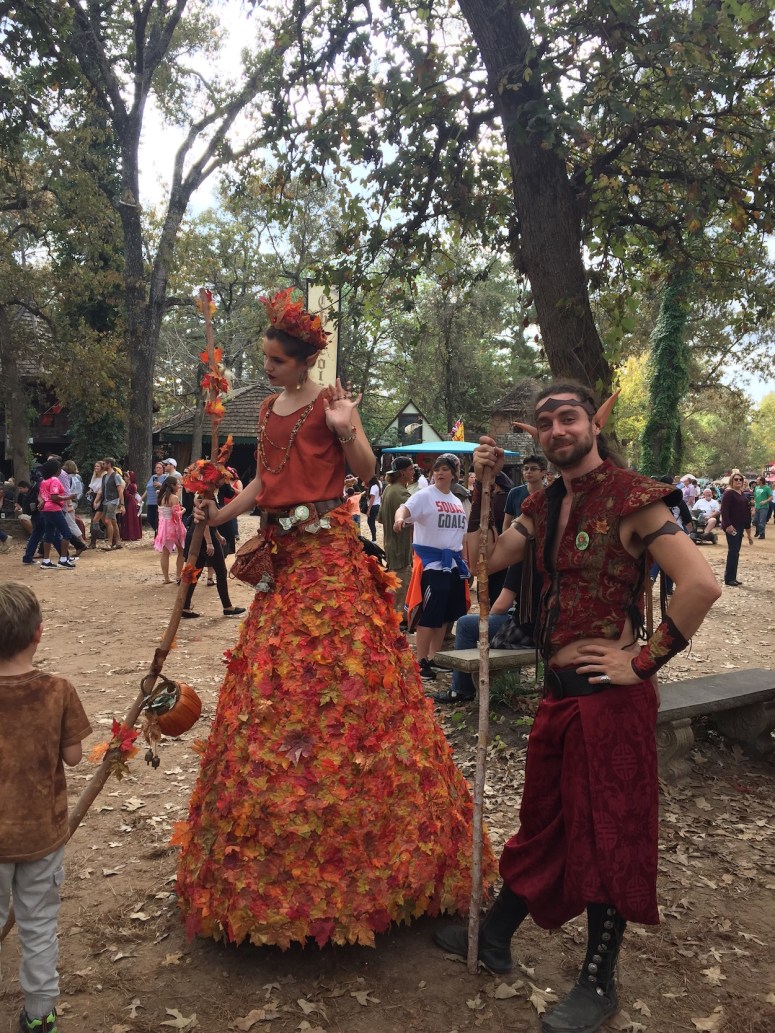
“Leaf me alone,” says the Fall Faerie

So, I was in Houston this past weekend, visiting my sister Julie. Hurricane Harvey had something to do with this trip. After it dumped its biblical portions of rain on the Houston area, Julie and I carved out this time—a grateful acknowledgment of the fact that she and her husband were spared any flooding.

It took a little while for our schedules to coalesce. I had the trip to Greece last month, and Sister Julie had a bunch of work travel that just wrapped up. She flew to three continents over a four-week period, I think. One of her trips was supposed to commence the week Harvey hit, but airport closures pushed it forward.

As the fates would have it, I found myself in Texas during the Texas Renaissance Festival, for its Highland Fling-themed weekend. A note about this fair: Wikipedia tells me it began in 1974, on the location of an old strip mining site. Julie has lived in Houston for the past twenty-five years, and has been an avid fan of the TRF since she discovered it, shortly after her arrival in the Lone Star State.

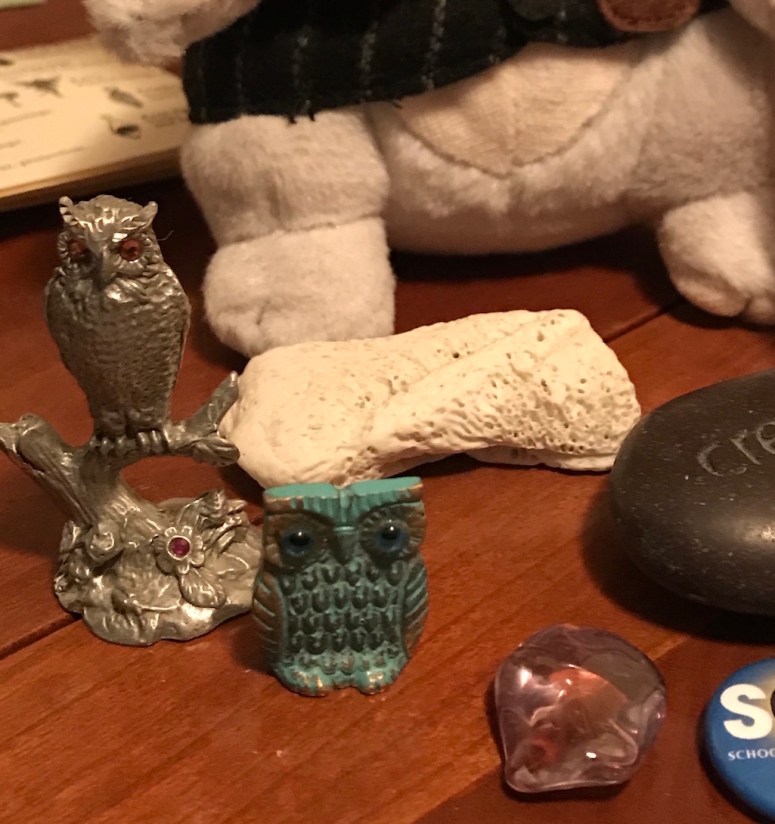
Through the years, there’s been an assortment of our family that’s joined her on her annual trek to the festival, held every autumn, fifty-five miles northwest of Houston. I’ve been with her once before, five or six years ago, when I purchased a little owl figure at one of the shops.

There is a specific reason behind my relatively new fascination with owls. Shortly after I began this writing journey, I dreamt I had an owl as a pet. More a familiar than a pet.  In the dream, the bird was trying to tell me in an owl-lie type way that I needed to adjust my focus, and pay more attention to writing. As motivation, it sorta backfired—while I definitely give writing more focus these days, I also get easily distracted by images or depictions of owls whenever I encounter them.

Original Owlie, plus a new sibling from Greece

Anyway, Sister Julie was in a reflective mood at this year’s festival. It might have been the effect of finally alighting at home after her round-the-world travels. Or maybe because her children are all grown now. Her daughter, Niece Emilie, would almost always join her for the Highland Fling weekend. Em just started a graduate program at Yale, so a trip back home to Texas just for the Fling was too hard to swing. 🙂

Julie pondered aloud about why she’s always loved the TRF. Was it the time of year, the South Texas air finally turning cooler? Was it the clothes and costumes? Was it Tartanic, the group that bills themselves as “Insane Bagpipe/Drum/Dance/Comedy” performers? Personally, I’d put in a vote for the scotch eggs and pear cider.

I reminded her that she’s always been drawn to that historical period:

“Remember the term paper you wrote in high school, ‘Was Medieval Woman Really…”

“Mid-Evil?” she finished my sentence. “Yeah,” she said, “How do you remember that?”

“I guess that’s the kind of stuff I remember.” Growing up the youngest of seven kids, with a nascent ambition to write, I paid attention to my older siblings’ term papers, short stories, plays, impromptu comedy skits…

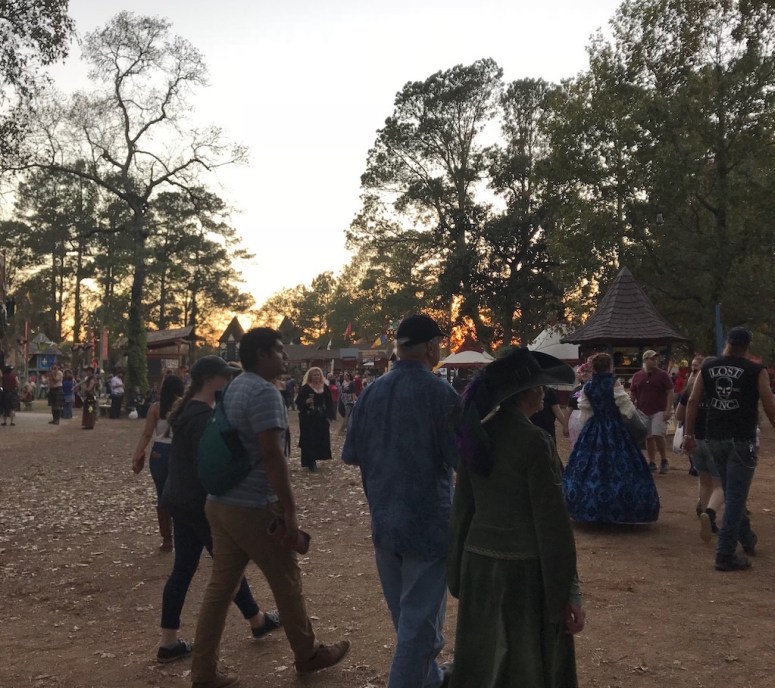
Really, it’s enough for me that the Texas Renaissance Festival is just something my sister loves. As well as a lot of other people, apparently—it was packed this past Saturday. And I love seeing all the costumes, which span far beyond the Renaissance period. (For more casual togs, I was not the only one in a Star Wars t-shirt. And Astros fans were also out in force.)

And finally, I like to think of the “reawakening” meaning of renaissance. Here is an old strip mine, reborn as a verdant, pastoral, place. And what a lovely venue, and event, for the people of Houston to return to each year.

Outfitted for Highland Fling
Blending in
Worlds collide
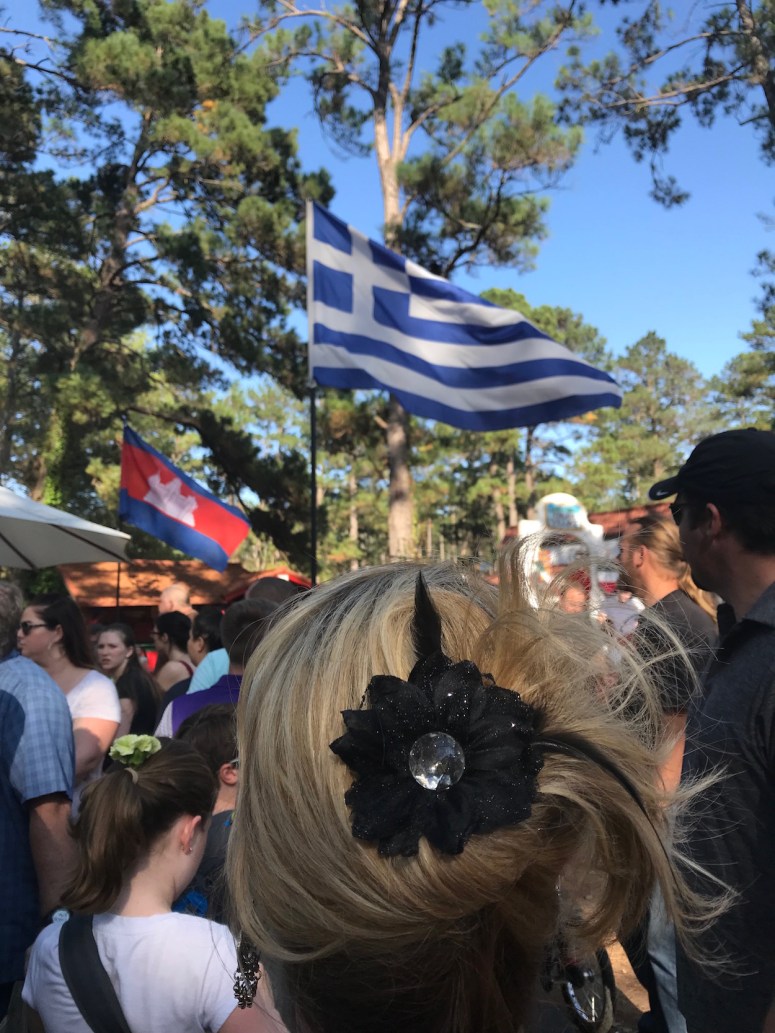
Admiring Julie’s new hair clip while waiting for the swings
The swings
Sunset at the TRF

Poetry Insurance

“Temperance” from the Lo Scarabeo Tarot

I’ve been thinking a lot about balance, lately. About how I can devote the time necessary to writing, and still go to work, earn a living…essentially, how to “pursue my passion” without abandoning adulthood entirely.

Which brings me to Ted Kooser and Wallace Stevens. I’ll start with Ted Kooser: he’s a former VP at an insurance company called Lincoln Bankers Life. He was also the U.S. Poet Laureate from 2004 to 2006. He managed the job/passion balance for a long while—by the time he retired from the insurance industry, he had published seven books of poetry.

Wallace Stevens was another poet insurer, but from a different age. He was born in 1879, and died in 1955. And, apparently, he never retired. He worked as an insurance executive in Hartford, Connecticut for most of his life. He was also awarded the Pulitzer Prize for Poetry in 1955. That same year, Harvard offered him a faculty position, but according to Wikipedia, he declined it “since it would have required him to give up his vice-presidency of The Hartford.”

Speaking of working in a different era, regarding the insurance industry connection, Ted Kooser reportedly quipped: “Stevens had far more time to write at work than I ever did.”

Kooser would write in the morning before going to work (like me. Or like I’m supposed to be doing). Writing time of day aside, I certainly find more in Ted Kooser’s profile to identify with than Wallace Stevens’s. Stevens traveled to Key West quite a bit, where he’d tussle with the likes of Robert Frost and Ernest Hemingway. And when I say tussle, I mean it in the corporeal sense—he evidently had several arguments with Frost, and at least one physical altercation with Hemingway.

If I were to dust up with current literary giants while on vacation, I’m pretty sure it would be all over social media. I’m also 100% certain I’d lose my job.

So I’m back to identifying with Ted Kooser. His Wikipedia page is pretty light on famous fights. He’s now 78-years-old, and still working that balance. While he’s retired from insurance, he’s the editor of a national newspaper column, “American Life in Poetry.” His poetry seems really accessible, and he also seems like someone you wouldn’t mind knowing in person.

This poem from Ted Kooser struck several emotional chords with me, so I thought I’d share it. Maybe one day my early morning writing sessions will yield something half as poignant:

Father

Today you would be ninety-seven
if you had lived, and we would all be
miserable, you and your children,
driving from clinic to clinic,
an ancient fearful hypochondriac
and his fretful son and daughter,
asking directions, trying to read
the complicated, fading map of cures.
But with your dignity intact
you have been gone for twenty years,
and I am glad for all of us, although
I miss you every day—the heartbeat
under your necktie, the hand cupped
on the back of my neck, Old Spice
in the air, your voice delighted with stories.
On this day each year you loved to relate
that the moment of your birth
your mother glanced out the window
and saw lilacs in bloom. Well, today
lilacs are blooming in side yards
all over Iowa, still welcoming you.

from Delights & Shadows, Copper Canyon Press, Port Townsend, WA 2004

You can find out more about Ted Kooser here: www.tedkooser.net


Louisiana Book Festival

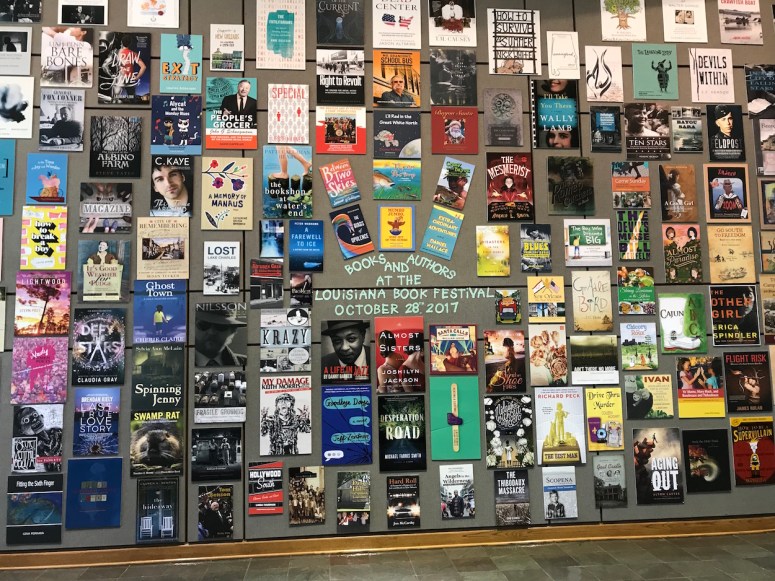
Each autumn, the State Library of Louisiana puts on the Louisiana Book Festival at the State Capitol grounds in Baton Rouge. Weather in Southern Louisiana can go one of two ways in October—unseasonably warm and muggy; or, what most people down here look forward to each fall—seasonably cool, moderate temperatures. We were fortunate to have the latter this past Saturday. It was a blustery day and I don’t think it got above 60 degrees, one of the first really cool days of this 2017 fall season.

I made the seventy-six mile trek up to Baton Rouge with my writing friend Samantha (she drove). For me, some highlights of the day were:

  • William Joyce: He’s primarily a children’s book writer, but I know him as the artist behind The Fantastic Flying Books of Mr. Morris Lessmore. This incredibly moving short film won an Academy Award in 2011.  We heard him speak in the House Chamber of the State Capitol building, which is a really cool thing about this book festival—the venue.
  • Michael Farris Smith: He spoke in the Senate Chamber, and I bought his book Rivers. It’s a dystopian story I’ve heard a lot about. From the back jacket copy: “Due to years of catastrophic hurricanes, the Gulf Coast has been sealed off by a government-drawn boundary called the Line. Those who remain below the Line live hand-to-mouth in this lawless, unforgiving land.”
  • Karen L. Cox: A professor of history at UNC Charlotte, she just released a book entitled Goat Castle: A True Story of Murder, Race, and the Gothic South. It’s about a notorious murder that took place in Natchez, Mississippi in 1932. The only person to go to prison for this murder has been largely forgotten by history. She was overshadowed by some whacked-out characters (who didn’t go to prison, despite their guilt), who captured the nation’s attention at the time and capitalized on their notoriety. Karen Cox gives some dimension to poor Emily Burns, the woman who was convicted as an accomplice and who did go to prison. The context is that this woman was hanging out with the wrong person, at definitely the wrong place, at the wrong time.
  • Hidden Figures: speaking of speaking up about the things history forgets…I received a free copy of Hidden Figures: The American Dream and the Untold Story of the Black Women Mathematicians Who Helped Win the Space Race. The book by Margot Lee Shetterly (that inspired the movie of the same name) is the 2018 “One Book, One Community” selection for Baton Rouge. The East Baton Rouge Parish Library was giving away copies!
  • The pecan pie cupcake I got from a food truck. I think the purveyor was Cupcake Allie out of Baton Rouge. Delicious.

The Louisiana Book Festival’s website says this was their 14th edition. I first found out about the festival just five years ago, in 2012. It was the early days of my writing journey, and I made the trek up to Baton Rouge alone to attend one of the “Word Shops” held in conjunction with the festival. Those four hours spent listening to the Pulitzer Prize-winning author Robert Olen Butler turned out to be a seminal moment in my writing career. Because it was then that I discovered what my writing lacked.

It was commitment.

If I truly wanted to put my work out in the world, and “go public” as a writer, I would need to find a way to put in the necessary hours. To negotiate the demands of job, family, life on Earth—and find a way, carve out the time needed to answer the call. The call to write had been a whisper for most of my life, but it began to shout insistently, smack-dab in mid-life.

While I’d love to say it’s been five years of consistent, steady effort ever since—I can’t. I still get derailed, it’s still a daily negotiation between the demands of job, family, life on Earth. But I’m not forgetting how far I’ve come in those five years: I’ve been published. I have writing friends. I have this blog. I even have an Amazon Author Page.

All these treasures felt like pipe dreams five years ago. I am exceedingly grateful to count them as part of my reality now.

Greece, Part 1

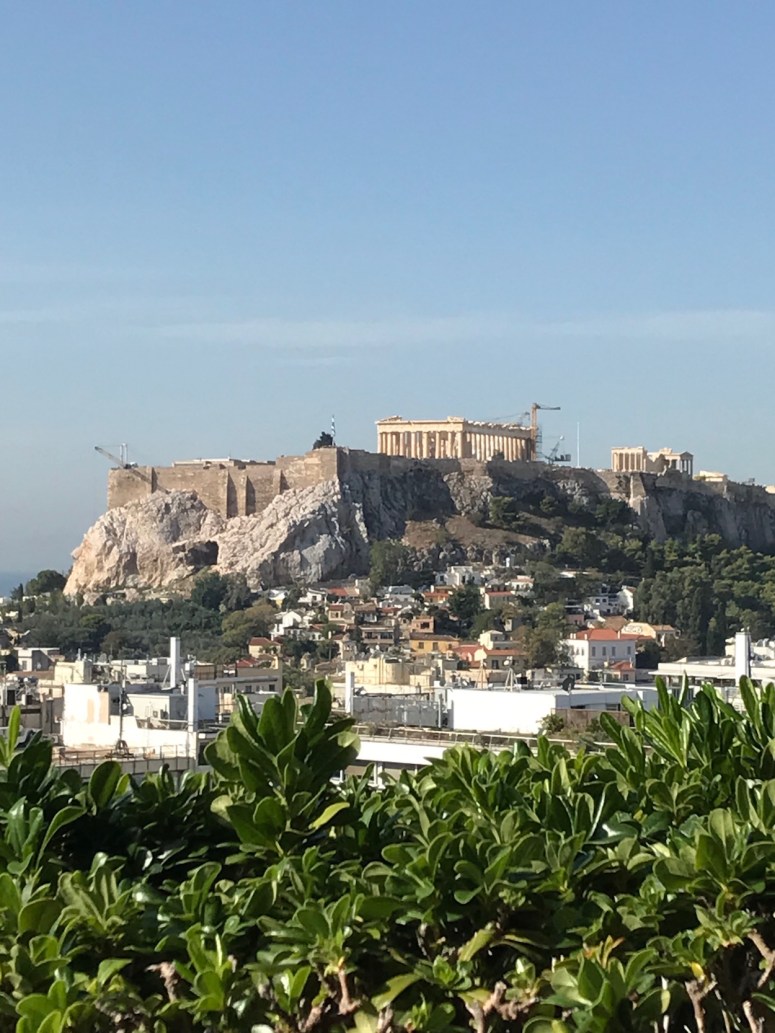
Ancient things. That’s what I’ve been thinking about, these past five days spent in Greece. So many ancient things.

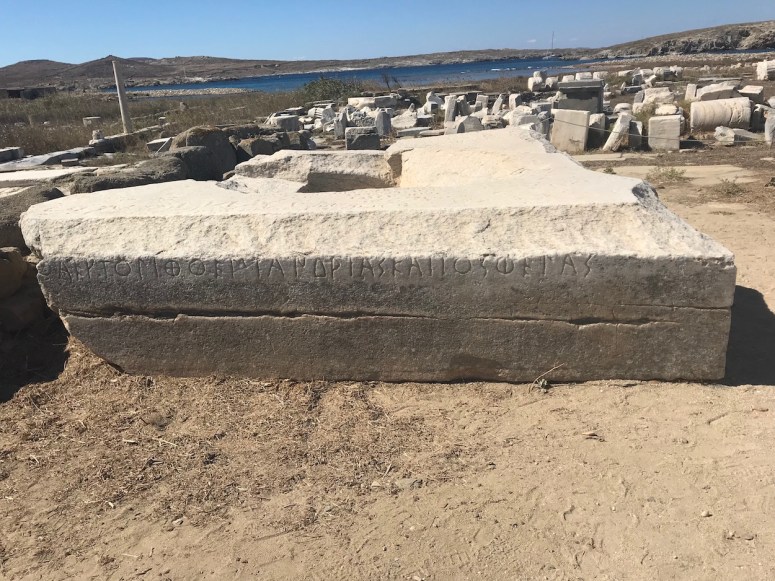
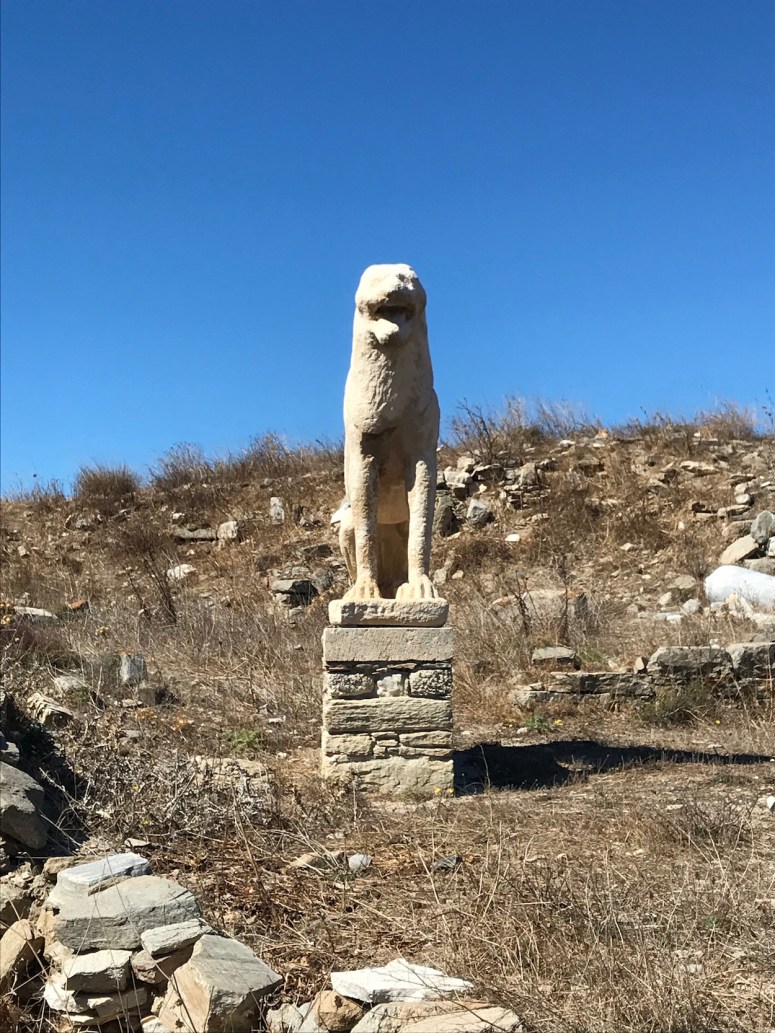
New Orleans will celebrate its Tricentennial in 2018. Three hundred years seems pretty minor, compared to the 3,400 of recorded history within Athens (according to Wikipedia). Mykonos had inhabitants before the 11th century BC. Delos, a now-uninhabited island a short boat ride from Mykonos, was inhabited from the 3rd millennium BC.

It was fascinating to tour the ruins on Delos. For roughly 1,000 years before the Greeks deemed it the birthplace of Apollo and Artemis, it was a holy sanctuary to the goddess of the earth (according to Maria, our tour guide on Delos).

Certainly, much has changed in the intervening millennia. And much of it in just the past 100 years or so. But I’ve been thinking of all the things about human life that haven’t changed. Our needs, especially. Eating. Drinking, both wine and water. Shelter. Employment, to occupy our days and provide means to the eating and drinking and shelter. Entertainment. Companionship. Worship.

The details have changed, and access to all these things has become much easier for a great many of earth’s inhabitants. But really, it seems not much has changed about the needs themselves. Being a human in the 21st century, who would like to make entertainment her employment, I’ve been intrigued by the story possibilities of all these ancient things.

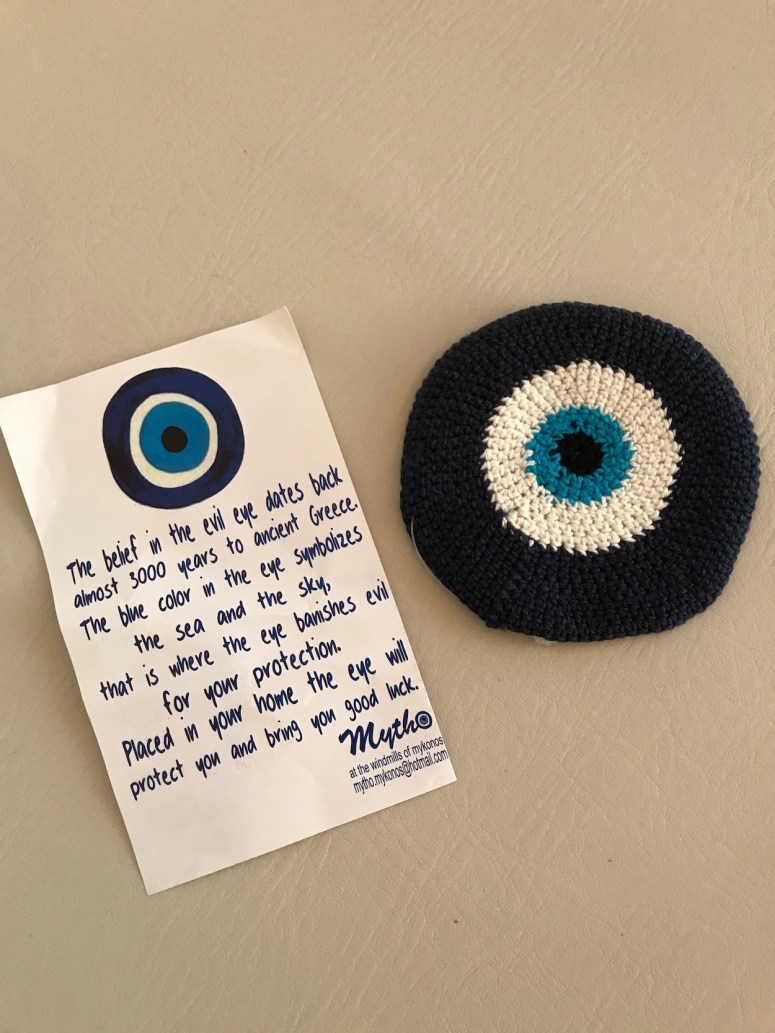
Like, why does “an ancient evil” sound so much more menacing than just plain old “evil?” I’ve been drawn to all the manifestations of the eye symbol I’ve seen while in Greece. On doorways, gates, on fighter planes I saw on the way to our hotel in Mykonos from the airport. A card I picked up from a gift shop tells me this: that use of the symbol dates back almost 3,000 years, and is supposed to ward off evil and bring the bearer good luck. So, apparently, it’s not just me—people have been worried about the bad gris-gris for a really long time.

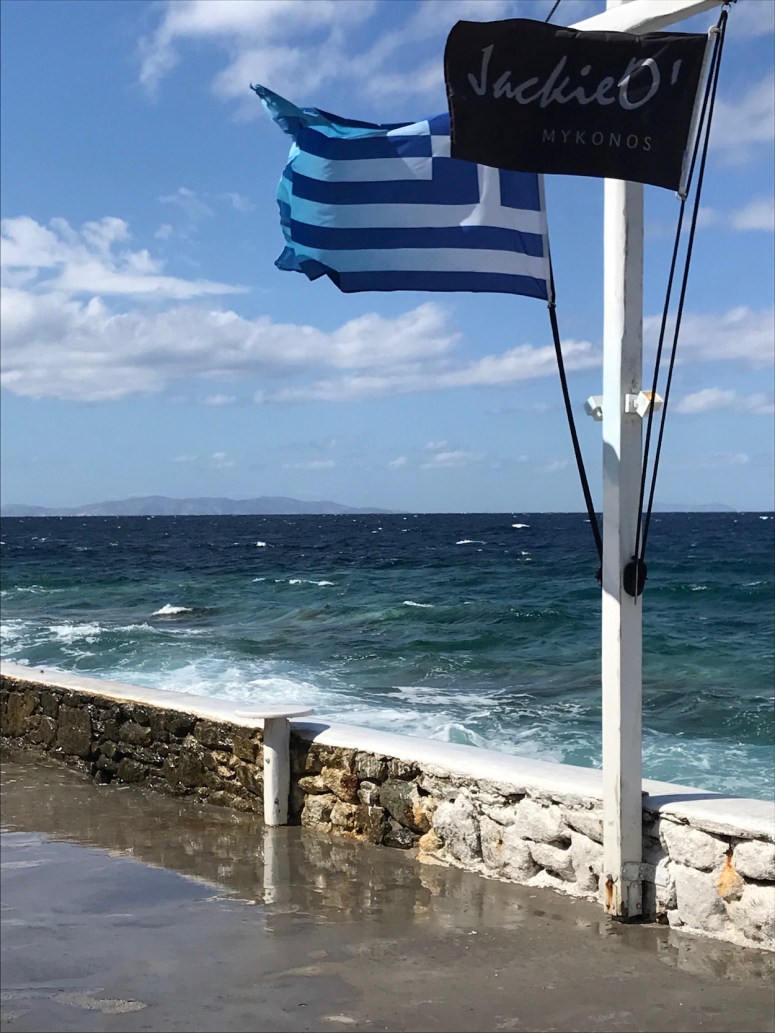
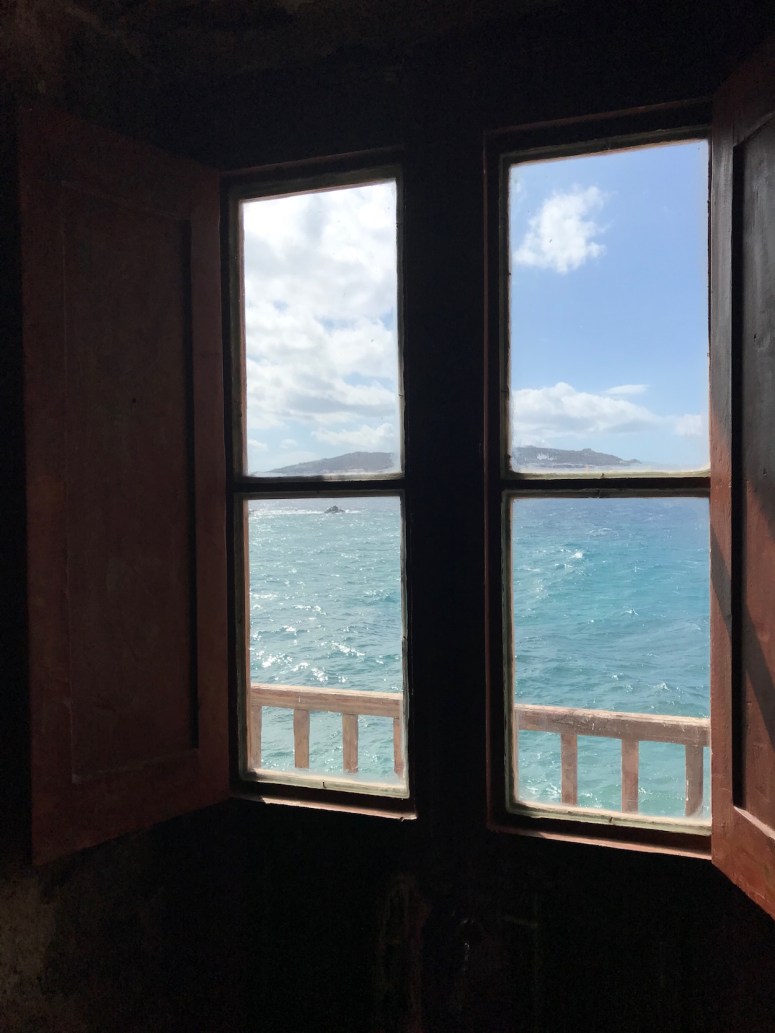
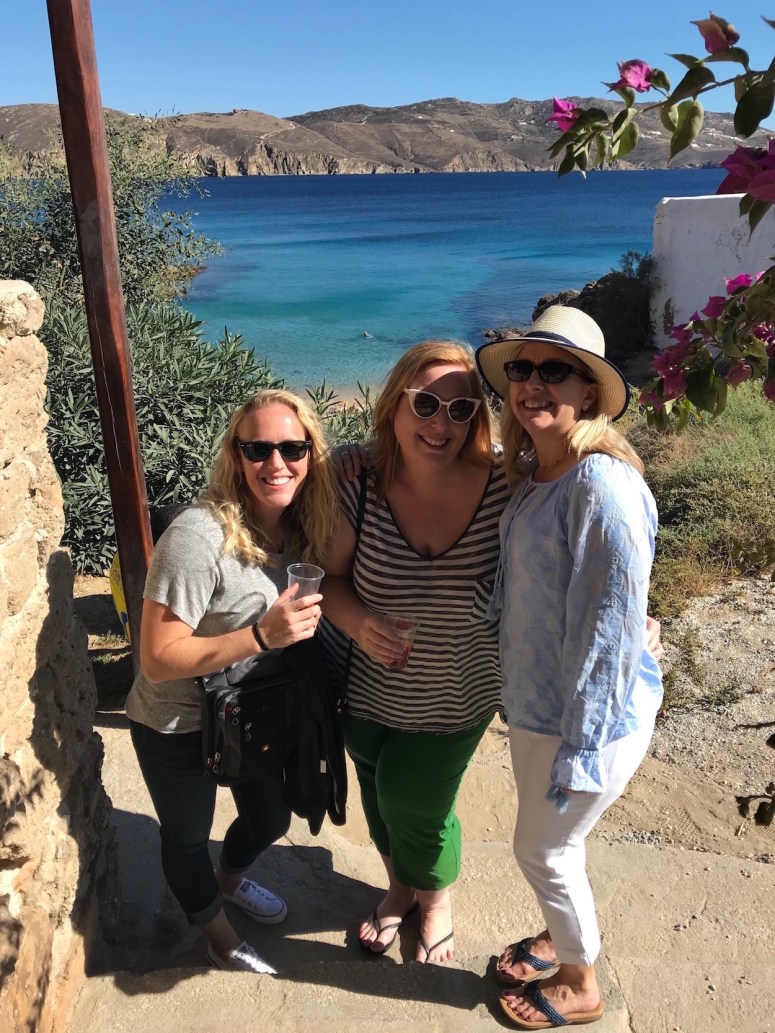
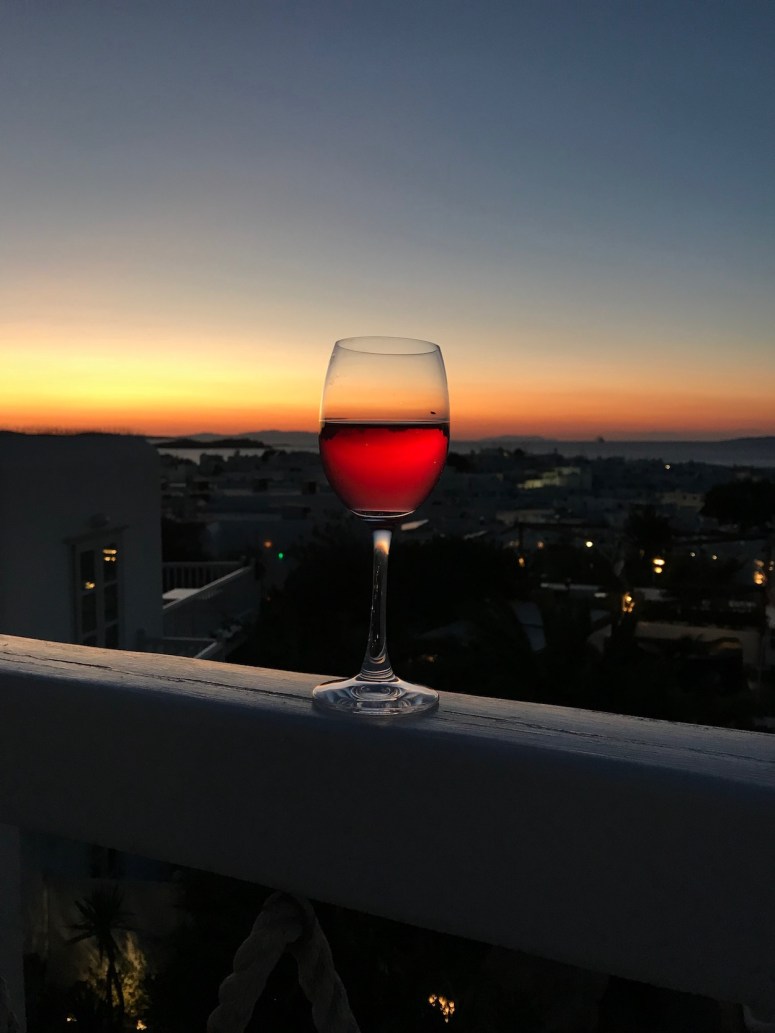
Since pictures are worth (at least) 1,000 words, I never intended to get too long-winded with this post. So here are some photos from my time in Greece thus far:

Athens
Mykonos Harbor
Shop window in Mykonos


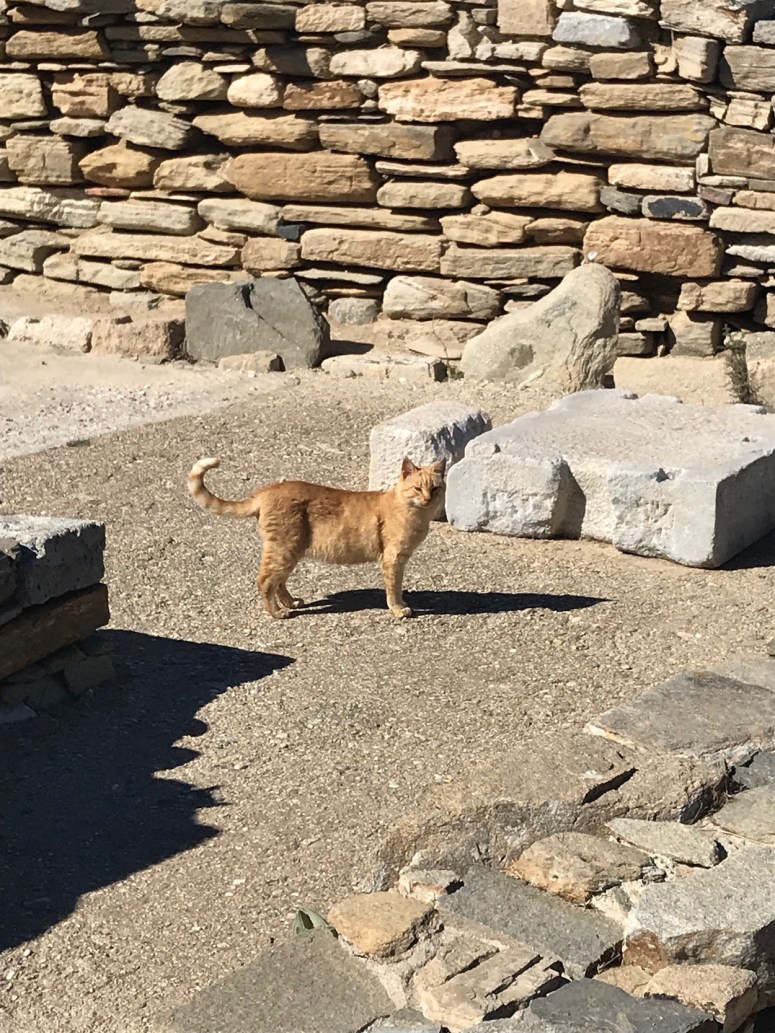
These four pictures are all from Delos
At Kiki’s Tavern on Mykonos
Last sunset in Mykonos