Ralph Waldo Emerson and ELO

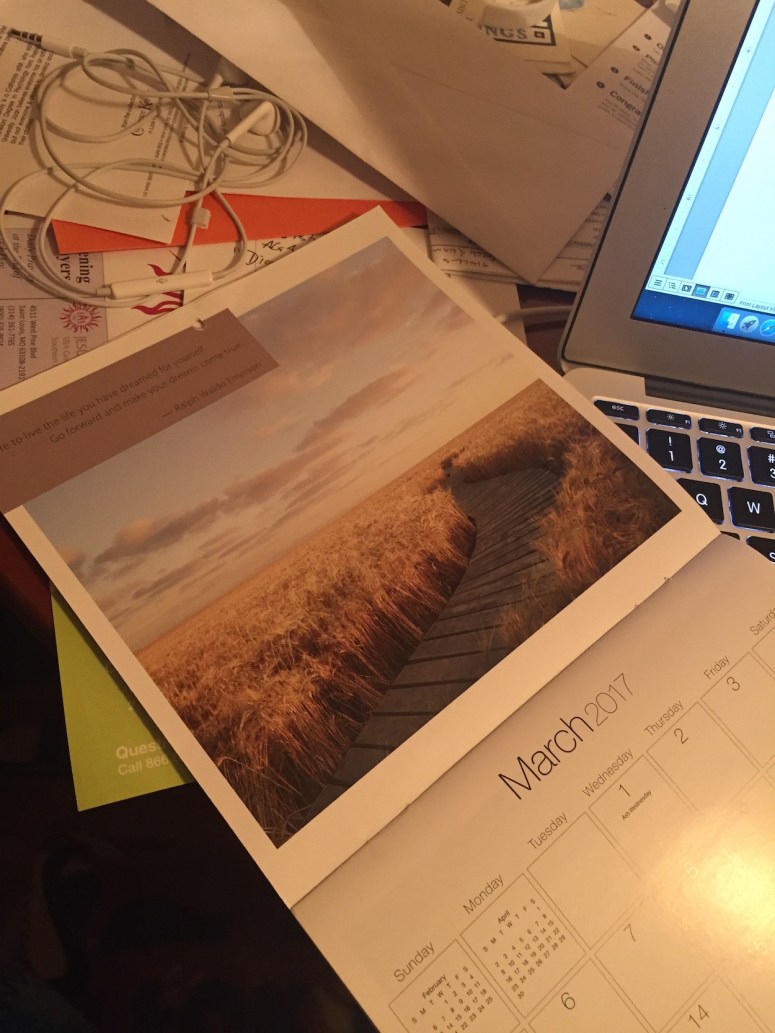
Dare to live the life you have dreamed for yourself. Go forward and make your dreams come true.

My calendar is one of the talismans of my writing life. I think it began in 2012—on a weekend away in late 2011, perusing a bookstore on Florida’s Gulf Coast, I found a mini-monthly calendar with some cool inspirational quotes. This is just what I need! I thought. I hung it up on the wardrobe that sits to the left of my desk, and have spent much time (perhaps too much time) pondering the quote that hangs there, anytime I turn my attention from my screen. Little did I know that purchase would beget an annual mini-panic that strikes about mid-December. I need a new calendar!

Up to now, bookstores have been my saving grace. It’s there that I can usually find something that strikes the right note for the year ahead. But alas, bookstores came up short this year. So I dared to turn to the bookstore’s enemy, the bane of traditional publishers, Amazon. Could it provide what I sought? Indeed, an Amazon search kicked me out to Calendars.com, a vast repository of printed calendars of all shapes and sizes and inspirational intents.

I’ve been pleased with my Calendars.com purchase for 2017. It’s called “First We Dream.” January was some pink and blue clouds, a wheat field, and a quote from William Blake: “No bird soars too high if he soars with his own wings.” February was rocks on a seashore and Goethe: “Dream no small dreams, for they have no power to move the hearts of men.”

And March brought me Ralph Waldo Emerson and the quote that opened this post. And that got me thinking. About transcendentalism and ELO. Yes, ELO, the Electric Light Orchestra. The English rock band most closely affiliated with Jeff Lynne, that hit its heyday in the ‘70s.

But first, transcendentalism. I was first introduced to the philosophy my junior year in high school, in my American Literature class. I was immediately drawn to it—the whole idea that an innate divinity unifies all creation totally jived with how I’d been raised, and on a deeper level, it resonated with some kind of intuitive sense in my gut.

It spurred a deeper dive into Emerson’s writings, but I remember getting bogged down pretty quickly. I recall dense prose. Perhaps it’s worth taking a look with more aged eyes, but being perennially short on time, I’ll settle for the quote that headlines March 2017.

The timing is particularly apropos. I’m in the trenches of trying to make the life I’ve always dreamed for myself: being a writer who can make a living off writing. Finishing my second novel is my current highest priority in that quest. And it all feels like a pretty big dare.

So it’s nice to have Ralph Waldo Emerson up there, urging me on. It’s kind of like having an old friend show up at mile 20 of a marathon, shouting out my name and general encouragement.

And where does ELO fit into all of this? It’s pretty simple. I’ve been an ELO fan longer than I’ve been a fan of transcendentalism. All this talk about dreams—from Emerson, and the 2017 calendar writ large—has planted ELO’s “Hold On Tight” firmly in my head. The song was released in 1981, and the opening lyrics might jog the memories of those of you who remember 1981:

Hold on tight to your dream
When you see your ship go sailing
When you feel your heart is breaking
Hold on tight to your dream

More inspiration to keep me going in these last few miles.

Ash Wednesday

The unexamined life is not worth living

Socrates is credited with that saying, and the circumstances under which they were uttered are as worthy of consideration as the saying itself. According to Plato’s Apology, Socrates said these words during his trial for impiety and corrupting youth.

So, here we have Socrates, bucking up against the government in power, having to defend himself, his actions, and his philosophy. Roughly 400 years later, Jesus Christ would come around.

Before Jesus underwent his own trial, he went on a legendary “life examination” in the desert, fasting for forty days and forty nights, and facing down the devil and his temptations. And initiated the very first Lenten observance.

Being an introspective sort, Lent is never a hard sell for me. Truthfully, a big part of me kinda looks forward to it every year. Life is a cumulative thing, and it’s not like the bad habits, thoughts, or attitudes I may have focused on in prior Lenten seasons have miraculously disappeared. Or cured themselves.

No, more often than not, they reassert themselves when I’m not paying attention.

I hate that.

Using Lent as a means to examine my life seems to have taken on greater importance, especially these last seven years or so. It’s in these last few years that I’ve “found” my vocation as a writer, thus I’ve been writing more than I ever have at any other time in my life. I could go so far as to say that “the unexamined word isn’t worth reading,” but I would only be speaking for myself. I wouldn’t want anyone reading something that I haven’t thought through.

(Believe it or not, I do think through these blog posts.)

So, here I find myself at the dawn of another Lenten season. Resolving to: limit my sugar intake, seek balance with family/work/home, and carve out the time to finish The Tremors on the PCH. Because very recently, I was reminded of what it would take to accomplish this. I have to work on it every day. It’s something I know works, because I’ve put it into practice before. But certain bad habits reasserted themselves when I wasn’t paying attention.

Or rather, when I was paying attention to the publishing and promotion of my first novel. I convinced myself that those tasks “count” as writing. But they definitely don’t. What counts is when I’m immersed in the story, and I can see things start to take shape, things that I only had an intuitive feeling about at the start of the process. And some things that come up out of the blue, but make so much sense for the story that I can’t believe I didn’t think of them in the first place.

No—that kind of stuff counts as writing. Because the only thing that produces a first draft, and all the subsequent drafts, and eventually a final, is immersing yourself into the thing and just writing it.

I lived in this desert (well, in an apartment in that desert, mostly) for nine years

Year of the Rooster

Photo from Harbin, China, courtesy of niece Nicole. She's a Water Monkey.
Photo from Harbin, China, courtesy of niece Nicole. She’s a Water Monkey.

I was born in the year of the rooster. It feels presumptuous to claim “this is my year,” when, by a rough calculation, I likely share this designation with 1/12th of the population of earth. Give or take a few one-thousandths. But it at least feels noteworthy, and worth a blog post, since a rooster year only rolls around every 1.2 decades.

My mother was also born in the year of the rooster. She died during a year of the horse, but I’m not sure if there’s meaning there. There is supposed to be significance to the “type” of sign you were born under, aligning with the five elements of wood, fire, earth, metal, and water.

Mom was a “Water Rooster.” According to TravelChinaGuide.com, that means she was “smart and agile, sensitive, keen on art and niceness.” That feels pretty accurate.

I am an “Earth Rooster,” so, supposedly, I’m “active, perceptive, like traveling and making friends.” I’d like to think that’s accurate. I’m also a Virgo, which is an Earth sign, so I guess I have a lot of earthiness going on. I do have a fondness for geology.

Many years ago, I frequented a restaurant in Tucson, Arizona. (I was living there at the time, so it wasn’t like I was commuting thousands of miles to go to this restaurant. The sesame chicken was good, but not that good.) It used paper placemats with the signs of the Chinese zodiac on it. If you’ve been to a Chinese restaurant in the U.S. in the past twenty years, you’ve likely seen similar.

I would bristle every time I read my sign. It called roosters, or cocks, “selfish and eccentric.” I was okay with the eccentric part. But, selfish? Heavens, no! And certainly not my mother. How could a woman who always put her seven children ahead of her own interests be considered selfish?

chinese-zodiac-placemat-chinese-new-year-animals

In the intervening years, I’ve learned to take my placemat horoscopes with a grain of salt. Truth be told, I certainly have a greater degree of self-interest than my mother possessed, but I still don’t consider myself selfish.

And there are many positive traits of the rooster that I either hold, or aspire to. This, according to (again) TravelChinaGuide.com: “Rooster is almost the epitome of fidelity and punctuality. For ancestors who had no alarm clocks, the crowing was significant, as it could awaken people to get up and start to work. In Chinese culture, another symbolic meaning chicken carries is exorcising evil spirits.”

Fidelity, yes; punctuality, I aspire to; and if waking up early to write can be considered a form of crowing, then that applies, too. And if my writing can do anything to exorcise evil spirits, I’ll be pretty happy with that.

2017 is the Year of the Fire Rooster. According to MindBodyGreen.com, it means we’re moving past the tempestuous Year of the Fire Monkey, and “we’ll start to play fair again, realizing that ‘winning’ (and slinging mud) isn’t worth much if it comes at the price of our pride and personal relationships.”

That would be something to crow about.

My First Reader Con

anne_mcclane_arc2

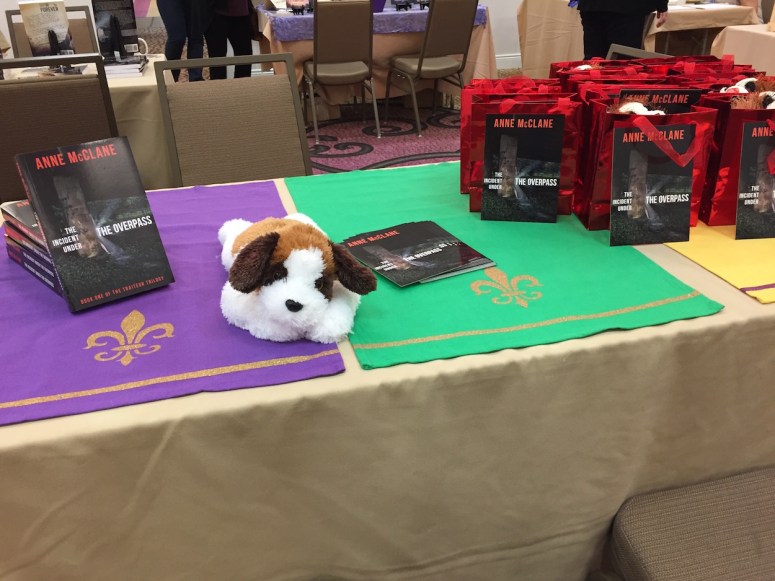
So, I participated in ARC NOLA 2017 this past weekend. ARC NOLA was an Author & Reader Convention held at the Holiday Inn New Orleans–Downtown Superdome. It was kind of surreal for me, talking to readers about The Incident Under the Overpass, sitting at a table behind a stack of books (that I wrote!)

The organizer is V.A. Dold, best-selling author of the award-winning Le Beau series. She does a great job of pulling both the event, and a great group of authors, together. As I followed the preparation for ARC NOLA on Facebook, I noticed some of the participating authors showcasing their swag. Swag?!? What kind of giveaways could I throw together—quickly—to promote the book?

I make a living preparing for trade shows, mostly business-to-business affairs, so I’m no stranger to swag. As a matter of fact, I’ve just returned from a few days in Atlanta (I left the day after ARC NOLA), where I helped to set up my company’s booth at a trade show. Highly sought after swag in years past at this show (it targets meat and poultry processors) have included a purse in the shape of a chicken, and something that is really called Chicken Poop™ Lip Junk.

Again, it was kinda heady, to be in a position to come up with swag for my very own product. But I was pretty late to the game, since I decided I needed to have swag at my ARC NOLA table about three weeks prior to the event. It was Ambrose to the rescue! I figure, he’s such a steady presence in Lacey’s life, (Lacey is the heroine of The Incident Under the Overpass), why not craft a little giveaway to celebrate him?

anne_mcclane_arc1

After all, if people will clamor for a lip balm called “Chicken Poop,” I figure a cute little plush St. Bernard should draw some attention.

chickenpoop

I crafted some nametags for the small assortment of Ambroses, and put my website address on the back. It’s a start, and I’ve learned some tricks and thought up some improvements for the next batch. I don’t know when my next Reader Con will be, but hopefully I’ll have more than three weeks to implement.

Because I’d certainly do another Reader Con again. V.A. Dold was a pleasure to work with. I also met several authors who provided much inspiration. I have to thank Tamara McHatton for her guidance and for being such a kind and helpful table neighbor. And I also have to thank Dionne Charlet, who first told me about ARC NOLA. And who continues to be so gracious in connecting me with other New Orleans writers. And, ultimately, it was great to meet and chat with readers in that environment—readers I might never have encountered otherwise. To those of you who picked up The Incident Under the Overpass, I hope you enjoy!

Children of the Bandit

children_of_bandit_mcclane

We’re gonna do what they say can’t be done.
We’ve got a long way to go and a short time to get there.

                                                Jerry Reed, “East Bound and Down”

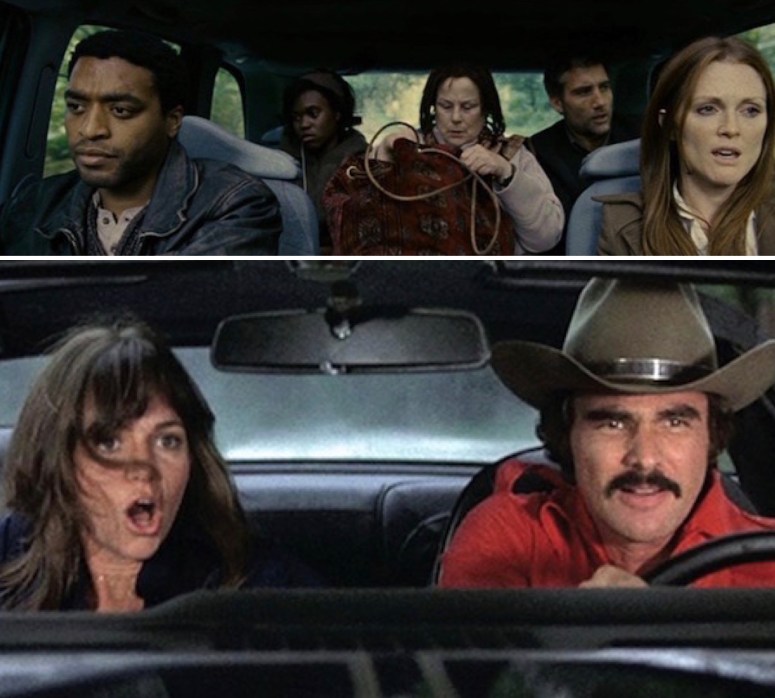
The title of this post could be “Procrastination.” True to the theme, I started writing this about a month ago, after Tim and I watched Smokey and the Bandit. But the holidays and other topics intervened.

I could use the same excuses for The Tremors on the PCH, the working title of the second book in the Lacey Becnel series. It’s the follow-up to The Incident Under the Overpass. In truth, I am not as far along as I hoped to be by this point. I’ve got an incomplete first draft, where I hoped to have at least a complete first draft by the time 2016 ended. While I’m not in full-on-panic-mode yet, I’m not ruling out the possibility of it striking. Soon.

Call it confirmation bias, but there are two things I read recently that made me feel a little better about my current state of incompletion.

First, Smokey and the Bandit. This is a movie I’ve only come to appreciate in recent years. Even though it is chock full of stuff I’ve long had an affinity for: big rigs, convoys, CB radios, car chases, romance, and alcohol. But it’s the song—“East Bound and Down,” by Jerry Reed—that’s pertinent to the point I’m trying to make. The lyrics at the top of this post have been in my head for the past month. (Because I have a long way to go. And a short time to get there.)

So here’s the first thing that assuaged my procrastination guilt: “East Bound and Down” was written overnight. Thank you, Mental Floss (13 Fast Facts about Smokey and the Bandit)

After promising he would come up with a song, he (Reed) didn’t have one at the end of filming. After (director Hal Needham) asked him about it, Reed promised he would have something for him the following morning. Despite being out all night, Reed managed to sing his new song “East Bound and Down” for Needham the next day. When Needham didn’t react right away, Reed said, “If you don’t like it I can change it. “If you change one damn note, I’ll f*ckin’ kill you!” the director replied.

I’m going to assume Jerry Reed didn’t compose it out of thin air—that he had been playing around with elements of the song, but just hadn’t gotten around to the actual composition. It’s probably more confirmation bias, but I could say I’ve been doing the same with Tremors on the PCH.

The second thing was a cover story on Vulture.com about Alfonso Cuarón’s 2006 film Children of Men. (Thanks for posting that, Hosky).

This is a film I’ve only seen once, ten years ago, at the movie theater. It’s one of those films that made a big impression, and was disturbing enough, that I didn’t feel the need to own, or re-watch multiple times.

The article, by Abraham Riesman, is interesting. It draws comparisons to our current state of the world and the dystopian future (the year 2027) depicted in the film. But what really interested me was a behind-the-lens story Cuarón tells of a scene near the end of the film. It’s one long take where the main protagonist, Theo (played by Clive Owen) is racing through a refugee camp, dodging gunfire and explosions.

“I think we had 14 days to shoot the whole set piece, except by day 12, we hadn’t rolled cameras yet,” Cuarón recalls. On the afternoon of the 13th day, they were finally ready to film. But around the 90-second mark, Cuarón yelled “Cut” because, as he puts it, the take “was just wrong.” . . . The morning of the final day dawned, and they gave it another stab. The cameras rolled, the scene commenced — then camera operator George Richmond tripped and the camera fell. Five hours of reset later, Cuarón had only one chance left.

To sum up, they shoot the scene, and it seems to be going well, but Cuarón freaks out because some fake blood accidentally squirts on the camera lens. He yells “Cut,” but no one hears him because of all the explosions. He’s thinking all is lost, but his cinematographer assures him that the accident was nothing short of miraculous. In the end, it only added to the hyper-real feel of the film.

So, yes, I just wrote about Smokey and the Bandit and Children of Men in the same post. But, I guess, I find it pretty fascinating that both an enduring song, and an enduring scene, were born in the last possible moments under a looming deadline.

Dearly Departed: Carrie Fisher, 1956-2016

leia-hoth

“There is no point at which you can say, ‘Well, I’m successful now. I might as well take a nap.’”

-Carrie Fisher, Wishful Drinking

Of all the great talents we have lost this year, this loss hits especially hard. I shudder to think of what more might be in store in these last four days of this watershed year.

Why this hits hard: when you’re an adult, yet you still dress up as Princess Leia once a year, that means the roles played by Carrie Fisher have transcended run-of-the-mill stardom in your life.

But it’s not just her integral part in the whole Star Wars galaxy. I’ve admired Carrie Fisher the writer for decades now. I remember reading all the promotional material around Postcards from the Edge when I was in college. She published the book during my first year, and the movie came out toward the end of my time in school. I took note of both her honesty and fearlessness.

It was also around that time that I discovered Carrie Fisher was a much-sought-after script doctor. Back then, I’m not sure I knew that such a vocation even existed. I wish I could say I have since become a script doctor or ghostwriter of some renown, but I would not be emulating Carrie Fisher’s honesty if I did. But the point is that I still have that aspiration, due, in large part, to her.

And of all the work she’s done in movies, either on the screen or as a writer, there is one tiny cameo role that stands out in my memory. It’s in Jay and Silent Bob Strike Back. I think Carrie Fisher has less than two minutes of screen time. But the context, the comedic timing, the dialogue is all so pitch perfect; it’s hard to forget.

I’ll leave you with one last quote attributed to Carrie Fisher. I don’t know where it’s from:

I don’t want my life to imitate art, I want my life to be art.

I hope she realized before the end that she managed to accomplish this—in funny, fiery, and downright heroic fashion.

Eggcorns and Engrams

eggcorn

I spent a recent down day watching TV and looking stuff up on the Internet. The television viewing consisted of three hours of classic Star Trek, amongst other things. (William Shatner, Leonard Nimoy, 1966-1969—that Star Trek, aka Star Trek: The Original Series.) I’ll get back to Star Trek in a bit; but first, the Internet.

My web searches revolved around the premise of cognitive dissonance. That thing Google defines as “the state of having inconsistent thoughts, beliefs, or attitudes, especially as relating to behavioral decisions and attitude change.”

Speaking for myself, when faced with challenges to my view of things, my first instinct is to retreat. And use that space to gather facts, examine stuff, get to a better understanding of what formed my worldview in the first place. I’m definitely a “Shoot later, ask questions first” kind of person. Resistance? I’ll see that obstacle and raise it with my own powerful brand of diffidence.

Thus, the term “cognitive diffidence” popped up in my head. I thought it was quite clever, and thought it might make a good topic for a post; right here, as a matter of fact. Yet, I quickly discovered I was not the first person to come up with it. The top search result was a post from another WordPresser, put up five years ago. And not too much further down, a post to the “Eggcorn Forum” another four years prior to that.

What, pray tell, is an eggcorn? I had found my rabbit hole.

So, an eggcorn “is an idiosyncratic substitution of a word or phrase for a word or words that sound similar or identical in the speaker’s dialect.” It originated with a linguistics professor back in 2003. And “cognitive diffidence” is considered an eggcorn.

While I’m no linguistics expert, I’m definitely interested in words. And coming from the South, I’m certainly aware of dialects (and how my own can be perceived). I’m facing a brand new bout of cognitive dissonance over the fact that I’ve never heard of eggcorns before now.

NPR even posted a list of top 100 eggcorns last year. Here are a few I hear fairly often:

  • Agreeance
  • Biting my time
  • Buck naked (apparently, it’s supposed to be butt naked. I never knew that.)
  • Expresso
  • Ice tea

I could go on about eggcorns, but I won’t. Now onto a word I heard as I caught the tail end (tale end?) of Star Trek episode “The Ultimate Computer.” That’s the one with the brilliant Dr. Richard Daystrom (played by William Marshall) and his M-5 computer. The M-5 goes all Skynet on some Federation ships, and Captain Kirk has to convince the M-5 that it should face the penalty for taking human lives. The M-5 shuts itself down, effectively committing suicide.

That’s the episode. But the word was “engram.” Dr. Daystrom programmed human engrams—his own—into the M-5 computer. Daystrom was on the verge of a breakdown, thus the M-5 picked up Daystrom’s instability.

Here’s the thing about engrams: while I don’t know much about Scientology, I know that engrams seem to come up a lot in that practice. Enough so that I thought the concept might have originated with L. Ron Hubbard. But the Internet tells me that is not so.

The term engram was coined in 1904 by a German biologist, Richard Semon, who did a bunch of research into the neurological origins of memory. He posited that engrams were a type of “memory trace” imprinted onto the nervous system.

On a sad side note, Richard Semon committed suicide, wrapped in a German flag, shortly after the end of World War I. He was depressed by the death of his wife; and it was also alleged that he was depressed by Germany’s role and defeat in the war.

Before I engender reader ennui over eggcorns and engrams, I’ll come to a conclusion. While I wish I could come up with some brilliant theme to tie them together, I cannot. So I’ll conclude with cognitive dissonance. Because it seems like it might have contributed to the ultimate demise of both the M-5 computer, and Richard Semon. In the latter case, we’re led to believe he couldn’t reconcile his nation’s part in such a horrific global conflict. He couldn’t erase his engrams.

My diffidence might save me, yet.

Courageous Self Promotion

jamm2

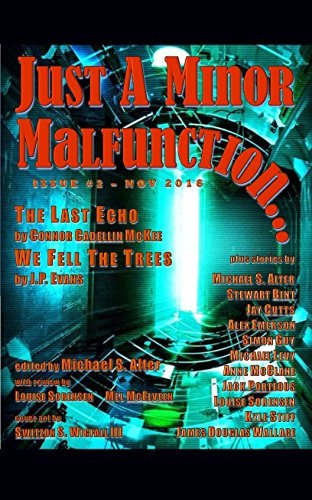
I’ll get straight to it: The second issue of science fiction anthology Just a Minor Malfunction released just before Thanksgiving. It’s available on Amazon: https://www.amazon.com/dp/B01NA9QRAY

If you don’t do Kindle, you could get an alternative digital file by sending $1 via PayPal to michael.s.alter.author@gmail.com

My short story “Lucky Eight” is in this collection. I am honored that my work has been included in both issues of Just a Minor Malfunction.

Thinking about where I was, writing-wise, just one year ago, this feels pretty significant. This blog was just a few months old, and I tried publishing a serialized version of a short story here. I was still months and months away from publishing The Incident Under the Overpass. I had NO IDEA how my fiction would be received.

Twelve months later, I have some idea. Amongst other lessons, I’ve learned that short fiction goes over better when it’s included in a collection of similarly themed stories. (It’s a revised version of that first-published-on-the-blog story—“Holiday Bob”—that appears in Just a Minor Malfunction #1.) I’m very grateful to Michael Alter (Twitter: @Michael_S_Alter ), the editor and creative force behind this anthology, for recognizing something in my work and including me alongside such accomplished writers.

It’s those other writers that make it easier to do this post. Because my aversion to self-promotion hasn’t waned at all. But in this instance, I’m not only promoting my own endeavor, I’m promoting these great collaborative efforts.

More on that aversion: my first inclination was to title this post Shameless Self Promotion. But that didn’t feel right, because I’m not coming to this exercise devoid of shame. And “shameful” isn’t quite right either. Unconfident, or hesitant, is more apt.

Yet, just a few days ago, I read this quote from the novelist Dani Shapiro:

Courage is more important than confidence.

It’s a paraphrasing of some of her reflections on writing and creative work in general (I think). She also has some great things to say about how writers should “embrace uncertainty, to be sharpened and honed by it.”

I can honestly say this—there was very little confidence (about .001), and great gobs of uncertainty (let’s say 510), when I first published “Holiday Bob” on this blog. Multiply those levels about four times, and there’s some idea of what I was feeling publishing The Incident Under the Overpass. So I have to believe there was a modicum of courage underlying those initial efforts. Otherwise, this post would have an entirely different tone to it (a more pessimistic one, most likely). Or maybe, I might have quit posting altogether.

I think there’s something there, about courage, confidence and self-promotion. Promotion is vital to any work that wants an audience. (Twenty years in marketing have taught me that, at least). Promotion is especially vital for independent authors and publishers. And confidence is hard to come by when you haven’t yet found that audience. So take courage. If you believe in the worth of what you’re doing, it’ll get you over the threshold.