Photo by American Public Power Association on Unsplash
As I write this, a tropical storm in the Gulf of Mexico is headed this way. The current forecast has it coming ashore east of New Orleans, sometime in the wee hours of Wednesday morning, September 5. Being on the west side of the storm center usually means we’ll see high winds, but not as much rain.
Having been through this rodeo a few times, I’m prepared to be without power on Wednesday morning. I plan to type in a quick update and post this using my cell phone, if necessary.
It’s a pity, because I attended a great writer’s conference this past weekend, and scheduled a post that would cover all the high points. There’s nothing stopping me from featuring it next week, of course. So that’s what I’ll plan to do.
Adaptability is a virtue any time of year, but especially during the height of hurricane season.
Stay safe, everyone!
Update as of 5:30 am CDT: The center of the storm came ashore last night around Pascagoula, near the Mississippi-Alabama border. It’s due to bring rain and winds to the midwest, through this weekend. New Orleans remained outside the path of the storm’s effects. I’m currently in my house, with power. It’s 75 degrees outside, the wind is at 3 MPH.
The hawks were yelling at me. I don’t think I stumbled upon a quarrelsome moment amongst the raptors; I’m fairly certain they were aiming their shouts my way. And I’m pretty sure they were telling me to “Go away.”
It all began when I went out early one morning, just after sunrise. Just a jaunt around the neighborhood, to get a bit of exercise.
Headed north on Marconi Drive, I strayed to see if I could get a better look at Popp Fountain and the Arbor Room. I’ve seen Popp Fountain before, it’s one of those City Park staples that’s been around since 1937. But I’ve yet to see the Arbor Room from the inside, it’s one of the newest event venues in City Park.
As I approached an oak tree near the fence line, I heard a very distinctive cry coming from its branches. Not a chirping, not a raven’s “caw,” but similar in cadence. Higher-pitched and not as caustic as a raven, and it finished with a bit of a whistle.
Looking for the source, I spied a large bird with a white speckled breast, maybe twenty feet dead ahead and twenty feet above. A hawk! I scrambled for my phone, but the best I was able to capture is the picture at the end of this post. The hawk took its squawking to a higher, less visible branch of the oak tree right after I took that photo.
But it got me thinking–so much of what I love about meandering through City Park are the sounds.
So in the interest of “show, don’t tell,” here’s an attempt to “show in words” some sounds I noted on that same jaunt.
The haunting notes of a train horn, miles away
The staccato beats of a woodpecker across the lagoon
The caustic caws of a pair of ravens (yes, I realize I’m re-using that description)
The subversive trill of crickets below
The “ga-dunk” of cars passing overhead, as I traversed under the I-610 overpass (yes, this is a direct reference to my novel, The Incident Under the Overpass)
As I concluded my exercise loop, I returned to the hawk’s oak tree, to see if the bird of prey was still there, hoping to get a better photo, if so. And to conclude this post’s loop, I’ll go back to the beginning. Said hawk was still there…with reinforcements. And they were yelling at me. At least two birds aimed their plaintive cries my way. And by plaintive, I mean pretty wretched. My guess is they were protecting a nest, and didn’t want curious bi-peds (or predatory quadrupeds, for that matter) lollygagging around.
The American Library Association held their annual conference and exhibition in New Orleans this past weekend. In a stroke of kismet, I was able to attend via my membership in IBPA, the Independent Book Publishers Association. In an even luckier stroke, I got to promote my book, The Incident Under the Overpass, during a Saturday afternoon time slot at the IBPA booth. (Okay, so, that last part wasn’t just luck—I paid a modest fee for the promotion).
It was great to be able to reach out to a receptive audience of librarians (readers-for-a-living!) But the highlight for me was getting to see the opening general session: former First Lady Michelle Obama sat down with the Librarian of Congress, Carla Hayden, and discussed her forthcoming memoir, Becoming. I could go on for a very long time about the fascinating stories she shared; her obvious devotion to not just family, but to a life of service; and just how impressive she is, without being intimidating. But I have a feeling all of this will come across in her book, which is scheduled for a November 2018 release.
I’m a big proponent of grace, in all its meanings. Both the descriptor implying elegance and poise, and the spiritual (Christian) meaning: God’s favor, the gift of the Holy Spirit. It was very reaffirming to see so much grace in action this past weekend: in Michelle Obama, in Carla Hayden, and in the thousands of people who traveled to New Orleans with the ultimate aim of providing access to mind-opening content.
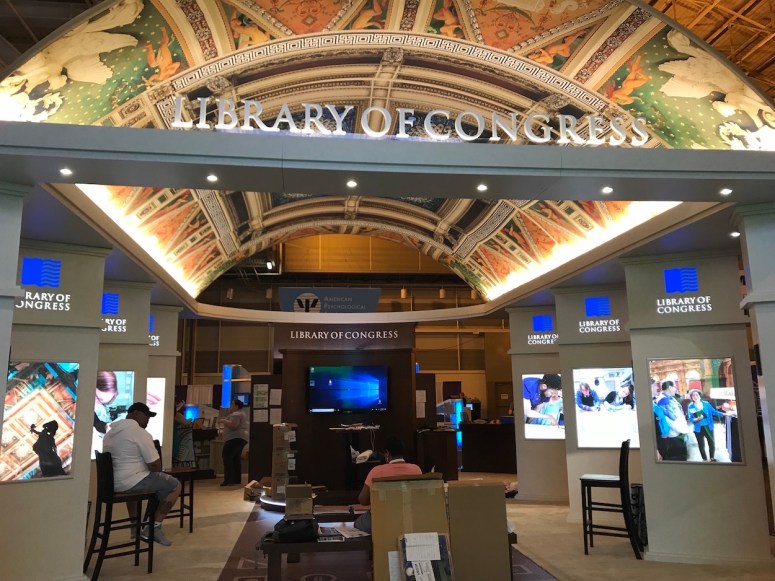
Library of Congress booth was pretty cool. This was during set-up, it was the only time I didn’t see it packed full of people.IBPA is headquartered in California
A post card with the forthcoming book cover, and this week’s inspiration (which happens to be about inspiration)
-Stopping by Woods on a Snowy Evening, by Robert Frost
There was nothing snowy nor frosty about the Couturie Forest, when I finally returned there one morning in early June. But it was so quiet and tranquil, the “lovely, dark and deep” line immediately popped into my head. I felt my mother with me—she was always one to quote poetry, or song lyrics.
I was glad the magical power I experienced there, during my trip last month, still held. To recap, the Couturie Forest is a part of New Orleans City Park, described on the City Park website as “the perfect place to escape from the city without ever leaving town.”
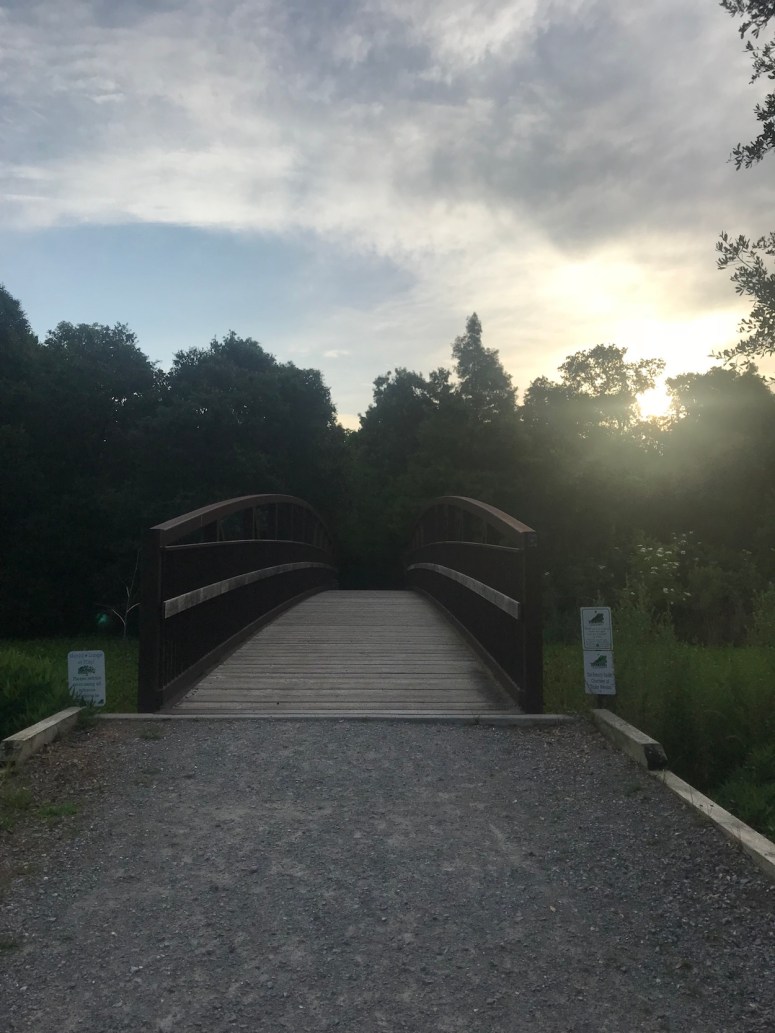
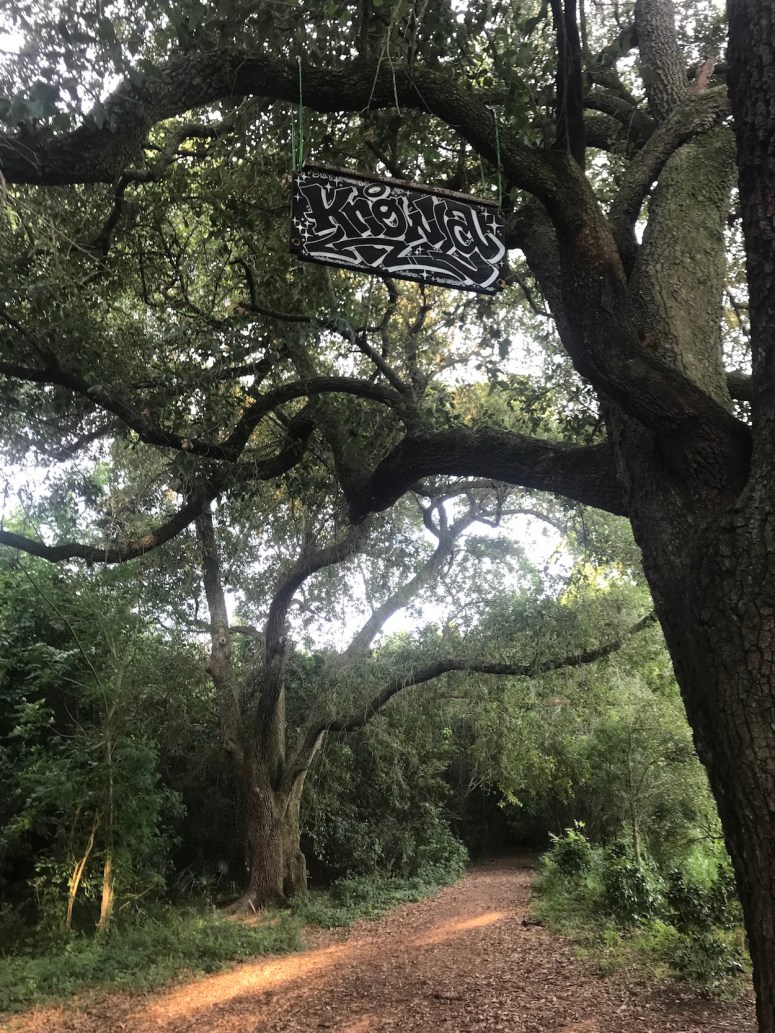
Indeed, the transportation spell is cast as soon as you cross the bridge into the forest. The sounds from the nearby road disappear. Signs of pestilence dissipate. (Prior to entering, I had some really bothersome horseflies after me. They did not follow me into the forest.)
The pictures featured here are all from the visit I made two weeks ago. I’ve returned once more since that time, and I intend on making many more visits in the days ahead. When there’s a surefire way to recharge my spirit in such close proximity, I’d be a fool to stay away.
The view from the bridge
Laborde Mountain, the highest point in New Orleans. A map of the city marks the spot.
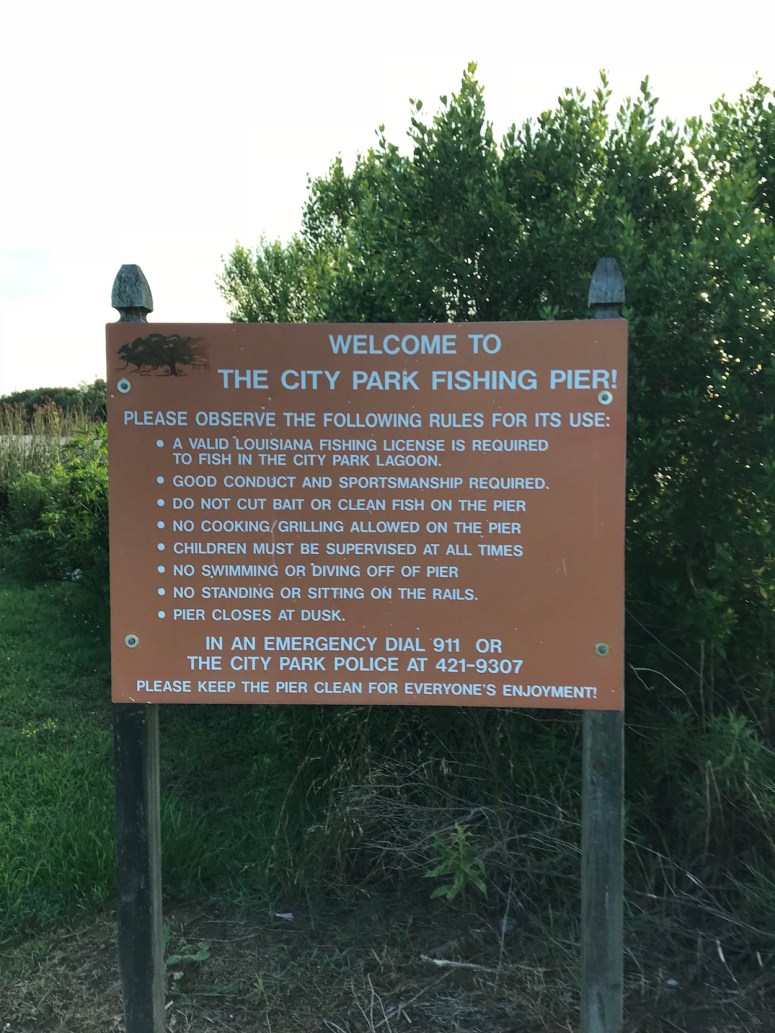
The City Park Fishing Pier, featured here last week, is visible from the roadway. During my recent meanderings, I discovered another, smaller, fishing pier tucked away and… Read more “City Park Pictorial, Part 2: Gander Point”
On Memorial Day morning, I got up with the sunrise, with the intention of capturing some photos in City Park’s Couturie Forest. I visited there a few weeks ago (without a camera), and wrote about the experience here.
For the next several weeks, I intend to post more picture-heavy posts, rather than word-heavy posts. I’m going off the old adage of a picture being worth a thousand words. Because I really need to get cranking on the third and final story of the trilogy I’ve been working on. For what feels like forever. Certainly longer than I’ve had this blog.
So anyway, the intention with the pictures, is that maybe I will channel the writing energy into the novel, while still sharing glimpses of the things I find compelling about this strange and wondrous city.
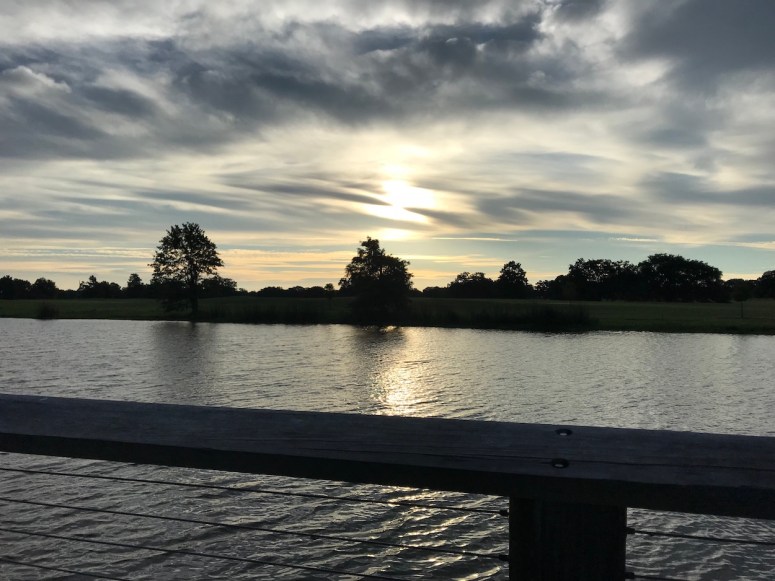
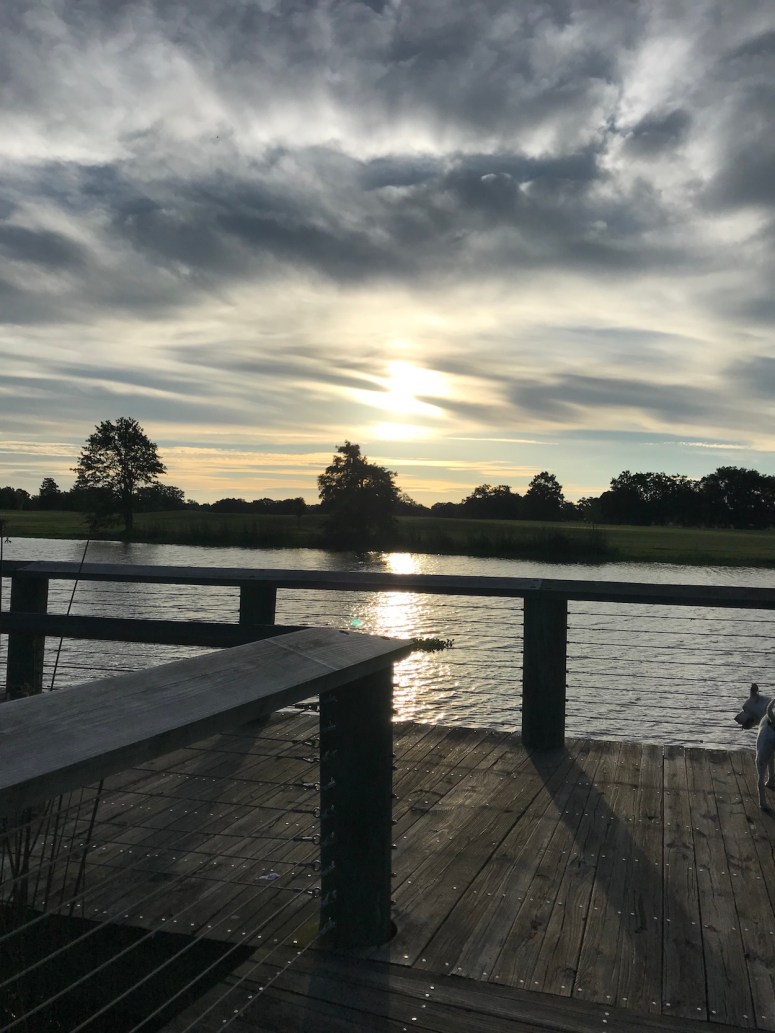
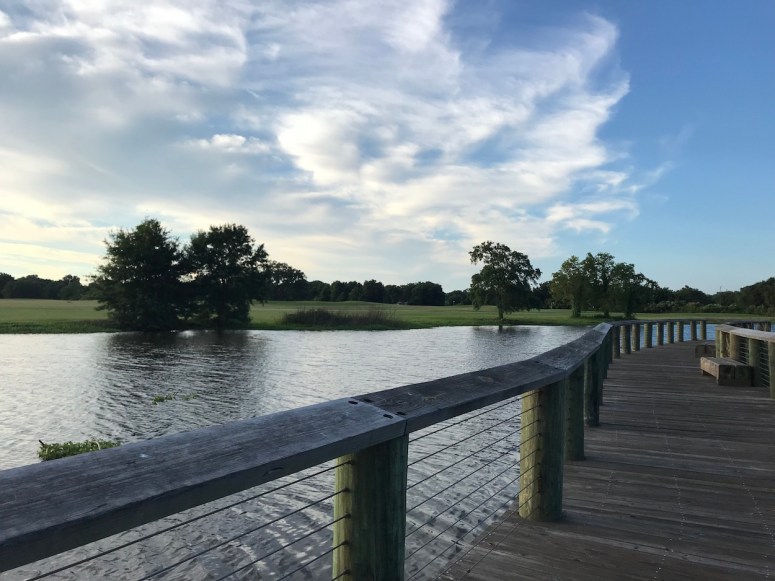
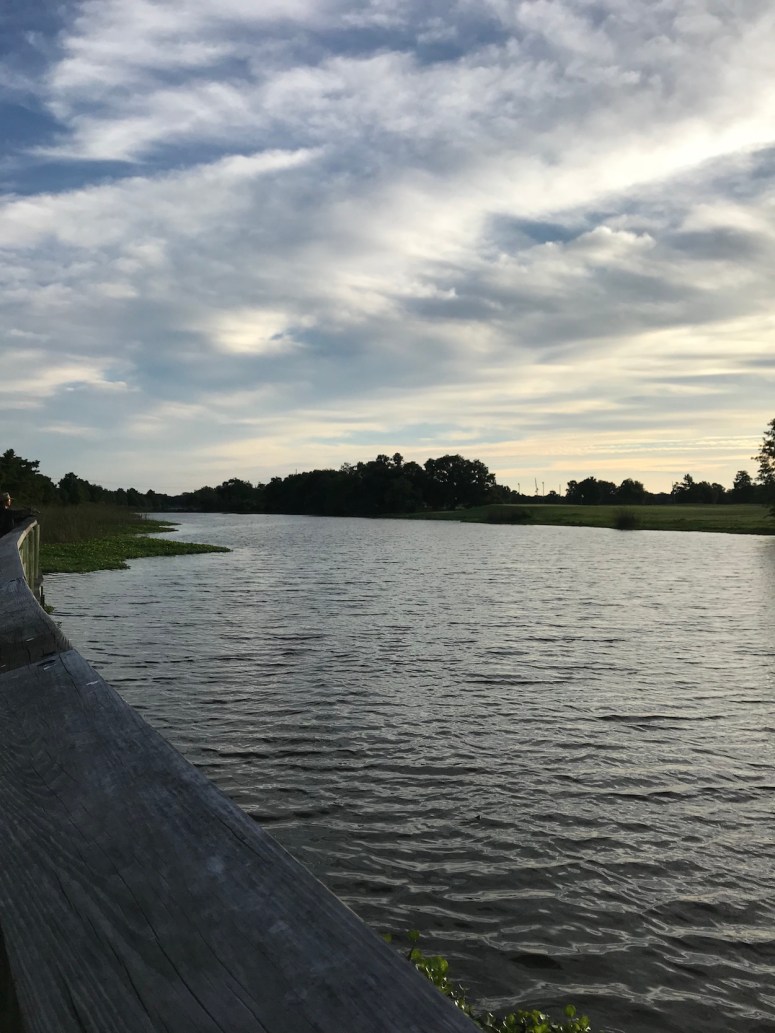
As it turns out, the Couturie Forest pictures will have to come at another time. A pad-locked chain link fence kept me from entering Monday morning. I suspect it doesn’t open until after 7 a.m., and I was a bit early. So I trekked about another half mile north to the City Park Fishing Pier. It was a beautiful morning, and early enough so that it was still cool.
I checked the Couturie Forest gate on my way back from the fishing pier–no joy. (It was still a few minutes before seven o’clock.) I will try again next weekend.
I was not the only one out that earlyI think that’s the Couturie Forest in the distanceLooking toward City Park’s North Course
Last Saturday began with no agenda, other than to get out and get some exercise. And to do this unplugged. I walked out my front door, maybe fifteen minutes after the official sunrise time of 6:14 a.m.
The next hour (plus) went a long way toward recharging my battery. Funny how unplugging can do that. The only reason I missed my phone was for its camera. It might have been nice to capture some photos of the eastern sky, which was awash in color for the first part of the walk. But I did get one shot before I left the house:
On the latter part of the walk, I took a detour into City Park’s Couturie Forest. It had been years since I’d ventured into this sylvan escape, even though I pass by it multiple times in any given week. Even on my more ambitious runs of days past (Saturday’s excursion was maybe 30% run, 70% walk), it didn’t make sense to venture into the forest. The paths there are definitely not meant for running, and I never felt I could spare the time to meander.
That feels foolish on my part, in retrospect.
Here’s a description of the Couturie Forest, from City Park’s website: “. . .the perfect place to escape from the city without ever leaving town! Combined with Scout Island, the 60-acre Couturie Forest is a nature-lover’s haven filled with native trees, scenic waterways, and fascinating wildlife — all in the heart of the New Orleans.”
It really is magical: you cross a small bridge, step onto a path, and instantly, the canopy of trees overhead muffle the sound of the roadway, no more than forty yards away. Well, that’s a guesstimate. . .the road is close, I know that much.
The highest point in New Orleans lies within the Couturie Forest. Climb Laborde Mountain, and you’ll be 43 feet above sea level. That was my first stop. There’s not much of a view, because the spot is surrounded by trees. But it sure is quiet up there.
There’s a lot more to write about the Couturie Forest, and I plan to visit again soon (with a camera). In the interest of not getting too long-winded, I’ll skip to my sighting upon exiting the forest. Around the bridge that marks the entrance (and exit), I saw a bright red bird, pecking away at the ground. It was still early, so maybe there were worms.
“A cardinal!” I thought. ‘Round these parts, I see robins, and blue jays, and these very loquacious green parrots; but cardinals are a lot rarer. But this little one didn’t have the features I’d associate with a cardinal: no black markings on the face, nor the comb atop the head.
I thought of my mother. . .while she wasn’t a birder, she was always one to pick up on the details of flora and fauna. I also thought of fellow blogger Dr. Rex, who wrote a lovely post about the meaning behind red birds and cardinals. (I hope you don’t mind me linking here, Dr. Rex!)
After conducting some sleuthing when I got back home, I decided the little red bird was a Summer Tanager, a member of the Cardinal family. Cornell’s Ornithology Lab has a very robust online library, that’s where I picked up the picture at the top of this post. (I hope I covered all the proper photo credits).
As often happens, I want to tie some direct spiritual or metaphysical meaning to my sighting of the Summer Tanager. It’s an exercise I have to remind myself, just as often, that’s fraught with peril. Trying to correlate cause and effect to these types of things never works out like I think it might. So I’ll just tie it to feelings. The things I was thinking and feeling during my unplugged walk, and the things that jumped out at me as I looked for the bird on the Internet:
I’m anticipating a convergence of my family members, coming into town for an upcoming wedding. It’s my niece’s wedding, she’s the second one of the next generation to get married, but it’s the first one my mom won’t be around for.
The first person I thought of when I saw the Summer Tanager was my mother.
The first line in Dr. Rex’s post about red birds is: “A cardinal is a representative of a loved one who has passed. When you see one, it means they are visiting you.”
So without going any deeper, I’ll just say that I’ll take this as an article of faith: that my mother will be with all her family as they gather here in the next week or so, in our hearts and memories. May her gentle spirit bless all the proceedings.
For anyone who’s spent any time in New Orleans over the past several months, there’s been no escaping all the tricentennial coverage, signage, and just all-around hullaballoo over this city’s 3ooth birthday.
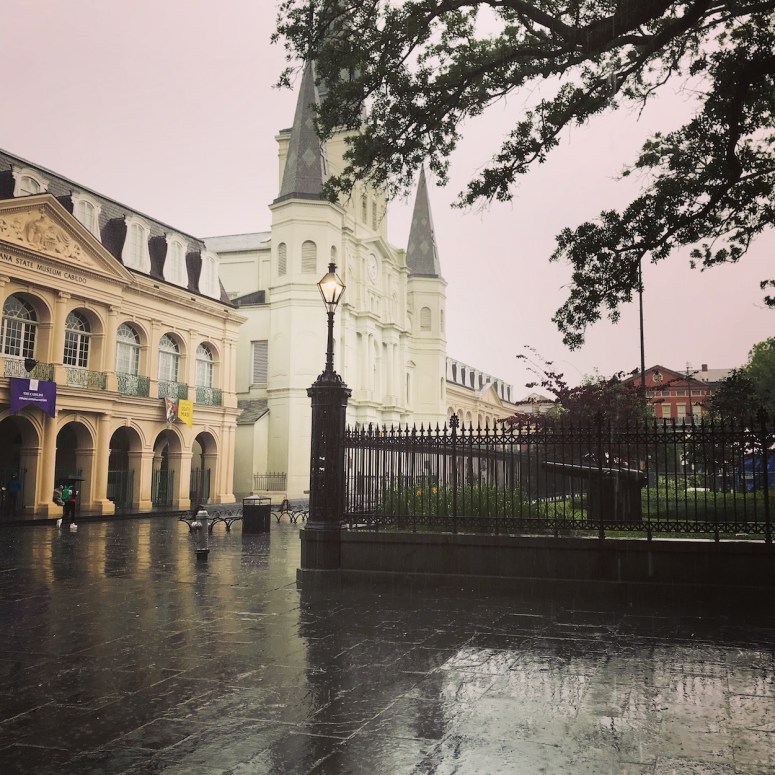
I spent this past Saturday in the French Quarter, amidst some volatile Spring weather. I think tornadoes hit in North Louisiana, but we were spared down in the Southeast corner of the state. Walking the streets, and getting soggy, I wasn’t necessarily soaking up history, but I was definitely thinking about it. (I’m a pretty sensitive sort, and there’s a lot of misery in this city’s history. Gotta be careful about what I soak up, for self-preservation.) Several questions came to mind, that Google and Wikipedia helped answer:
Is there an actual date for New Orleans’s founding? According to Wikipedia, yes and no. It was founded in the Spring of 1718 by Jean-Baptiste Le Moyne de Bienville, who was heading up the French Mississippi Company at the time. The actual date has been lost to history, but someone apparently picked May 7 as a good springtime date to celebrate the anniversary. And as an aside, Bienville’s name has not been lost to history. He did a lot of settling all along the Gulf Coast.
Does the iconic St. Louis Cathedral predate the founding? Nope. There was a wooden church in the same location in 1718, not the big cathedral that stands today. It was upgraded in 1727, destroyed in the “Great New Orleans Fire” in 1788, and rebuilt by 1794. So the structure that stands there today is only 224 years old. It received its “cathedral” status in 1793, so it is, at least, one of the oldest, if not the oldest cathedral in the U.S.
What’s the big deal? Okay, well, neither Google nor Wikipedia could answer this question. But in the course of my searching, I discovered that New York City was founded in 1624 (as New Amsterdam). The English renamed it New York in 1664. So will New York go all woo-woo for 400 in six years? And then again in forty-six years? And what about St. Augustine, Florida? It’ll turn 500 in 2065. That seems like a big deal. (Yes, Brother David, it really is the oldest city in the U.S. The city of St. Augustine has been an inside joke between the two of us for roughly forty years, now. No way to make that long story short).
I don’t want to seem like I’m not supportive of all these celebratory efforts with that last bit of snark. It is a pretty cool thing to live in a city that’s been around longer than the United States. I guess I just feel that a celebration of that many years should be tempered with some recognition of all the things those years encompassed, the good and bad. And tempering, or temperance, is not one of the things this city is known for.
On Monday, I had the amazing opportunity to attend presentations at the FBI field office in New Orleans. Many thanks to the New Orleans chapter of Sisters in Crime for arranging this outing for its members. Sisters in Crime is a national organization offering networking, advice and support to mystery authors. (While I wouldn’t qualify myself as a “mystery author,” I certainly seek to incorporate elements of mystery into my stories. My membership in this group has proven very worthwhile).
Having never been in any real trouble with the law, my impression of the FBI is mostly formed from movies. So, of course I’ve had Hans Gruber’s aforementioned quote from Die Hard going through my head as I attempt to write this piece. And then there’s also Agent Kay from Men in Black, when he’s posing as an FBI agent: “We at the FBI do not have a sense of humor we’re aware of.”
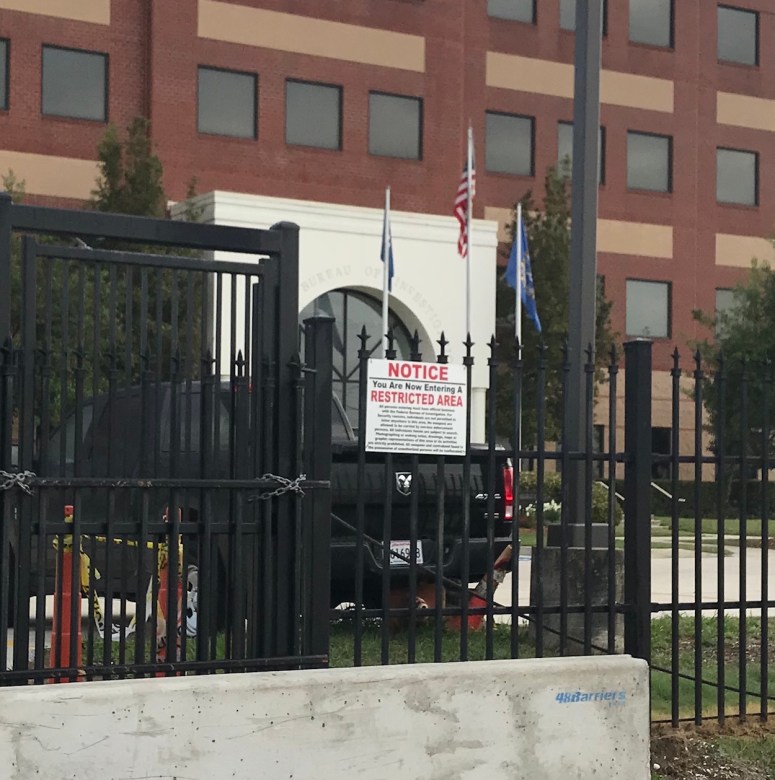
Entering the FBI field office was certainly serious business. We had to pass a limited background check in order to access the facility. And as the picture above shows, you can’t just waltz through the front door once you’ve been approved. We had to sign in at a guard gate, and then we were escorted by private security to the front door, where “Federal Bureau of Investigation” appears etched in invisible ink around the arch. You can barely make it out in the picture—which is, by the way, the only one I have, because we were not allowed to bring cell phones or any electronics into the field office.
Once inside, we were escorted by the community liaison to the “Old Case Files” room, where we were greeted by the Special Agent in Charge, Eric Rommal. He explained a little bit of how the FBI is organized around the country. The largest offices are in New York and Washington, D.C.; but they each cover a relatively small geographic area. New York covers the five boroughs, and Washington the D.C. metro area. By comparison, the New Orleans office covers the entire state of Louisiana.
After the SAC’s introduction, the newly-appointed Supervisory Special Agent (SSA) from the local Cyber division presented a case study on the investigation into some criminals, who stole about $100,000 by hacking into and assuming someone’s personal email address.
Later, when it was time for a bathroom break, I got a glimpse into why there was so much pre-screening before the FBI just let anyone into their facility. We had to be escorted to the toilets, too—right past an open door with “Gun Vault” marked alongside the door frame. I could see a line of rifles—I think they were rifles, I’m no gun expert—secured against the wall inside.
Our final presentation in the “Old Case Files” room was from the SSA of New Orleans’s Counterintelligence division. He played a lead role in the investigation of Tai Shen Kuo, a New Orleans resident who was convicted of spying for China. The case has been declassified, so SSA Bob Thibault was able to present a fascinating, first-hand account of all the cool, espionage-y details. My imagination was definitely sparked.
Finally, before we left, we received a quick demonstration of FATS, a firearms training simulator. It was a sobering look into the use of deadly force, and how every single time it boils down to a judgement call on the part of law enforcement.
It was pretty phenomenal to get a look inside an institution as public, in-the-glaring-spotlight/news-every-day-kinda-public, as the FBI. They’ve been at this for over a century! In the few hours I spent in the New Orleans office, I got a sense of earnest people, just trying to do their jobs, protecting honest folks from bad actors. Sorry, Hans, that may not be miraculous, but I’m grateful people remain willing to do the job, just the same.
On a run through New Orleans City Park this past Saturday, something caught my eye. My runs these days are a sorta walk-run combo, so I’m not opposed to breaking my stride to satisfy my curiosity. I’m at a point in my life where finding the unexpected is more important to me than reaching some particular cardiovascular fitness milestone.
I was pleased to find a few thistles blooming, right at the shoreline of the lagoon. When you think of New Orleans flora, “thistle” is not one of the first plants to come to mind. Not for me, at least. So these prickly, lilac-colored-bloom beauties were a pleasant surprise.
They were in a fairly secluded area of City Park, set back about fifty yards from the nearest roadway, but only a few feet off the paved walking path. I don’t like to run with my phone, so I made an intention to return the next day for a more leisurely picture-taking expedition.
That’s where the story comes in.
I was out and about early on Sunday morning, so I cheated and drove to the thistle spot. Or rather, I parked near there as I made my way back home. Traipsing the fifty yards across the grass and fallen oak leaves, I could see someone was already there ahead of me. I first thought it was a photographer, setting up to get their own thistle pic. (Photographers are definitely not a rare sight in City Park.)
As I approached, I could see it was a man closing up a backpack. It looked like a nice, solid backpack, not something cobbled together. And he seemed pretty intent on his task—striking camp, I assumed—and not so interested in the nearby runners and / or amateurish iPhone photographers.
But still, I had to do one of those instant threat/need assessments. You know, all the questions and answers that run through your head in a split second. “Does this person look dangerous?” Maybe, but he’s behind and bent over his pack, so it’s not like he’s lying in wait. “Does this person look like they need help?” He does not look like he needs or wants help. “Is this person supposed to be camping here?” Probably not, but I’m not about to call him out on it.
So in that instant, I decided to proceed with a few quick thistle pictures, but not dally doing it. I told him “Good morning” as I approached the lagoon’s edge. He looked up, but didn’t respond. (That’s when I got the idea that he neither needed or wanted any kind of attention). I took the photos, and then hightailed it out of there.
Being a fiction writer, I’ve had nothing but possibilities running through my head ever since. Daylight savings time had begun just about seven hours earlier, so did backpack man think he was striking his camp earlier than he actually was? Was he wondering why so many runners, walkers, and just general people were out so blooming early?
And then, don’t get me started on the thistles. Are they a sign for off-the-grid backpackers, “Here You May Camp”? Kind of like the scarlet pimpernel? Or does some scout come and seed them for off-the-grid backpackers? Is there a Secret Society of the Thistle?
Reality still creeps in. I don’t want it to seem like I am making light of this person’s circumstances. I get the gravitas. Outdoor living is tough, and especially so if it’s not by choice. My sense was his was mostly by choice. But my sense has been wrong before.
Which brings me to one of those things I’ve learned about writing, my writing, in the eight or so years I’ve been at it. And here it is: ideas for fiction—even the zaniest ideas, especially the zaniest ideas—are rarely worth pursuing if they aren’t backed up somehow by the weight and gravity of the real world.













 Anne McClane