June in New Orleans

The fountain murmuring of sleep,
A drowsy tune;
The flickering green of leaves that keep
The light of June;
Peace, through a slumbering afternoon,
The peace of June.


A waiting ghost, in the blue sky,
The white curved moon;
June, hushed and breathless, waits, and I
Wait too, with June;
Come, through the lingering afternoon,
Soon, love, come soon.


–“In Fountain Court” by Arthur Symons

June is a magical time in New Orleans. But the magic is not in the temperature. June is definitely not the best weather month—it’s when the air becomes really laden; June 1 marks the start of hurricane season; and don’t get me started on either the mosquitos or flying cockroaches. (Some call them Palmetto bugs, but I prefer to get straight to the point—these things are giant roaches that fly.)

So maybe part of the magic is this: the promise of something beautiful amidst these more miserable aspects. Arthur Symons wrote about “the flickering green of leaves that keep / The light of June.” For me, the light of June in New Orleans is a big piece of its magic puzzle. Now, Symons was a Welsh poet who died in 1945. I have to guess the light of the Junes he knew was a little different from mine—more northern, I suppose. But I also have to believe that there’s something universal about June in the Northern hemisphere, those days leading up to and away from the summer solstice.

Symons also wrote about waiting. “June, hushed and breathless, waits, and I / Wait too, with June.” Was he referring to something specific, or maybe just the quality of waiting in and of itself? Maybe he was referring to the solstice—the one day a year when light gets the best of darkness.

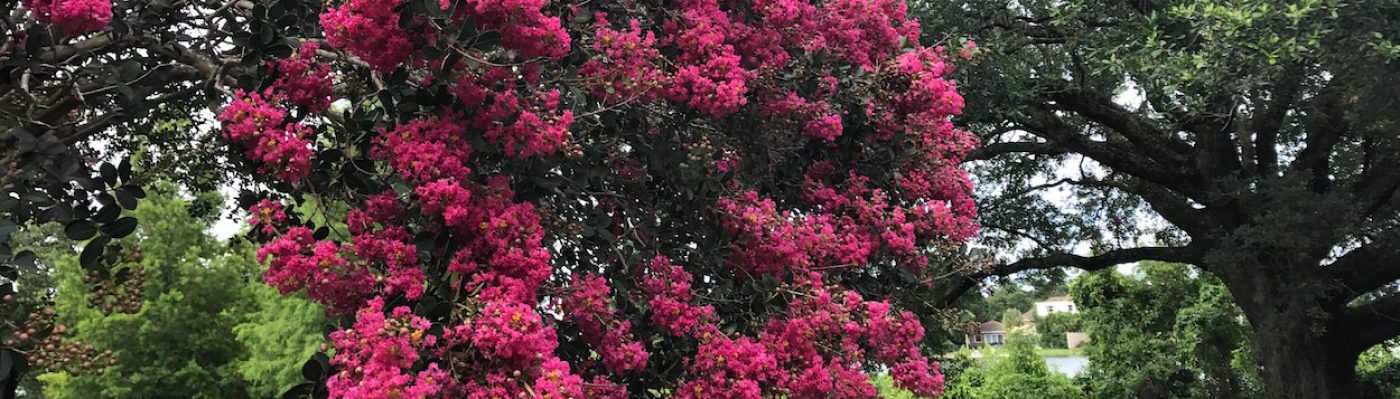
There’s something about June’s magic that had me set The Incident Under the Overpass during this month. Maybe it was because of the light, or maybe it was because the quality of waiting can help the “build” in a narrative sense. Or maybe it was just because it gave me an excuse to write about Maxfield Parrish skies, and the abundant, colorful, crape myrtle that bloom all throughout New Orleans this time of year.

June is also a challenge—if you haven’t figured it out yet, there’s something about the appeal of this month I find hard to articulate. Thus I explore it in fiction, in a blog post. Maybe if I keep trying, elucidation will come soon, love; come soon.

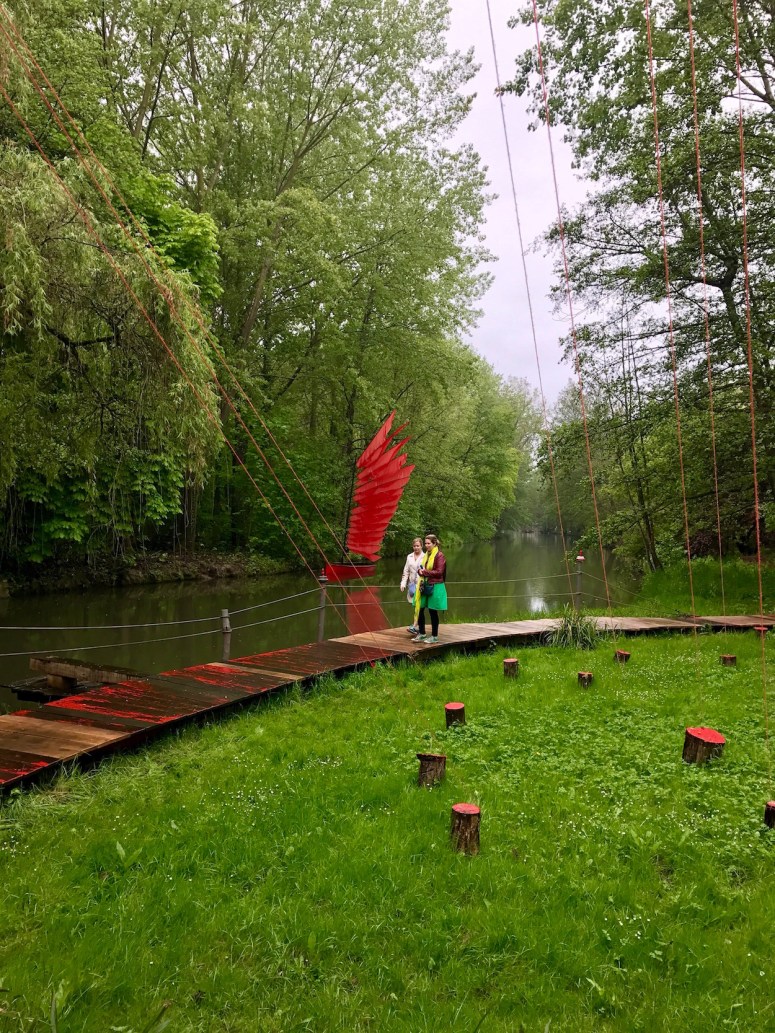
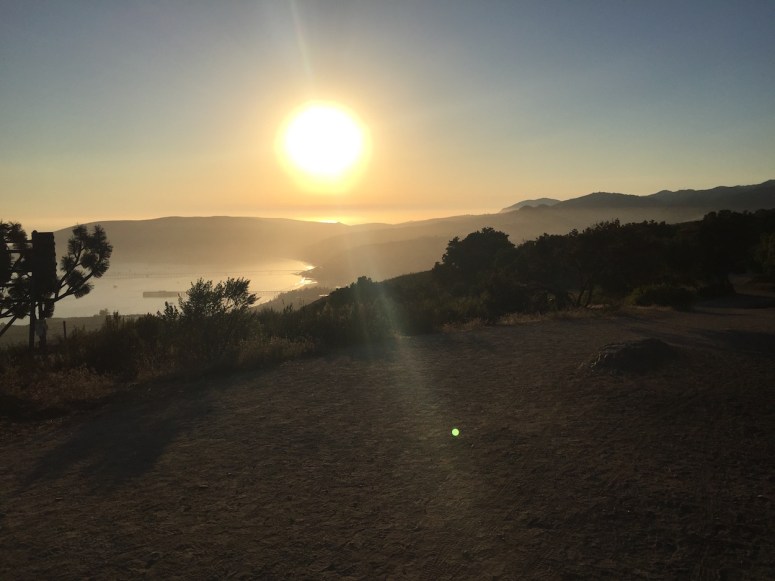
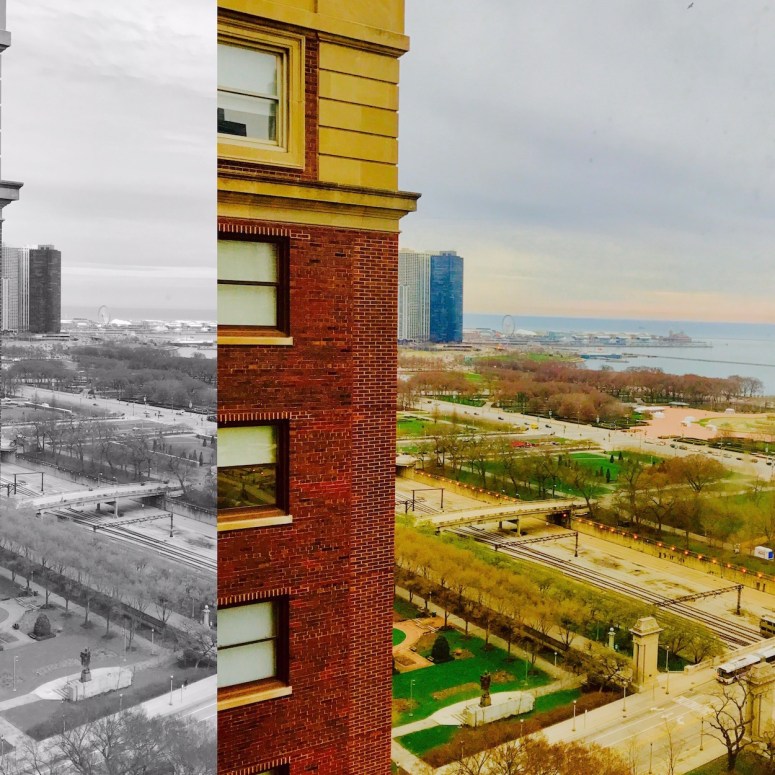
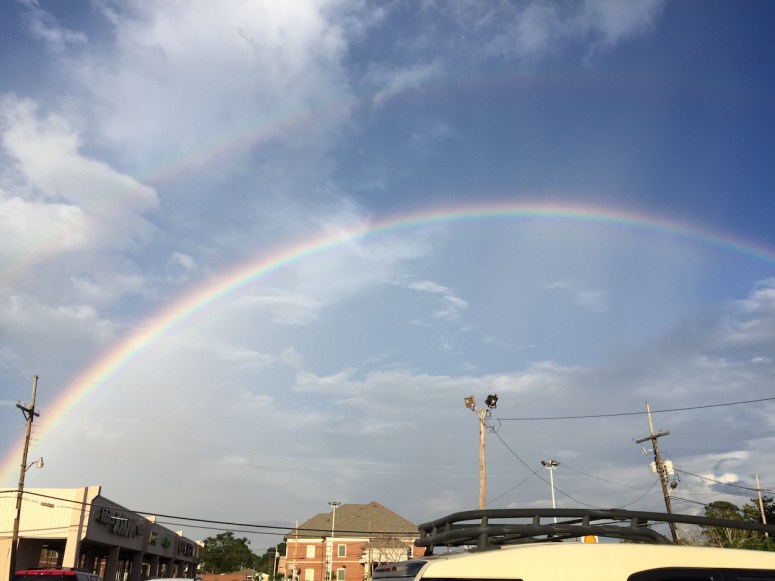
Alas, I’ve spent what time I had to spare today on those attempted articulations. Sorry for the disjointedness. But since I’ve heard a picture is worth a thousand words, here are some photos I’ve taken over the past four years, all within a month of the summer solstice. All in New Orleans, except the one with the water/beach. That was in Pensacola, which is not so far from here, and less than half a degree north in latitude. 🙂

Oh, also, the picture at the top of this post: if you look closely, it even has “the white curved moon,” like Symons’s poem.

Writing Prompts

The very talented Tom put this together.

I’ve been part of a writing group—a writing workshop, I dare to say—since 2013. I count my years-long participation in this group as one of my bona fides as a writer. “Of course I’m a real writer. I meet with other writers regularly in a bar!” You can’t get more legitimate than that.

The group is run by Stephen Rea, author of Finn McCool’s Football Club: The Birth, Death and Resurrection of a Pub Soccer Team in the City of the Dead. (Thank you, Stephen, for helping me meet my word count goal for this post). Stephen runs several different courses of fiction-writing classes at a lovely bar in New Orleans called Treo. If you’re interested, you can find out more about the classes on Facebook here.

The most recent 10-week session for our particular group will conclude tonight. It’s a little bittersweet, because we stumbled upon a bit of alchemy in this last course. We agreed to do a group project, collaborating on two short stories based on a prompt. The prompts were configured as such:

  • Man lying on the ground, woman tapping on both shoulders
  • Woman lying on the ground, man tapping on both shoulders

Everyone committed to writing 1,500 words. Names were drawn each week to determine who would work on which story. I drew the final chapter for the second story—Woman lying on the ground…

The first prompt became “The Fallen Man,” a tale of a woman named Carol escaping men in hazmat suits while trying to protect a young boy named Matt. There’s also the threat of biochemical warfare, an explosion, possible brainwashing, and Atomic Burger.

The second prompt became “Bai Polar,” the story of a woman named Bai Cavallo, who’s either from another planet entirely, or in the midst of a psychotic break. There’s also Glossolalia, cookies and milk, ectrodactyly, and plenty of references to an alien star system.

Brain injury figures into both stories.

There was a fair amount of friendly rivalry as the stories progressed. One group dubbed themselves “Team Awesome,” leaving the other group to dub themselves “Team Awesome-er.” Since I drew the last chapter, several weeks passed before I knew which team I’d wind up on. (It was “Team Awesome-er.”)

I wrote the conclusion to “Bai Polar” on the plane ride back from Europe, and had more fun doing it than I remotely suspected. I got to draw together all the threads sewn by five different writers, and it was a really awesome(er) challenge.

Writing is such a singular occupation, nearly all of the time. I loved this opportunity to be part of team, rallying behind a character and story that we composed together. If this experience is anything like what it is to be part of a “writers’ room” on a television series, then that is an enviable occupation, indeed.

Untethered

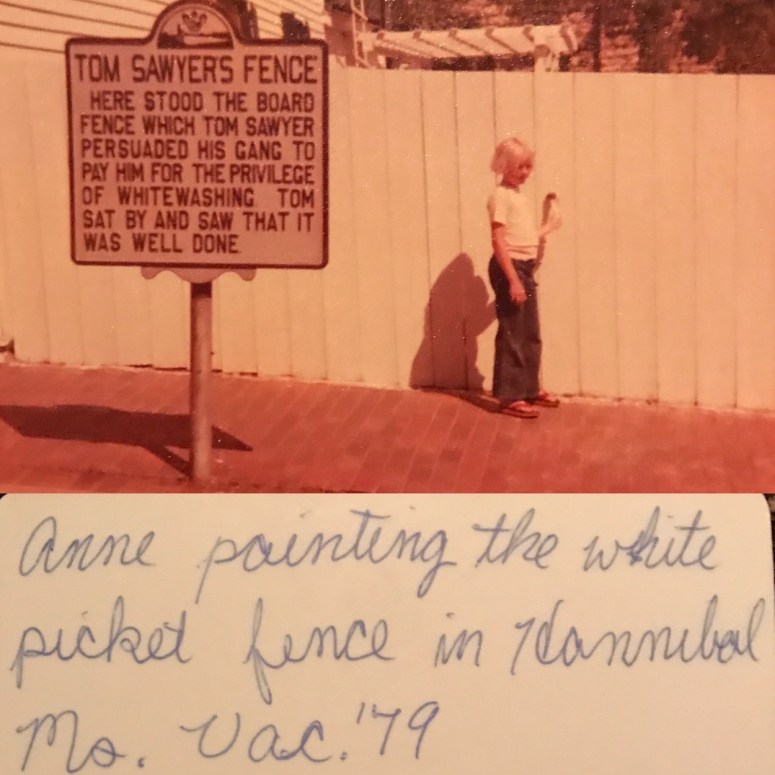
Yes, I referred to myself in the third person in the caption on the back. I think I’ve always been afraid I’ll forget who I am.

My father called it “re-entry syndrome.” That period, after a time away, when you get back into the life that was waiting on you while you were somewhere else.

Dad had big-time wanderlust. He would take us on really long vacations in the summer. I remember making our way from southern Louisiana to Glacier National Park in Montana in one three-week road trip. That might have been the summer of ’79, when we traversed a portion of the Lewis and Clark trail.

Back then, all that was waiting on me when we returned were the family pets. (Quat the cat, Rin the dog, and Bunny the bunny. Bunny had several nicknames—actually, all the animals did. “Bunny” was itself a nickname—but I won’t get into that here.) Sometimes there were swim lessons. So I had the pets, some swimming, and a lingering dread of the impending school year. That constituted my re-entry back in the day.

It was a different scenario for my father. He had his job as an Air Traffic Controller, his commission in the National Guard, and seven children to raise. That last bit was by no means his responsibility alone—I have to mention Mom here. She liked to travel, too, and was a gentle and quiet constant on all these “vacations.” But I suspect the marathon-no-frills road trips were purely the brainchild of my father. So he only had himself to blame for whatever re-entry awaited him.

After twelve days in Germany and France, I’ve been feeling a bit untethered. I suppose that’s my version of re-entry syndrome. It feels apropos, since my life, by my choice, is not as heavy as my father’s was. There’s a lot less to burn as I enter the atmosphere.

There are some changes happening at my place of employment that are factoring into the feeling. But the state of my writing life is also contributing in a major way. Two manuscripts are out of my hands, awaiting revisions. Lacey’s first story is with the new publisher, and a draft of Lacey’s second story is with an editor. I plan to take the rest of this month off before I start outlining and composing the third.

Some part of me knows that this untethered time is absolutely necessary. Especially for writing. It will give me needed distance from the material, so that I can come back to it with fresh eyes and renewed vigor.

But I miss the discipline of working on it every day. And what will happen if I let myself get too distant? Will my capacity diminish, along with my prospects? What if a big rogue wave comes up and displaces my little unmoored dinghy somewhere really far away?

Come to think of it, that might make a pretty good story. One person, alone in the ocean in a small boat. Though I think it’s been done a few times before. 😉


Paris

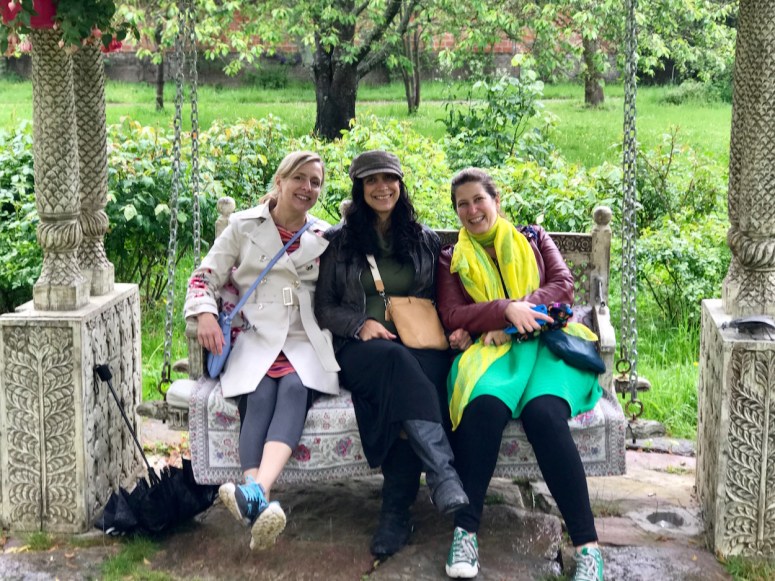
Me, Kris and Tamara at les jardins des Moulin Jaune

So, by the time folks in the U.S. are waking up, and may (or may not) see this post in their feeds, I should be somewhere over the Atlantic, returning home to the U.S. after twelve days in Europe.

I spent the last five days with friends in Paris. My friend Tamara has lived in Paris for the past six years; she met me in Geneva last year when I was traveling in Europe for work.

This time, I went to her home after my work was done in Düsseldorf. And as a bonus, two more friends from California came to Paris. The last time we were all together was in 2012, so it turned into a mini reunion of sorts.

Thinking it over, I realized this was my fourth visit to Paris (in the past twenty years). And each time, I’ve become progressively less of a tourist. And the time that I just passed there was exceedingly special, and not just because we had an insider’s tour to the city. Or because I was there when Macron was elected. (Though that was nice news).

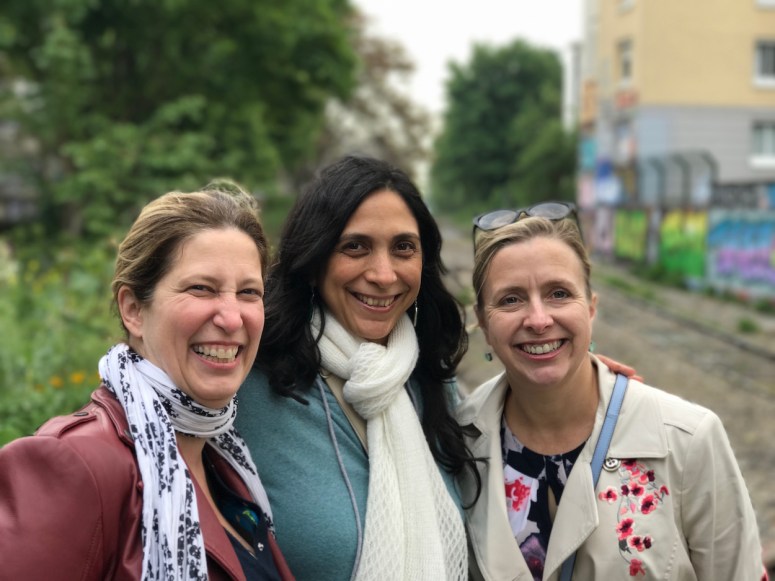
A good bit of the reason was because I got to spend time with both Tamara and Kris. The three of us forged an enduring friendship in our youth, when we all lived in Los Angeles. It was one of those things where we found ourselves at similar stages of our lives, and something just clicked.

The three of us are like sisters from different mothers. And it’s a description that’s particularly poignant, since we find ourselves again at similar stages now, in middle age. We’ve all lost our mothers recently—Kris most recently—and there was just something so enriching about spending time with close friends who know you and get you. And still want to spend time with you anyway. 🙂

Tamara lives in the 20th Arrondissement, in a lovely apartment that is amazingly quiet, and within walking distance of Père Lachaise cemetery. We spent the first day walking our way to Père Lachaise, and took a detour through the Petite Ceinture, a railway line that’s no longer in use.

The second day was rainy, and we wandered the Marais, shopped, and ducked into three different churches. None of them the BIG Notre Dame.

On Sunday, the third day, we headed outside the city to Crécy-la-Chapelle, to a special event at Le Moulin Jaune. A man named Slava opens up this property to the public every few months. On this particular Sunday, the gardens were open to wander, and it was a true “through the looking glass” experience. It was raining, and the damp only added to the chill we all felt. But there was borscht and vin chaud at the end, and we all left with some amazing pictures and a true sense memory of a very unique place.

Finally, in the time just passed, I had plenty of opportunity to reflect on my writing life. I’ve been on this writing journey for the past seven years, and was pretty quiet about it for the first five. But Kris and Tamara have known since the early days, probably since Tamara’s going-away-party when she left for Paris.

So it was nice to look down the abandoned underground passages of the Petite Ceinture, and say something about how it made me think of C.H.U.D., and not have my companions blink an eye. Or same thing, when I expressed how a gypsy wagon on the grounds of Le Moulin Jaune haunted me in a downright preternatural way.

My soul’s been enriched and my imagination sparked. Don’t think I could ask for much more.

On the Petite Ceinture. C.H.U.D. might be lurking.
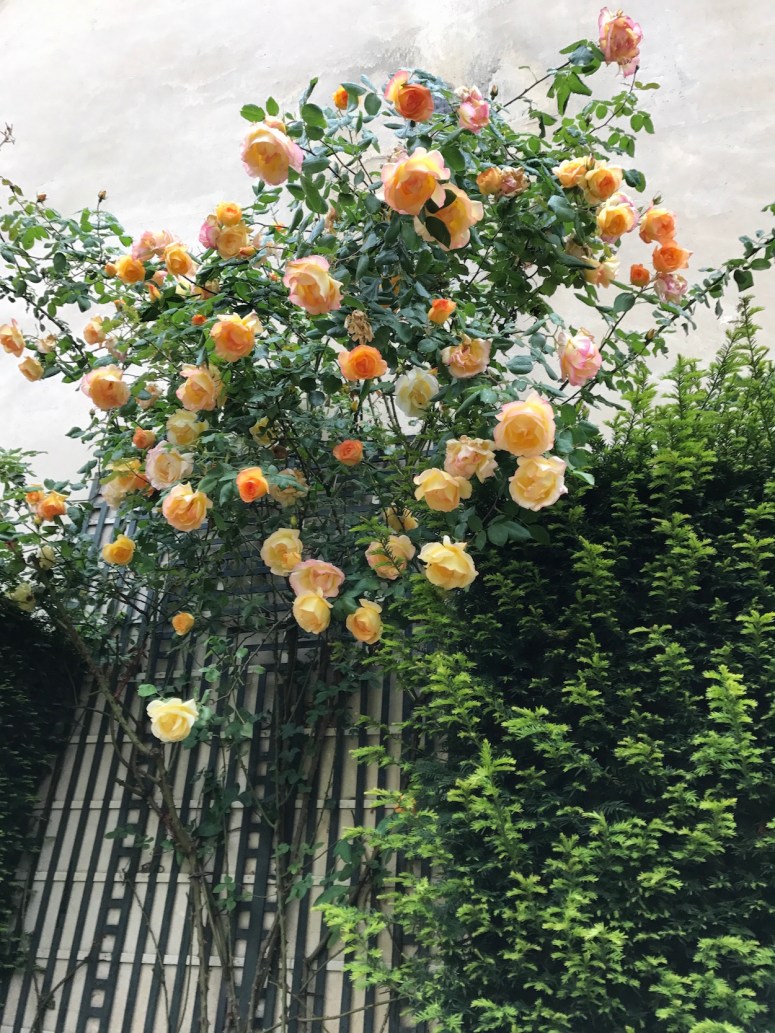
Amazing roses in the Marais
The organ at St. Eustache
Les jardins des Moulin Jaune
The gypsy wagon. And yes, that is a white rabbit in the background.

Düsseldorf

So, I’m in Germany right now—Düsseldorf, to be exact—setting up a trade show. The show opens tomorrow. The heavy lifting (from a marketing perspective) began yesterday and will continue full bore today. The weather has been kind of gray and miserable since Monday, so it hasn’t been so bad being stuck inside Messe Düsseldorf Hall 13.

Airfare and timing wise, it worked out best to arrive over the weekend. Sunday was a bright, cool, glorious spring day, and my friend and colleague, Sherri, and I had the time to check out some of the sights before our work began in earnest.

Herewith some of those sights:

*Rheinturm

Rheinturm, or the Rhine Tower, is this massive concrete structure, and the tallest building in Düsseldorf. Wikipedia tells me it’s a communication tower that holds aerials for directional radio, FM and TV transmitters. I’d imagine all that stuff was a much bigger deal when it was built in 1981, because there didn’t seem to be much hoopla about the communications equipment when we went there. Or maybe there was, but it was all in German. Anyway, we went for the sole purpose of checking out the observation deck that sits 168 meters above the earth.

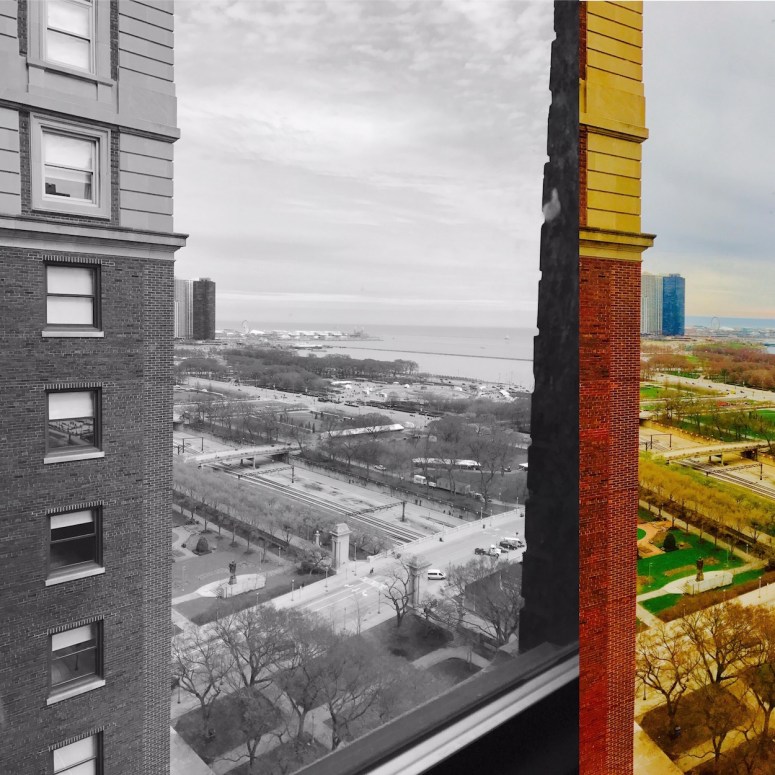
The picture at the top of this post shows the impressive view from the tower. All those white tents along the right side of the Rhine River were for the Düsseldorf Marathon, which just so happened to be this past Sunday. If you look really closely, you can see the runners.

In this picture, taken from the bridge nearest my hotel, you can see the tower on the right:

*Neuer Zollhof

In nearly every depiction of the Rheinturm I encountered, there were these really cool, curvy buildings featured in the foreground. I got to see them up close before I knew anything about them:

The one I’m standing in front of is covered in these keen reflective stainless steel tiles. Wikipedia tells me the three buildings are known as Neuer Zollhof, were designed by Frank O. Gehry, and completed in 1998. It looked to me like they house offices and restaurants.

Nothing too much more meaningful to share here, except that there was just something Gaudi-esque about those buildings that appealed to me.

Finally, I’ll conclude with Monday. It was gray and rainy, and there wasn’t a whole lot going on—even at the convention center—because of the May Day holiday. The only open restaurant we could find near our hotel was one called “China Town.” (Thank you, China Town, for upholding the old adage.) It was a lovely find, the service was wonderful, and the Chow Mein (I think it’s called something “Nudeln” in German) was delicious.

Auf wiedersehen.

Finished, But Not Abandoned

The Tremors on the PCH?

So, this post is going to be chock full of news (and quotes):

First, I finished Lacey’s second story! When I completed the (then-final) draft of Lacey’s first story, The Incident Under the Overpass, I posted something in these pages attributed to Leonardo da Vinci: “Art is never finished, only abandoned.”

The second story is by no means ready to be abandoned yet. It is definitely a first draft, not-yet-ready-for-prime-time. Something I read years ago, in Anne Lamott’s Bird by Bird: Some Instructions on Writing and Life, has stuck with me:

“You need to start somewhere. Start by getting something—anything—down on paper. A friend of mine says that the first draft is the down draft—you just get it down. The second draft is the up draft—you fix it up.”

Here’s another quote: “You can always edit a bad page. You can’t edit a blank page.” It appears that’s attributed to Jodi Picoult, though Goodreads attributes “You can’t edit a blank page” to Nora Roberts. Either way, in the latest story I wrote, all the characters and the elements of the plot are down. Some might go away, some might get added, but the bones, and a good bit of the musculature, are there. I’m just ecstatic I now have a complete story to revise.

Second, I signed a publishing contract for The Incident Under the Overpass! I signed with After Glows Publishing, a press “that offers page turning romances and urban fantasies that allow readers the escape from real life.” I’m very excited that Lacey will soon be appearing on After Glows’ bookshelf.

So, it turns out, I didn’t abandon Lacey’s first story after all: it will get re-edited, re-designed, and re-released later this year.

And finally, this is my last post from the U.S. for a couple of weeks! I’ll be in Germany for work next week, and then returning home from France the week after that. This upcoming travel was the main reason I was so determined to finish the second story. I knew I wouldn’t be able to devote any real time to it over the first two weeks of May. And I had a good bit of momentum going that would have been lost during that break.

Hopefully, the break will work out for the best, and I’ll be ready to jump into revisions when I get back.

Auf wiedersehen, (and au revoir), for now.

“Do You Think That” by Robert Creeley

April is National Poetry Month. The Internet tells me the Academy of American Poets first organized this annual celebration more than twenty years ago.

As we enter the waning days of April, it seems like a good time to share my favorite poem of all time. I first encountered it more than thirty years ago, in an American Literature class in high school. It was written by Robert Creeley, a prolific poet whose Wikipedia bibliography scrolls on for a while.

I loved the poem so much that I transcribed it, sometime circa 1986. That piece of unlined paper has traveled with me since: to college, to Los Angeles after college, and back home to New Orleans after that.

Just a few days ago, I purchased a volume of Robert Creeley poems. I was thinking thirty years on, I might consider perusing some of the other things Robert Creeley wrote. (Better late than never). I also figured there was a good chance I would find “Do You Think That” in a volume encompassing the years 1975-2005.

It didn’t turn out that way. So, thanks to LorenWebster.net and that now quite yellowed unlined piece of paper, I can still share the verses of “Do You Think That.”

Before I do, a few words on why this poem resonates with me. When I first read it, my answer to most of the questions it poses was a resounding yes(!). It seems to strike at the very nature of human consciousness. How we have to rely on our own very subjective, very unreliable, senses and perceptions to distill a reality from all the inputs that surround us. And I loved its rhythm, and still do today. Finally, I kinda like that it’s not well-known. Like it’s something I’ve been carrying around all these years as a one-of-a-kind personal anthem. I do think that I take great meaning from that uniqueness.

DO YOU THINK THAT

Do you think that if
you once do what you want
to do you will want not to do it.

Do you think that if
there’s an apple on the table
and somebody eats it, it
won’t be there anymore.

Do you think that if
two people are in love with one another,
one or the other has got to be
less in love than the other at
some point in the otherwise happy relationship.

Do you think that if
you once took a breath, you’re by
that committed to taking the next one
and so on until the very process of
breathing’s an endlessly expanding need
almost of its own necessity forever.

Do you think that if
no one knows then whatever
it is, no one will know and
that will be the case, like
they say, for an indefinite
period of time if such time
can have a qualification of such time.

Do you know anyone,
really. Have you been, really,
much alone. Are you lonely,
now, for example. Does anything
really matter to you, really, or
has anything mattered. Does each
thing tend to be there, and then not
to be there, just as if that were it.

Do you think that if
I said, I love you, or anyone
said it, or you did. Do you
think that if you had all
such decisions to make and could
make them. Do you think that
if you did. That you really
would have to think it all into
reality, that world, each time, new.

29 Hours in Chicago, Part 2

When last we heard from this hapless writer, she’d:

  • Just returned from a quick trip to Chicago, and complained about how exhausted she was
  • Seen Radiohead in concert, and complained that it made her sad
  • Watched and complained as her dishwasher leaked all over the kitchen floor

It’s time for a different perspective. First, Chicago:

While there were no parades heralding auspicious and long-sought victories, there was a race in Grant Park. I unwittingly avoided the 20,000+ runners by heading straight to the McCormick Place convention center from the airport (instead of stopping at the Hilton Chicago to set my bag down). Everything else about the trip ran just as smoothly—there were no hitches in my part of the trade show business (the reason I was there), and I even found some time to write in my downtime. And, there was shepherd’s pie.

The last time I was in Chicago, I’d had the shepherd’s pie at Kitty O’Sheas, the Irish pub inside the Hilton Chicago. If you like meat and potatoes and carrots, it’s worth trying. For months, I had been looking forward to having it again, and it did not disappoint. Shepherd’s pie is a major comfort food for me—it has very fond associations from childhood. But it’s also one of those foods that can easily be kind of blah if everything doesn’t come together right. I think everything comes together brilliantly in Kitty O’Sheas shepherd’s pie.

Next up, Radiohead:

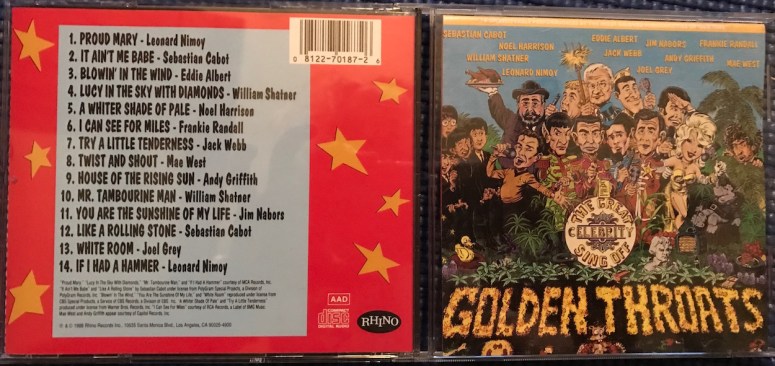
Radiohead’s OK Computer has been my desert island album for the last twenty years. As in, if I found myself stuck on a desert island, what piece of music would I want to have with me. It’s a pat answer, and if I were really forced to select one piece of music on the fly, I would probably pick something very quixotic and regrettable, like my Golden Throats compilation.

But the reason I love OK Computer…no, really, it’s reasons, plural. One, I can listen to it after a long absence and still hear something new. Two, it always evokes an emotional response. So maybe that response is sadness, but it’s always a new sadness. Hear me out on this: some songs that used to make me sad—say, “Landslide” by Fleetwood Mac, covered by various artists hence—I’ll hear now, but the emotional response is over. It’s like, “remember that time ‘Landslide’ made me cry,” I’ll recall with something like fondness.

With OK Computer, I can hear the wailing guitars and other stringed instruments opening the song “Airbag,” and I’m transported to someplace new. Someplace different from whatever was making me sad twenty years ago.

Now, I don’t necessarily enjoy feeling sad. But I enjoy the necessity of feeling sad. If that makes any sense. It’s nothing short of a gift, that there is music out there that can consistently evoke new, edifying, sadness in me. Plus, there’s this lyric from “Subterranean Homesick Alien:”

…all these weird creatures who lock up their spirits / Drill holes in themselves / And live for their secrets

It may not be the most optimistic view of the human race, but there is a lot of truth in this particular lyric, and it has stuck with me through the years.

So, the concert: They didn’t play “Subterranean Homesick Alien,” but they did play several songs from OK Computer and The Bends, and they all sounded great. I heard one reviewer complain that frontman Thom Yorke looked like he was listening to something different from what he was playing, but I was too far away to notice. Thus, I enjoyed the concert, and I’m ecstatic that I can finally say I’ve seen Radiohead live. And I’m happy that Radiohead can still make me sad.

And finally, the dishwasher:

Husband Tim fixed the drainage problem when he got home from work that day. I’m pleased to report that I ran the dishwasher this past weekend, and nary a drop escaped to the floor the entire cleaning cycle.

Wash. Rinse. Repeat.

29 Hours in Chicago, Part 1

My advance apologies, if this comes off as a rant. That’s why I have every intention of keeping it short.

In the week that’s passed since I made my last post here, I’ve flown to Chicago on a 6:30 am flight, assisted in a trade show promotion there, flown back the next day at 1:30 pm, sat through two full days of meetings at my pay-the-bills job (that was before Chicago), and saw Radiohead live in concert in New Orleans. (I have friends that travel a LOT for work, and I can see them rolling their eyes at this schedule: light by comparison. But I’m just not wired for that much social/business interaction—the meetings and trade show. That zaps me more than the travel does).

I had counted on being pretty exhausted at the end of all that. But I didn’t count on the dishwasher backing up and leaking all over the kitchen, and having to deal with some upcoming project stressors at my pay-the-bills job. And I’m behind in writing Lacey’s second story (which I had counted on but it’s still stressing me out). And finally, while watching Radiohead, I remembered that listening to them almost always makes me blue.

So right now, I’m not just exhausted, I’m burnt out and pretty out of sorts, to tell the truth.

My plan had been to write about my first return to Chicago since my momentous visit last November, right after the Cubs had won the World Series. And ruminate about what it’s like to check “seeing Radiohead in concert” off my bucket list. (My concert bucket list is not long, so this was an opportunity I kinda had to seize).

And I still will. But I’m going to do myself (and you patient readers) a favor and take a little time to get back into sorts. So, next week, a much more positive spin on my busy week that included 29 hours in Chicago.

End rant.

#AmWriting

I see this hashtag, #AmWriting, almost daily on one social media platform or another. And without fail, it makes me feel guilty. “Oh, lucky Tweeter in the U.K., there you are, #AmWriting. Or, Facebooker in Indiana, there you are, at it, too.” That’s what I should be doing. Writing. AMWriting. Anne McClane, Writing.

There’s an inherent paradox, there. When I’m looking at social media, I’m most decidedly #NOTwriting.

But…I can say, for the past three weeks, I have been doing a lot more writing. #Writing. Whatever you want to call it, I’ve been getting back into the swing of it.

Speaking of swing, I recently saw a post, I think it was on Facebook, where a writer compared the act of writing to chopping firewood. No one wants to do it, this writer claimed, but if you want to stave off the cold and keep the house warm, you better get to it. Or something like that. I’ve always lived in temperate climates, so the analogy was a little lost on me.

What resonated with me is that writing, most of the time, is a chore. Iterations and iterations. The horror of suffering through brain dumps, raw outputs, to try to sift through to the gold that may or may not be there.

But three positive things (one for each week?) have occurred to me as I’ve gotten back into the habit of writing.

The first: I’ve missed Lacey! (She’s the protagonist in the series of stories I’m in the midst of). You spend too much time with someone, you’re invariably gonna get a little sick of them. But the break I had in writing The Tremors on the PCH, unintentional as it was, must have made my writing heart grow fonder. It’s a nice thing to realize.

The second: I’d really like to do whatever is within my power to keep an unintentional break from EVER happening again. The next break I take from writing, I want it to be of a limited duration, and according to my own plan, my own schedule. And not because I got wrapped around the axle of my own insecurities and anxieties about publishing and promoting. Or caught up in the struggle to balance the demands of my wage-earner job.

And finally: there’s the magic. Speaking of wage-earning, for years, I’ve bemoaned “magic-less” days as a corporate cog in a giant promotional machine. (I’ve worked in marketing for large to mid-size companies for most of my 20+ year career). Not every day is a slog, but there are always those inevitable moments where you feel the life being sucked out of you. Like Count Rugen’s machine from The Princess Bride.

While I can’t go so far as to say that writing puts all that life back; for me, it’s a way to insert the supernatural, the unexpected, the magical, into my day. Another reason I’d be foolish to let the unintentional come between me and #writing again.