Finished, But Not Abandoned

The Tremors on the PCH?

So, this post is going to be chock full of news (and quotes):

First, I finished Lacey’s second story! When I completed the (then-final) draft of Lacey’s first story, The Incident Under the Overpass, I posted something in these pages attributed to Leonardo da Vinci: “Art is never finished, only abandoned.”

The second story is by no means ready to be abandoned yet. It is definitely a first draft, not-yet-ready-for-prime-time. Something I read years ago, in Anne Lamott’s Bird by Bird: Some Instructions on Writing and Life, has stuck with me:

“You need to start somewhere. Start by getting something—anything—down on paper. A friend of mine says that the first draft is the down draft—you just get it down. The second draft is the up draft—you fix it up.”

Here’s another quote: “You can always edit a bad page. You can’t edit a blank page.” It appears that’s attributed to Jodi Picoult, though Goodreads attributes “You can’t edit a blank page” to Nora Roberts. Either way, in the latest story I wrote, all the characters and the elements of the plot are down. Some might go away, some might get added, but the bones, and a good bit of the musculature, are there. I’m just ecstatic I now have a complete story to revise.

Second, I signed a publishing contract for The Incident Under the Overpass! I signed with After Glows Publishing, a press “that offers page turning romances and urban fantasies that allow readers the escape from real life.” I’m very excited that Lacey will soon be appearing on After Glows’ bookshelf.

So, it turns out, I didn’t abandon Lacey’s first story after all: it will get re-edited, re-designed, and re-released later this year.

And finally, this is my last post from the U.S. for a couple of weeks! I’ll be in Germany for work next week, and then returning home from France the week after that. This upcoming travel was the main reason I was so determined to finish the second story. I knew I wouldn’t be able to devote any real time to it over the first two weeks of May. And I had a good bit of momentum going that would have been lost during that break.

Hopefully, the break will work out for the best, and I’ll be ready to jump into revisions when I get back.

Auf wiedersehen, (and au revoir), for now.

“Do You Think That” by Robert Creeley

April is National Poetry Month. The Internet tells me the Academy of American Poets first organized this annual celebration more than twenty years ago.

As we enter the waning days of April, it seems like a good time to share my favorite poem of all time. I first encountered it more than thirty years ago, in an American Literature class in high school. It was written by Robert Creeley, a prolific poet whose Wikipedia bibliography scrolls on for a while.

I loved the poem so much that I transcribed it, sometime circa 1986. That piece of unlined paper has traveled with me since: to college, to Los Angeles after college, and back home to New Orleans after that.

Just a few days ago, I purchased a volume of Robert Creeley poems. I was thinking thirty years on, I might consider perusing some of the other things Robert Creeley wrote. (Better late than never). I also figured there was a good chance I would find “Do You Think That” in a volume encompassing the years 1975-2005.

It didn’t turn out that way. So, thanks to LorenWebster.net and that now quite yellowed unlined piece of paper, I can still share the verses of “Do You Think That.”

Before I do, a few words on why this poem resonates with me. When I first read it, my answer to most of the questions it poses was a resounding yes(!). It seems to strike at the very nature of human consciousness. How we have to rely on our own very subjective, very unreliable, senses and perceptions to distill a reality from all the inputs that surround us. And I loved its rhythm, and still do today. Finally, I kinda like that it’s not well-known. Like it’s something I’ve been carrying around all these years as a one-of-a-kind personal anthem. I do think that I take great meaning from that uniqueness.

DO YOU THINK THAT

Do you think that if
you once do what you want
to do you will want not to do it.

Do you think that if
there’s an apple on the table
and somebody eats it, it
won’t be there anymore.

Do you think that if
two people are in love with one another,
one or the other has got to be
less in love than the other at
some point in the otherwise happy relationship.

Do you think that if
you once took a breath, you’re by
that committed to taking the next one
and so on until the very process of
breathing’s an endlessly expanding need
almost of its own necessity forever.

Do you think that if
no one knows then whatever
it is, no one will know and
that will be the case, like
they say, for an indefinite
period of time if such time
can have a qualification of such time.

Do you know anyone,
really. Have you been, really,
much alone. Are you lonely,
now, for example. Does anything
really matter to you, really, or
has anything mattered. Does each
thing tend to be there, and then not
to be there, just as if that were it.

Do you think that if
I said, I love you, or anyone
said it, or you did. Do you
think that if you had all
such decisions to make and could
make them. Do you think that
if you did. That you really
would have to think it all into
reality, that world, each time, new.

29 Hours in Chicago, Part 2

When last we heard from this hapless writer, she’d:

  • Just returned from a quick trip to Chicago, and complained about how exhausted she was
  • Seen Radiohead in concert, and complained that it made her sad
  • Watched and complained as her dishwasher leaked all over the kitchen floor

It’s time for a different perspective. First, Chicago:

While there were no parades heralding auspicious and long-sought victories, there was a race in Grant Park. I unwittingly avoided the 20,000+ runners by heading straight to the McCormick Place convention center from the airport (instead of stopping at the Hilton Chicago to set my bag down). Everything else about the trip ran just as smoothly—there were no hitches in my part of the trade show business (the reason I was there), and I even found some time to write in my downtime. And, there was shepherd’s pie.

The last time I was in Chicago, I’d had the shepherd’s pie at Kitty O’Sheas, the Irish pub inside the Hilton Chicago. If you like meat and potatoes and carrots, it’s worth trying. For months, I had been looking forward to having it again, and it did not disappoint. Shepherd’s pie is a major comfort food for me—it has very fond associations from childhood. But it’s also one of those foods that can easily be kind of blah if everything doesn’t come together right. I think everything comes together brilliantly in Kitty O’Sheas shepherd’s pie.

Next up, Radiohead:

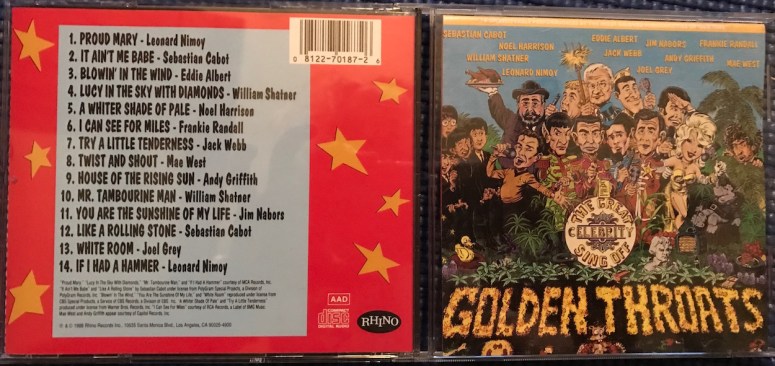
Radiohead’s OK Computer has been my desert island album for the last twenty years. As in, if I found myself stuck on a desert island, what piece of music would I want to have with me. It’s a pat answer, and if I were really forced to select one piece of music on the fly, I would probably pick something very quixotic and regrettable, like my Golden Throats compilation.

But the reason I love OK Computer…no, really, it’s reasons, plural. One, I can listen to it after a long absence and still hear something new. Two, it always evokes an emotional response. So maybe that response is sadness, but it’s always a new sadness. Hear me out on this: some songs that used to make me sad—say, “Landslide” by Fleetwood Mac, covered by various artists hence—I’ll hear now, but the emotional response is over. It’s like, “remember that time ‘Landslide’ made me cry,” I’ll recall with something like fondness.

With OK Computer, I can hear the wailing guitars and other stringed instruments opening the song “Airbag,” and I’m transported to someplace new. Someplace different from whatever was making me sad twenty years ago.

Now, I don’t necessarily enjoy feeling sad. But I enjoy the necessity of feeling sad. If that makes any sense. It’s nothing short of a gift, that there is music out there that can consistently evoke new, edifying, sadness in me. Plus, there’s this lyric from “Subterranean Homesick Alien:”

…all these weird creatures who lock up their spirits / Drill holes in themselves / And live for their secrets

It may not be the most optimistic view of the human race, but there is a lot of truth in this particular lyric, and it has stuck with me through the years.

So, the concert: They didn’t play “Subterranean Homesick Alien,” but they did play several songs from OK Computer and The Bends, and they all sounded great. I heard one reviewer complain that frontman Thom Yorke looked like he was listening to something different from what he was playing, but I was too far away to notice. Thus, I enjoyed the concert, and I’m ecstatic that I can finally say I’ve seen Radiohead live. And I’m happy that Radiohead can still make me sad.

And finally, the dishwasher:

Husband Tim fixed the drainage problem when he got home from work that day. I’m pleased to report that I ran the dishwasher this past weekend, and nary a drop escaped to the floor the entire cleaning cycle.

Wash. Rinse. Repeat.

29 Hours in Chicago, Part 1

My advance apologies, if this comes off as a rant. That’s why I have every intention of keeping it short.

In the week that’s passed since I made my last post here, I’ve flown to Chicago on a 6:30 am flight, assisted in a trade show promotion there, flown back the next day at 1:30 pm, sat through two full days of meetings at my pay-the-bills job (that was before Chicago), and saw Radiohead live in concert in New Orleans. (I have friends that travel a LOT for work, and I can see them rolling their eyes at this schedule: light by comparison. But I’m just not wired for that much social/business interaction—the meetings and trade show. That zaps me more than the travel does).

I had counted on being pretty exhausted at the end of all that. But I didn’t count on the dishwasher backing up and leaking all over the kitchen, and having to deal with some upcoming project stressors at my pay-the-bills job. And I’m behind in writing Lacey’s second story (which I had counted on but it’s still stressing me out). And finally, while watching Radiohead, I remembered that listening to them almost always makes me blue.

So right now, I’m not just exhausted, I’m burnt out and pretty out of sorts, to tell the truth.

My plan had been to write about my first return to Chicago since my momentous visit last November, right after the Cubs had won the World Series. And ruminate about what it’s like to check “seeing Radiohead in concert” off my bucket list. (My concert bucket list is not long, so this was an opportunity I kinda had to seize).

And I still will. But I’m going to do myself (and you patient readers) a favor and take a little time to get back into sorts. So, next week, a much more positive spin on my busy week that included 29 hours in Chicago.

End rant.

Crawfish Break

I’ve spent a fair amount of time this month squirreled away, focused on writing, getting Lacey’s story down and out of my head. But it was time to take a break this past Saturday, for my family’s annual crawfish boil.

I can’t tell you who first decided to pick up one of these little crustaceans and put them in a boiling pot full of spices. But apparently, they’ve always been plentiful in the swamplands of southern Louisiana. I figure some hungry, early denizen of these parts must have figured they were worth a shot.

By the late 1800s, crawfish were being sold commercially. This, according to the Louisiana Crawfish Promotion and Research Board. In those 100 plus years gone by, crawfish have grown into a pretty big deal down here. This time of year, not a weekend goes by where someone isn’t boiling crawfish somewhere.

With our mild winters and really (really) long summers, some clever folks have claimed that our seasons are different in Southern Louisiana. Instead of Winter, Spring, Summer and Fall, we have: Mardi Gras, Crawfish, Hurricane, and Football. (I’ll sometimes see Hunting instead of Mardi Gras, and Sno-ball instead of Hurricane, but Crawfish and Football are constants.)

To give you some idea of the scope of crawfish boils down here: as of this year, Louisiana has a crawfish “pardoning event.” Yes, like the pardon some lucky Thanksgiving turkey receives from the POTUS each year. On March 7, Louisiana’s Lieutenant Governor pardoned Emile the Crawfish to live out the rest of his days in Bayou Segnette. (Emile was named after Emile Zatarain [1866-1959], the guy who first packaged all the spices together. Seems a little ironic.)
The crawfish boil tradition in my family only goes back six or seven years. It’s definitely tied to the next generation—several of my nieces and nephews have birthdays in March. Since March/April is the height of crawfish season, it makes sense. It’s also a great excuse to get people to come visit, since all but one of those March birthday holders live outside Louisiana.

There’s a lot I like about this family event. I like that it’s something that’s been forged recently—it’s not some holdover from our family’s past. I like to see Husband Tim and Brother Jerry working together like Matt Damon and Greg Kinnear in Stuck on You. I like that it gets distant family and friends into New Orleans for a visit.

I could go on, but I won’t. There’s a quote from A Knight’s Tale that sums up my feelings nicely. (Uttered by Paul Bettany, from his brilliant portrayal of Geoffrey Chaucer): Days like these are far too rare to cheapen with heavy-handed words.

Indeed.

#AmWriting

I see this hashtag, #AmWriting, almost daily on one social media platform or another. And without fail, it makes me feel guilty. “Oh, lucky Tweeter in the U.K., there you are, #AmWriting. Or, Facebooker in Indiana, there you are, at it, too.” That’s what I should be doing. Writing. AMWriting. Anne McClane, Writing.

There’s an inherent paradox, there. When I’m looking at social media, I’m most decidedly #NOTwriting.

But…I can say, for the past three weeks, I have been doing a lot more writing. #Writing. Whatever you want to call it, I’ve been getting back into the swing of it.

Speaking of swing, I recently saw a post, I think it was on Facebook, where a writer compared the act of writing to chopping firewood. No one wants to do it, this writer claimed, but if you want to stave off the cold and keep the house warm, you better get to it. Or something like that. I’ve always lived in temperate climates, so the analogy was a little lost on me.

What resonated with me is that writing, most of the time, is a chore. Iterations and iterations. The horror of suffering through brain dumps, raw outputs, to try to sift through to the gold that may or may not be there.

But three positive things (one for each week?) have occurred to me as I’ve gotten back into the habit of writing.

The first: I’ve missed Lacey! (She’s the protagonist in the series of stories I’m in the midst of). You spend too much time with someone, you’re invariably gonna get a little sick of them. But the break I had in writing The Tremors on the PCH, unintentional as it was, must have made my writing heart grow fonder. It’s a nice thing to realize.

The second: I’d really like to do whatever is within my power to keep an unintentional break from EVER happening again. The next break I take from writing, I want it to be of a limited duration, and according to my own plan, my own schedule. And not because I got wrapped around the axle of my own insecurities and anxieties about publishing and promoting. Or caught up in the struggle to balance the demands of my wage-earner job.

And finally: there’s the magic. Speaking of wage-earning, for years, I’ve bemoaned “magic-less” days as a corporate cog in a giant promotional machine. (I’ve worked in marketing for large to mid-size companies for most of my 20+ year career). Not every day is a slog, but there are always those inevitable moments where you feel the life being sucked out of you. Like Count Rugen’s machine from The Princess Bride.

While I can’t go so far as to say that writing puts all that life back; for me, it’s a way to insert the supernatural, the unexpected, the magical, into my day. Another reason I’d be foolish to let the unintentional come between me and #writing again.

Ralph Waldo Emerson and ELO

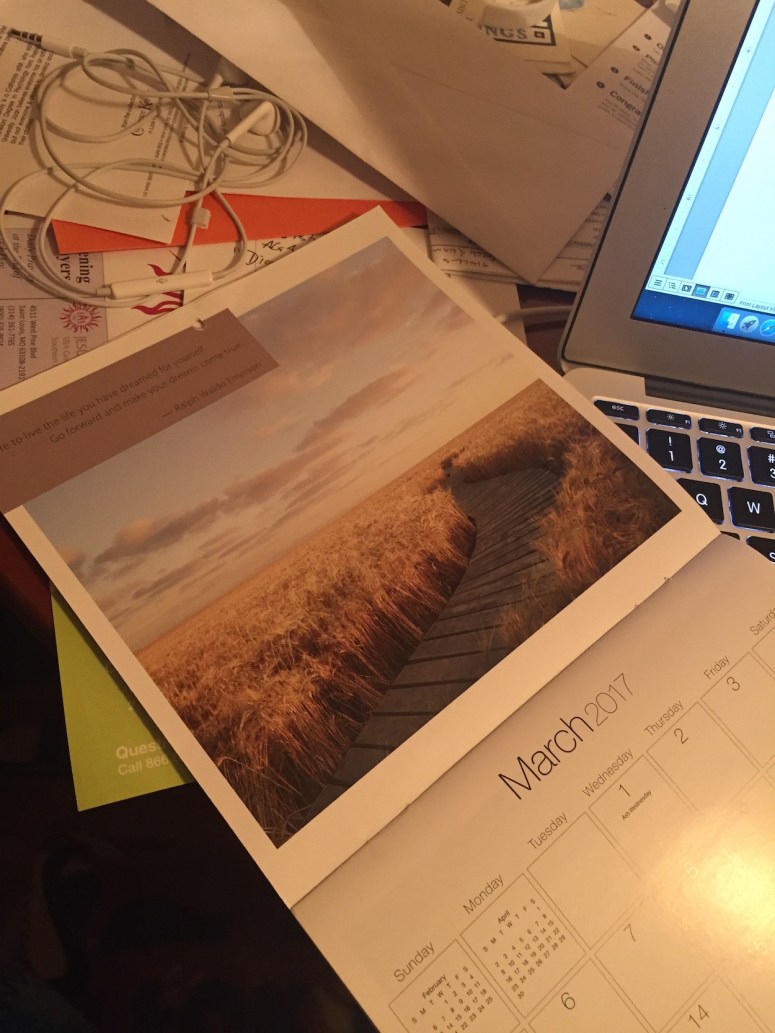
Dare to live the life you have dreamed for yourself. Go forward and make your dreams come true.

My calendar is one of the talismans of my writing life. I think it began in 2012—on a weekend away in late 2011, perusing a bookstore on Florida’s Gulf Coast, I found a mini-monthly calendar with some cool inspirational quotes. This is just what I need! I thought. I hung it up on the wardrobe that sits to the left of my desk, and have spent much time (perhaps too much time) pondering the quote that hangs there, anytime I turn my attention from my screen. Little did I know that purchase would beget an annual mini-panic that strikes about mid-December. I need a new calendar!

Up to now, bookstores have been my saving grace. It’s there that I can usually find something that strikes the right note for the year ahead. But alas, bookstores came up short this year. So I dared to turn to the bookstore’s enemy, the bane of traditional publishers, Amazon. Could it provide what I sought? Indeed, an Amazon search kicked me out to Calendars.com, a vast repository of printed calendars of all shapes and sizes and inspirational intents.

I’ve been pleased with my Calendars.com purchase for 2017. It’s called “First We Dream.” January was some pink and blue clouds, a wheat field, and a quote from William Blake: “No bird soars too high if he soars with his own wings.” February was rocks on a seashore and Goethe: “Dream no small dreams, for they have no power to move the hearts of men.”

And March brought me Ralph Waldo Emerson and the quote that opened this post. And that got me thinking. About transcendentalism and ELO. Yes, ELO, the Electric Light Orchestra. The English rock band most closely affiliated with Jeff Lynne, that hit its heyday in the ‘70s.

But first, transcendentalism. I was first introduced to the philosophy my junior year in high school, in my American Literature class. I was immediately drawn to it—the whole idea that an innate divinity unifies all creation totally jived with how I’d been raised, and on a deeper level, it resonated with some kind of intuitive sense in my gut.

It spurred a deeper dive into Emerson’s writings, but I remember getting bogged down pretty quickly. I recall dense prose. Perhaps it’s worth taking a look with more aged eyes, but being perennially short on time, I’ll settle for the quote that headlines March 2017.

The timing is particularly apropos. I’m in the trenches of trying to make the life I’ve always dreamed for myself: being a writer who can make a living off writing. Finishing my second novel is my current highest priority in that quest. And it all feels like a pretty big dare.

So it’s nice to have Ralph Waldo Emerson up there, urging me on. It’s kind of like having an old friend show up at mile 20 of a marathon, shouting out my name and general encouragement.

And where does ELO fit into all of this? It’s pretty simple. I’ve been an ELO fan longer than I’ve been a fan of transcendentalism. All this talk about dreams—from Emerson, and the 2017 calendar writ large—has planted ELO’s “Hold On Tight” firmly in my head. The song was released in 1981, and the opening lyrics might jog the memories of those of you who remember 1981:

Hold on tight to your dream
When you see your ship go sailing
When you feel your heart is breaking
Hold on tight to your dream

More inspiration to keep me going in these last few miles.

Logan and John Wick

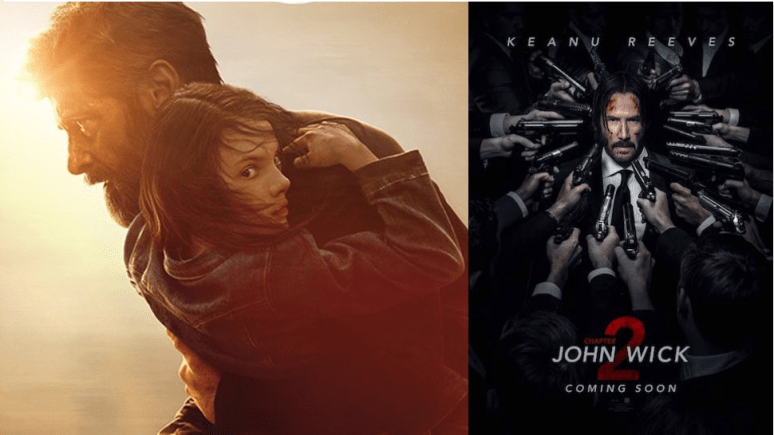
I realize today is International Women’s Day. And I will get to that in a bit, I promise. But first, an introduction: in determining a topic for this week’s post, it occurred to me that I just saw the new Wolverine movie, Logan, two nights ago. And prior to that, the last movie I saw in the theater was John Wick: Chapter 2. There are certain similarities to the two films, so that seemed as good a thing as any to write about.

The biggest similarity that comes to mind is the ultra violence. According to the Internet, the total body count in John Wick: Chapter 2 is 128. I think that’s like a 50% increase in kills from the first John Wick. I couldn’t find a total body count for Logan, maybe because the crafty Internet denizens who spend their time counting such things haven’t gotten around to it yet. Suffice it to say, it felt pretty high. And with an “R” rating and an extra set of adamantium claws in the movie, it gets really bloody.

There is always some part of me that feels I need to apologize for my love of action movies. To those folks who feel action movies glorify violence, or only reinforce certain gender stereotypes. Since my affinity for action movies has not diminished over time, my justification is pretty much the same as it’s ever been: it’s the stories that I love, not the violence or the macho-ness for their own sake. When it’s a great story, the actions of the characters serve the plot. Sometimes those actions can include lots of killing and questionable choices.

And I might be able to offer an argument against the gender-stereotyping claim. Today being International Women’s Day, I’d like to focus on the females in these two movies. To be sure, there aren’t many, but they are crucial to the story of each, especially Logan.

But first, John Wick: Chapter 2. The most memorable female role (to me) was assassination target Gianna D’Antonio, played by Claudia Gerini. She was a powerful woman who showed no fear, who appeared to live as she died—by her own rules. The other main female role was one of John Wick’s chief adversaries, Ares, played by Ruby Rose. She never uttered any great memorable lines because she never spoke—she communicated via sign language.

And as I recall, many of the contract killers who go after John Wick (there are a lot of them) are female. I can’t go so far as to say John Wick: Chapter 2 takes great steps to further the cause of equality; but as far as the story goes, it was very enjoyable. It took itself even less seriously than the first, and played up its arch elements to utmost effect. (I love the whole concept of the criminal underworld’s Continental hotel chain, which allows no “business”—read killings—on the premises).

Logan was also enjoyable, but in a more heart-breaking way. And I definitely could make a case for how equality is at the very heart of the entire X-Men series—of comic books and movies. So I feel there is less need of a defense on that claim. In Logan, for female roles, there is Gabriela, a nurse played very effectively by Elizabeth Rodriguez, who seeks out Logan and sets the whole story in motion.

But finally, there is the character of Laura. Dafne Keen plays her to indelible effect. There would be no story without Laura, and it would be a very different movie with a different actor in the role. It feels condescending to say Dafne Keen is “one to watch,” so instead I’ll just say I was consistently amazed by her portrayal.

In a very short span of story time, and with no words spoken, I was totally convinced of the connection she forged with Charles Xavier. (I could go on about how phenomenal Patrick Stewart is in this movie, but since today isn’t International British Knight Day, I won’t). And Laura’s relationship with Logan is immediately intense, and complex, and I don’t think I’m spoiling anything by calling it heartbreaking.

I’m getting long-winded, so I’ll wrap this up. Some final similarities between Logan and John Wick: Chapter 2—I think each improved upon preceding films in the series. And neither did anything to lessen my love for action movies.

Ash Wednesday

The unexamined life is not worth living

Socrates is credited with that saying, and the circumstances under which they were uttered are as worthy of consideration as the saying itself. According to Plato’s Apology, Socrates said these words during his trial for impiety and corrupting youth.

So, here we have Socrates, bucking up against the government in power, having to defend himself, his actions, and his philosophy. Roughly 400 years later, Jesus Christ would come around.

Before Jesus underwent his own trial, he went on a legendary “life examination” in the desert, fasting for forty days and forty nights, and facing down the devil and his temptations. And initiated the very first Lenten observance.

Being an introspective sort, Lent is never a hard sell for me. Truthfully, a big part of me kinda looks forward to it every year. Life is a cumulative thing, and it’s not like the bad habits, thoughts, or attitudes I may have focused on in prior Lenten seasons have miraculously disappeared. Or cured themselves.

No, more often than not, they reassert themselves when I’m not paying attention.

I hate that.

Using Lent as a means to examine my life seems to have taken on greater importance, especially these last seven years or so. It’s in these last few years that I’ve “found” my vocation as a writer, thus I’ve been writing more than I ever have at any other time in my life. I could go so far as to say that “the unexamined word isn’t worth reading,” but I would only be speaking for myself. I wouldn’t want anyone reading something that I haven’t thought through.

(Believe it or not, I do think through these blog posts.)

So, here I find myself at the dawn of another Lenten season. Resolving to: limit my sugar intake, seek balance with family/work/home, and carve out the time to finish The Tremors on the PCH. Because very recently, I was reminded of what it would take to accomplish this. I have to work on it every day. It’s something I know works, because I’ve put it into practice before. But certain bad habits reasserted themselves when I wasn’t paying attention.

Or rather, when I was paying attention to the publishing and promotion of my first novel. I convinced myself that those tasks “count” as writing. But they definitely don’t. What counts is when I’m immersed in the story, and I can see things start to take shape, things that I only had an intuitive feeling about at the start of the process. And some things that come up out of the blue, but make so much sense for the story that I can’t believe I didn’t think of them in the first place.

No—that kind of stuff counts as writing. Because the only thing that produces a first draft, and all the subsequent drafts, and eventually a final, is immersing yourself into the thing and just writing it.

I lived in this desert (well, in an apartment in that desert, mostly) for nine years

Chewbacchus

chewbacchus1

So, this past Saturday, I had a blast participating in The Intergalactic Krewe of Chewbacchus Mardi Gras parade. It was my third year marching with The Leijorettes, a subkrewe of Chewbacchus; this is my second year writing about it.

For those of you not from around these parts, here’s the interpretation of that first paragraph. The name of the parade is an amalgam of Chewbacca, the legendary Wookiee warrior of Star Wars fame, and Bacchus, the Greco-Roman god of wine. The organization that pulls a Mardi Gras parade together is called a “Krewe;” so if a parade consists of many different marching groups, like Chewbacchus, those groups are called subkrewes. The Leijorettes are a subkrewe honoring Princess Leia Organa of Alderaan (also of Star Wars fame).

I think I saw Chewbacchus listed as an “alternative” parade in the official Mardi Gras guide. It’s been around for less than a decade…I’m not sure how much time it takes in the eyes of the official Mardi Gras guide to no longer be alternative. It sure felt bigger than alternative. This is from Chewbacchus’s website: “Chewbacchus has grown from a scrappy band of a couple hundred Science Fiction lovers into a walking super krewe of a couple thousand enthusiastic freaks and geeks representing the vast spectrum of pop culture fandom.” Judging by the thick crowds we marched through, Chewbacchus seems to resonate with a lot of people.

But I’m sure the crowds gathered for Chewbacchus pale in comparison to those who come out for Bacchus, the huge parade that rolls through the streets of New Orleans the Sunday before Fat Tuesday. Bacchus the parade has been around for nearly fifty years, and it’s likely what most folks in New Orleans think of when they hear the word “Bacchus.” It’s the opposite of alternative parade.

It’s kind of interesting, because according to Wikipedia, Bacchus the deity has a more comprehensive title than just god of wine. He’s listed as “god of the vine, grape harvest, winemaking, wine, ritual madness, religious ecstasy, and theatre.”

I can’t think of a more perfect descriptor for Mardi Gras than “ritual madness.” Truth be told, that madness is one of the reasons I’m very picky about how and when I partake in Mardi Gras. At my age, I’ve grown to dislike standing around in a crowd, much less a rowdy crowd. In any given year, I might be a spectator at two parades, and that’s only if I have immediate access to a nearby establishment where I can sit down, eat, take a respite from the noise (and use the facilities, if necessary).

Which brings me back around to why I thoroughly enjoy participating in the Intergalactic Krewe of Chewbacchus. The theme of this year’s parade was “The Revel Alliance.” Walking to The Leijorettes’ spot in the lineup, I got to see some fantastic costumes, banners, and themes. I loved the 1984-themed subkrewe (picture featured at the top of this post.)

And then when the parade rolls, I don’t have to worry about standing around in a rowdy crowd. Instead, I get to see the crowd’s reaction when they hear the taps on the boots of nearly one hundred Princess Leias, or see those same Leias dancing to Whitney Houston’s “I Wanna Dance With Somebody.”

Chewbacchus’s brand of ritual madness is, for me, especially cathartic.

chewbacchus_route_2017

chewbacchus3

chewbacchus2