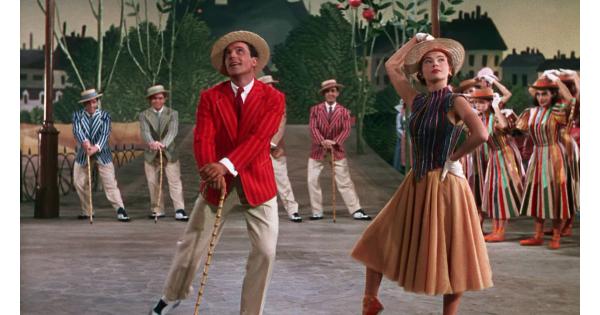
So, I was planning on posting something about David Copperfield (the novel by Charles Dickens) — I’m about two-thirds of the way through — but last night, I happened to watch the 1951 film An American in Paris. And I felt the need to pre-empt my previously scheduled programming.
I’d seen the film at least once before, a very long time ago. If my memory’s not faulty, I saw it on New Orleans’s local PBS station, WYES, tempted into the viewing by a life-long love of Gene Kelly and a burgeoning interest in Gershwin. Granted, life-long was not as significant a qualifier back then as it is now, but I’m happy to report that my appreciation of Gene Kelly has only matured and deepened. Like wine. Or perhaps cheese.
I guess that’s what I want to write about. The maturation process. What’s changed for me in the roughly 30 or more years between viewings. Of course, not about everything that’s changed, no one’s got time for that. I’ll limit it to a few observations about the film itself:
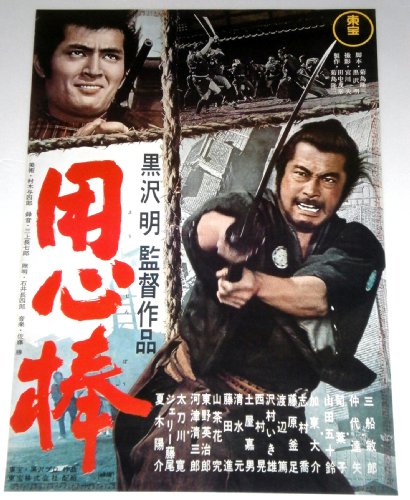
- The music. Gershwin’s music was my biggest takeaway the first time I watched the movie. It’s what cemented it in my mind. Much like how Masaru Sato’s theme from Yojimbo stuck with me in the long years between my first viewing and my more recent renaissance with that film. Last night, I watched the before and after commentary from Brad Bird and Ben Mankiewicz, part of TCM’s The Essentials program. They talked about the iconic ending of the movie, how the ballet sequence was “one of the more perfect dance sequences set to film,” I think one of them said. But they didn’t say anything about Gershwin. I’d take it one step further to include George Gershwin’s music — it’s a pretty phenomenal visualization / realization of the composition itself.
- The story. The first time I saw the movie, I’d never been to Paris. I was roughly the age Leslie Caron was when the film was made. I’d never seen Casablanca. So I didn’t catch the similarity between Lise being sheltered as a teenager by Henri during the war, and Ilsa’s connection with Victor Laszlo. As a matter of fact, I think the whole love triangle was lost on me first time around. Say what you want about love triangles, but Casablanca-variety ones are good for adding a touch of gravitas. And the movie has some great quotes: Gene Kelly as Jerry Mulligan — “Back home everyone said I didn’t have any talent. They might be saying the same thing over here but it sounds better in French.” Also, Leslie Caron as Lise Bouvier — “Paris has ways of making people forget.” Jerry Mulligan in response — “Paris? No. Not this city. It’s too real and too beautiful to ever let you forget anything.”
- The actors. Gene Kelly and Leslie Caron are still as captivating as I remember them being. But I was so charmed this time around by Oscar Levant and Nina Foch. Oscar Levant plays the musician Adam Cook, and the scene where Jerry comes into his room singing “Tra La La La (This Time It’s Really Love)” is a new favorite. And I suppose, years and experience just give me an extra appreciation for everything Nina Foch brought to her role as Milo Roberts, Jerry’s art sponsor.
Everything else about the film — the costumes, the staging, the choreography — were just as enchanting as I remember them being. It’s such a lovely thing to revisit an experience from way back when, and have it not disappoint.

 Anne McClane