An American in Paris

An American in Paris

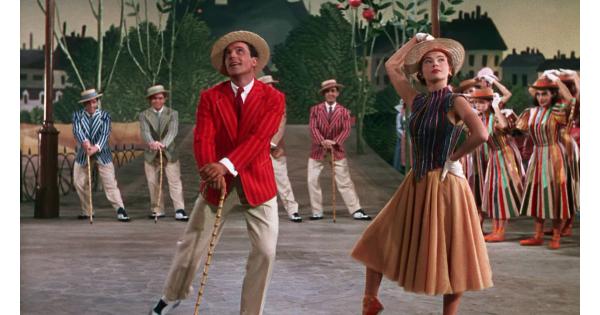
So, I was planning on posting something about David Copperfield (the novel by Charles Dickens) — I’m about two-thirds of the way through — but last night, I happened to watch the 1951 film An American in Paris. And I felt the need to pre-empt my previously scheduled programming.

I’d seen the film at least once before, a very long time ago. If my memory’s not faulty, I saw it on New Orleans’s local PBS station, WYES, tempted into the viewing by a life-long love of Gene Kelly and a burgeoning interest in Gershwin. Granted, life-long was not as significant a qualifier back then as it is now, but I’m happy to report that my appreciation of Gene Kelly has only matured and deepened. Like wine. Or perhaps cheese.

I guess that’s what I want to write about. The maturation process. What’s changed for me in the roughly 30 or more years between viewings. Of course, not about everything that’s changed, no one’s got time for that. I’ll limit it to a few observations about the film itself:

  • The music. Gershwin’s music was my biggest takeaway the first time I watched the movie. It’s what cemented it in my mind. Much like how Masaru Sato’s theme from Yojimbo stuck with me in the long years between my first viewing and my more recent renaissance with that film. Last night, I watched the before and after commentary from Brad Bird and Ben Mankiewicz, part of TCM’s The Essentials program. They talked about the iconic ending of the movie, how the ballet sequence was “one of the more perfect dance sequences set to film,” I think one of them said. But they didn’t say anything about Gershwin. I’d take it one step further to include George Gershwin’s music — it’s a pretty phenomenal visualization / realization of the composition itself.
  • The story. The first time I saw the movie, I’d never been to Paris. I was roughly the age Leslie Caron was when the film was made. I’d never seen Casablanca. So I didn’t catch the similarity between Lise being sheltered as a teenager by Henri during the war, and Ilsa’s connection with Victor Laszlo. As a matter of fact, I think the whole love triangle was lost on me first time around. Say what you want about love triangles, but Casablanca-variety ones are good for adding a touch of gravitas. And the movie has some great quotes: Gene Kelly as Jerry Mulligan — “Back home everyone said I didn’t have any talent. They might be saying the same thing over here but it sounds better in French.” Also, Leslie Caron as Lise Bouvier — “Paris has ways of making people forget.” Jerry Mulligan in response — “Paris? No. Not this city. It’s too real and too beautiful to ever let you forget anything.”
  • The actors. Gene Kelly and Leslie Caron are still as captivating as I remember them being. But I was so charmed this time around by Oscar Levant and Nina Foch. Oscar Levant plays the musician Adam Cook, and the scene where Jerry comes into his room singing “Tra La La La (This Time It’s Really Love)” is a new favorite. And I suppose, years and experience just give me an extra appreciation for everything Nina Foch brought to her role as Milo Roberts, Jerry’s art sponsor.

Everything else about the film — the costumes, the staging, the choreography — were just as enchanting as I remember them being. It’s such a lovely thing to revisit an experience from way back when, and have it not disappoint.

We’ll never have Arnhem?

It’s been a while since I’ve written about movies. They’re one of five categories I use on this blog, (I don’t count “Uncategorized” as a category) and I feel like it’s been somewhat neglected lately. So, time to correct that.

I watched A Bridge Too Far for the first time, just a few nights ago. This WWII movie, directed by Richard Attenborough, came out in 1977. It’s loaded with actors, an “all stars of the 1970s” cast: Sean Connery, Michael Caine, Laurence Olivier, Anthony Hopkins, Robert Redford, James Caan, Elliott Gould, Maximilian Schell. It being a war movie, there didn’t seem to be many roles for women—I think Liv Ullmann is the woman with the most screen time. She plays the owner of a house in the Netherlands where a bunch of wounded Allied soldiers crash.

Two casting choices had me scratching my head a bit—Ryan O’Neal as a baby-faced Brigadier General, and Gene Hackman as a Polish Major General. He spoke with an accent that felt mildly Eastern European.

It’s a looong movie, clocking in at nearly three hours. I fell asleep for a while in the middle of it (my couch is really comfortable). But I caught enough to get the gist of it. I thought the ending was really strong, so I was glad I was awake for that part.

A Bridge Too Far is based on Cornelius Ryan’s book of the same name. (William Goldman did the screenplay. Why does that name sound familiar? Because he also wrote The Princess Bride 🙂) Anyway, A Bridge Too Far tells the story of Operation Market Garden, a failed attempt to break through German defenses in the Netherlands, roughly three months after D-Day. In the Allies’ effort to secure the bridge in the Dutch town of Arnhem, a whole lot goes wrong.

At the end of the movie, British general Urquhart, played by Sean Connery, meets up with his superior, Lt. General Browning (played by Dirk Bogarde). Urquhart tells him how he went in to the mission with 10,000 men, and came out with less than 2,000. Browning tells him how Field Marshal Montgomery, who devised the whole plan, is calling Operation Market Garden “90 percent successful.”

I was pretty stunned by that. And suffice it to say, Montgomery does not come off well at all in A Bridge Too Far. It’s also pretty interesting that Montgomery is not portrayed in the movie (unless he showed up while I was sleeping). For what I saw, his orders are represented through Browning, who was the one to tell Montgomery before the operation, “I think we may be going a bridge too far.”

It all got me thinking about WWII in a different way. My schooling gave me, really, just a cursory knowledge of  WWII, from just the American perspective. I like to think that my understanding has grown over the years, much of it gained through movies. Earlier this year, it was Dunkirk that had me looking at history from different angles.

Dunkirk was in theaters this past summer. It, by contrast, is less than two hours long, and I did not fall asleep. While the details are not as fresh to me as A Bridge Too Far, I came away from Dunkirk thinking about this: all the really bad stuff that was going on in WWII long before the United States ever got involved. (The events depicted in Dunkirk happened in May 1940). And how insurmountable the odds seemed for the Allies. From that point of view and point in time, the eventual Allied victory was far from a “given.”

Casablanca always gets me thinking about that uncertainty, too—especially because it was made and released years before the war ended!

Anyway, I’ve probably yammered on enough about war movies. From the perspective of a writer who’s trying to improve her story telling, I found a lot to be gleaned from A Bridge Too Far, some from Dunkirk, and don’t get me started on Casablanca. That one’s a gold mine.