Am I a Plotser?

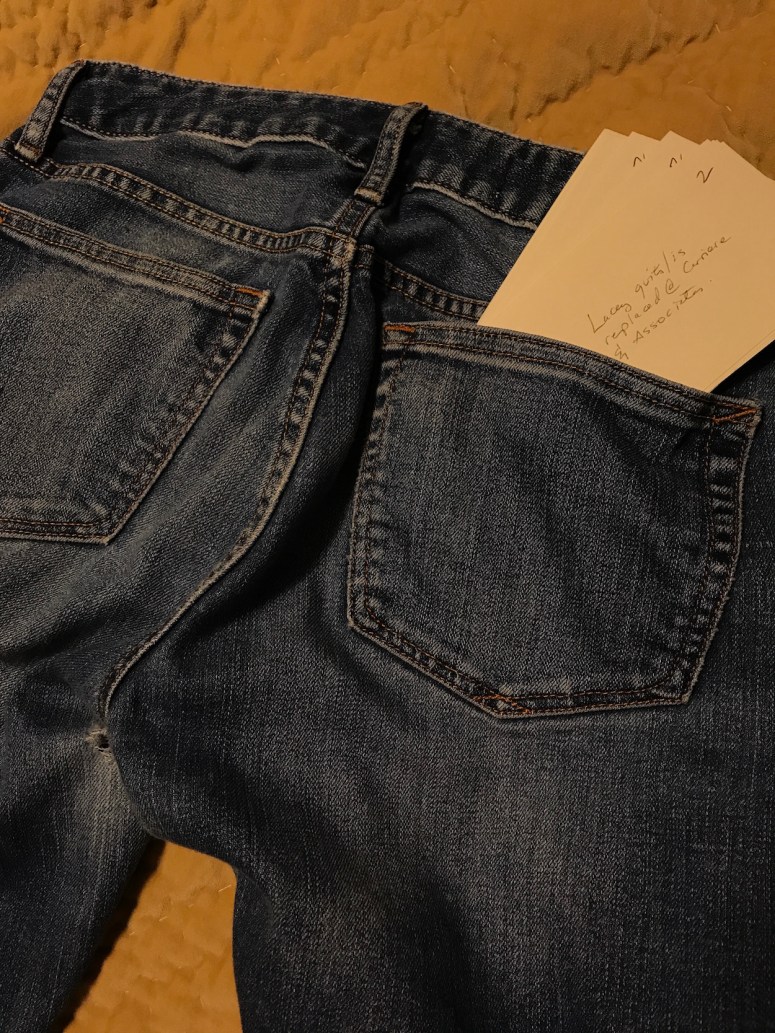
My favorite jeans. I can no longer wear them outside the house, because of a hole in…the seat of the pants.

There are two terms I’ve encountered in fiction-writing circles: plotter and pantser. A “plotter” is just like it sounds: a writer who composes a story by writing an outline first. A plotter gets the elements of the narrative down in some way, shape, or form—be it index cards, a synopsis, or an old-fashioned Roman-numeral type outline.

A “pantser” is a writer who composes by “the seat of their pants.” No outline or sketch, little to no prep work. A pantser just sits down to write and sees what happens.

In an article I found via Google, the novelist Cindi Myers suggests that there might be some shame in admitting you’re a plotter, because being a pantser could be considered more “artistic.” In it, she goes on to list the benefits of plotting. (Though, this article is housed on a site for an online editing tool called AutoCrit, which I assume has a vested interest in converting more writers into plotters.)

Assessing myself as a fiction writer, I’d say I began as a pantser, but have evolved into a plotter. And I still exhibit traits of both in my day-to-day writing life.

I’m definitely a pantser with these blog posts. Their short length is the reason why I can write them without a plan. If I go off on a tangent, I can afford the time spent on that thread. Because it’s typically portions of an hour, not portions of days or weeks (or months). And even if that thread gets cut, I find the time writing it was usually well spent, because those tangents often help clarify my thoughts.

But, with fiction, I can’t afford to be a pantser. I’ve spent some time in this space bemoaning the breaks I’ve taken from writing. (Some self-induced, others not so much.) It took me six years to get The Incident Under the Overpass to a point ready to publish. I want to be more expeditious with subsequent stories.

Part of the reason my first novel took so long was because I spent the first three years without a plan. I can’t say things got easier once I outlined the story, but I can say my approach to the work improved. I like to think my output improved, too.

I’ve started writing the third and final story featuring Lacey Becnel (the heroine of my first novel.) I outlined it a while ago, and I foresee many changes to that original plot. Also, about nine months ago, I started using some writing software. (I purchased Scrivener—I was sold by numerous testimonials from writers claiming how expeditious it made them).

The point I’m trying to get to is this: in a pantser-ish move, I began to compose the opening to the story before importing/updating that old outline into the program. I was a little surprised to find out that what I wrote hewed pretty close to the outline. So what originally felt like a little pantser rebellion was in truth a loyal plotter move.

Short stories get the same plotter treatment. It’s been about a year since I’ve written one—way longer than I’d like it to be—but I blame Lacey for that. Anyway, it might just be three sentences at the top of a document, outlining the short story arc, but I find it helps tremendously in getting me to the finish line.

Slow and steady, wasn’t it the plodding (plotting?) tortoise who won the race?
Solstice and Solnit

Sunrise / Moonset in San Luis Obispo. Around the time of summer’s end, last year.

Last night at 11:24 pm (Central Time), summer began. It feels a bit ironic that the point when we mark the most daylight in the Northern Hemisphere—the most we’re going to get in 2017—happens in the middle of the night here. I think this has something to do with New Orleans being five hours behind the prime meridian, but I could be wrong.

I wrote a few weeks ago about looking forward to the solstice. I’ve always been a summer person. Maybe the thing I like most about the summer is the sunlight. When things feel uncertain—and so much about everything feels uncertain right now—I’m grateful that abundant daylight can illuminate the shadows.

To mention a few geographically-specific uncertainties: there’s a tropical storm (named Cindy) currently headed for our coast. And one of southern Louisiana’s Congressmen lies in serious condition in a hospital in Washington, DC, after a horrific shooting. These are some bleak shadows. While I don’t need to hope that the sun will come out after this storm (because barring something catastrophic, it will); I am hoping that abundant light and goodwill will help Congressman Scalise to a rapid recovery.

There’s another thing I like about summer. It may be a holdover from my school days, but I still appreciate the freedom summer affords. To learn outside of textbooks or prescribed courses. I write this even though I’ve been out of school a really long time—by now, I’ve been out of school longer than I was ever in school. But I have a mighty long memory.

Speaking of learning and shining a light, an essay from the writer Rebecca Solnit popped up in my social media feeds last week. There’s a specific reason I hold Rebecca Solnit in high regard, but I’ll get to that in a bit. The piece that was making the rounds was a very eloquent essay on our President. Here’s a link to it, but fair warning: if you are pro-this-particular-President, it is not a complimentary assessment.

One of the reasons why I know of Rebecca Solnit: she co-wrote a book titled Unfathomable City: A New Orleans Atlas. I don’t own this book, but I have given it as a gift. But here’s the real source of my admiration: she wrote an essay last fall that I keep (permanently) on my phone’s browser. It’s called: “How to be a Writer: 10 Tips from Rebecca Solnit.

I refer to it whenever I need to shine a light on my writing habits. Or just need a little encouragement. Every bit of advice in it is thoughtful, useful, and truthful. I’m hard-pressed to excerpt a “favorite,” but No. 9 feels particularly salient for a little-known writer with earnest intentions (guess who?)

What we call success is very nice and comes with useful byproducts, but success is not love, or at least it is at best the result of love of the work and not of you, so don’t confuse the two. Cultivating love for others and maybe receiving some for yourself is another job and an important one. The process of making art is the process of becoming a person with agency, with independent thought, a producer of meaning rather than a consumer of meanings that may be at odds with your soul, your destiny, your humanity, so there’s another kind of success in becoming conscious that matters and that is up to you and nobody else and within your reach.”

Illuminating words, indeed.

Writing Prompts

The very talented Tom put this together.

I’ve been part of a writing group—a writing workshop, I dare to say—since 2013. I count my years-long participation in this group as one of my bona fides as a writer. “Of course I’m a real writer. I meet with other writers regularly in a bar!” You can’t get more legitimate than that.

The group is run by Stephen Rea, author of Finn McCool’s Football Club: The Birth, Death and Resurrection of a Pub Soccer Team in the City of the Dead. (Thank you, Stephen, for helping me meet my word count goal for this post). Stephen runs several different courses of fiction-writing classes at a lovely bar in New Orleans called Treo. If you’re interested, you can find out more about the classes on Facebook here.

The most recent 10-week session for our particular group will conclude tonight. It’s a little bittersweet, because we stumbled upon a bit of alchemy in this last course. We agreed to do a group project, collaborating on two short stories based on a prompt. The prompts were configured as such:

  • Man lying on the ground, woman tapping on both shoulders
  • Woman lying on the ground, man tapping on both shoulders

Everyone committed to writing 1,500 words. Names were drawn each week to determine who would work on which story. I drew the final chapter for the second story—Woman lying on the ground…

The first prompt became “The Fallen Man,” a tale of a woman named Carol escaping men in hazmat suits while trying to protect a young boy named Matt. There’s also the threat of biochemical warfare, an explosion, possible brainwashing, and Atomic Burger.

The second prompt became “Bai Polar,” the story of a woman named Bai Cavallo, who’s either from another planet entirely, or in the midst of a psychotic break. There’s also Glossolalia, cookies and milk, ectrodactyly, and plenty of references to an alien star system.

Brain injury figures into both stories.

There was a fair amount of friendly rivalry as the stories progressed. One group dubbed themselves “Team Awesome,” leaving the other group to dub themselves “Team Awesome-er.” Since I drew the last chapter, several weeks passed before I knew which team I’d wind up on. (It was “Team Awesome-er.”)

I wrote the conclusion to “Bai Polar” on the plane ride back from Europe, and had more fun doing it than I remotely suspected. I got to draw together all the threads sewn by five different writers, and it was a really awesome(er) challenge.

Writing is such a singular occupation, nearly all of the time. I loved this opportunity to be part of team, rallying behind a character and story that we composed together. If this experience is anything like what it is to be part of a “writers’ room” on a television series, then that is an enviable occupation, indeed.

Finished, But Not Abandoned

The Tremors on the PCH?

So, this post is going to be chock full of news (and quotes):

First, I finished Lacey’s second story! When I completed the (then-final) draft of Lacey’s first story, The Incident Under the Overpass, I posted something in these pages attributed to Leonardo da Vinci: “Art is never finished, only abandoned.”

The second story is by no means ready to be abandoned yet. It is definitely a first draft, not-yet-ready-for-prime-time. Something I read years ago, in Anne Lamott’s Bird by Bird: Some Instructions on Writing and Life, has stuck with me:

“You need to start somewhere. Start by getting something—anything—down on paper. A friend of mine says that the first draft is the down draft—you just get it down. The second draft is the up draft—you fix it up.”

Here’s another quote: “You can always edit a bad page. You can’t edit a blank page.” It appears that’s attributed to Jodi Picoult, though Goodreads attributes “You can’t edit a blank page” to Nora Roberts. Either way, in the latest story I wrote, all the characters and the elements of the plot are down. Some might go away, some might get added, but the bones, and a good bit of the musculature, are there. I’m just ecstatic I now have a complete story to revise.

Second, I signed a publishing contract for The Incident Under the Overpass! I signed with After Glows Publishing, a press “that offers page turning romances and urban fantasies that allow readers the escape from real life.” I’m very excited that Lacey will soon be appearing on After Glows’ bookshelf.

So, it turns out, I didn’t abandon Lacey’s first story after all: it will get re-edited, re-designed, and re-released later this year.

And finally, this is my last post from the U.S. for a couple of weeks! I’ll be in Germany for work next week, and then returning home from France the week after that. This upcoming travel was the main reason I was so determined to finish the second story. I knew I wouldn’t be able to devote any real time to it over the first two weeks of May. And I had a good bit of momentum going that would have been lost during that break.

Hopefully, the break will work out for the best, and I’ll be ready to jump into revisions when I get back.

Auf wiedersehen, (and au revoir), for now.

#AmWriting

I see this hashtag, #AmWriting, almost daily on one social media platform or another. And without fail, it makes me feel guilty. “Oh, lucky Tweeter in the U.K., there you are, #AmWriting. Or, Facebooker in Indiana, there you are, at it, too.” That’s what I should be doing. Writing. AMWriting. Anne McClane, Writing.

There’s an inherent paradox, there. When I’m looking at social media, I’m most decidedly #NOTwriting.

But…I can say, for the past three weeks, I have been doing a lot more writing. #Writing. Whatever you want to call it, I’ve been getting back into the swing of it.

Speaking of swing, I recently saw a post, I think it was on Facebook, where a writer compared the act of writing to chopping firewood. No one wants to do it, this writer claimed, but if you want to stave off the cold and keep the house warm, you better get to it. Or something like that. I’ve always lived in temperate climates, so the analogy was a little lost on me.

What resonated with me is that writing, most of the time, is a chore. Iterations and iterations. The horror of suffering through brain dumps, raw outputs, to try to sift through to the gold that may or may not be there.

But three positive things (one for each week?) have occurred to me as I’ve gotten back into the habit of writing.

The first: I’ve missed Lacey! (She’s the protagonist in the series of stories I’m in the midst of). You spend too much time with someone, you’re invariably gonna get a little sick of them. But the break I had in writing The Tremors on the PCH, unintentional as it was, must have made my writing heart grow fonder. It’s a nice thing to realize.

The second: I’d really like to do whatever is within my power to keep an unintentional break from EVER happening again. The next break I take from writing, I want it to be of a limited duration, and according to my own plan, my own schedule. And not because I got wrapped around the axle of my own insecurities and anxieties about publishing and promoting. Or caught up in the struggle to balance the demands of my wage-earner job.

And finally: there’s the magic. Speaking of wage-earning, for years, I’ve bemoaned “magic-less” days as a corporate cog in a giant promotional machine. (I’ve worked in marketing for large to mid-size companies for most of my 20+ year career). Not every day is a slog, but there are always those inevitable moments where you feel the life being sucked out of you. Like Count Rugen’s machine from The Princess Bride.

While I can’t go so far as to say that writing puts all that life back; for me, it’s a way to insert the supernatural, the unexpected, the magical, into my day. Another reason I’d be foolish to let the unintentional come between me and #writing again.