The American Crisis

unsplash_eagle

My 2016 “Mindful Living” calendar tells me today is the International Day for Tolerance. Yep, November 16, 2016. I’m good with that.

I could afford a little tolerance for myself. Because I’ve been kicking same self over my naiveté. For most of this year, I’ve been looking forward to this election just being over. For all the acrimony, discord and vitriol to dissipate. To return to the more temperate level of anxiety most of us modern citizens are accustomed to.

Yeah, so much for that. The discord continues; now instead of it being concentrated between two individuals, it’s steeping to the far corners of our Republic.

The morning after the election, I awoke with a phrase in my head: These are the times that try men’s souls. After a quick search for the source, I’ve developed a new appreciation for the revolutionary Thomas Paine.

My memory of Thomas Paine from school days consists of five words, in no particular order: Common Sense, pamphlets, American Revolution. If I thought a little harder about it, I could probably come up with “he was the guy who wrote stuff that inspired the revolutionaries back in 1776.” I always got stuck on the word “pamphlets,” though. My experience with pamphlets up to that point in my schooling was limited to “Here are some new books from Scholastic.” Or, in more somber moments, “What is Spina Bifida?”

Yet, in my middle age days, here is that phrase: These are the times that try men’s souls. It’s the opening to Paine’s series of articles collected under the title The American Crisis. Apparently, George Washington was so inspired by the first essay, he ordered it read to the troops at Valley Forge.

Here’s an excerpt I found particularly salient:

‘Tis surprising to see how rapidly a panic will sometimes run through a country. All nations and ages have been subject to them. Britain has trembled like an ague at the report of a French fleet of flat-bottomed boats; and in the fourteenth [fifteenth] century the whole English army, after ravaging the kingdom of France, was driven back like men petrified with fear; and this brave exploit was performed by a few broken forces collected and headed by a woman, Joan of Arc….

Yet panics, in some cases, have their uses; they produce as much good as hurt. Their duration is always short; the mind soon grows through them, and acquires a firmer habit than before. But their peculiar advantage is, that they are the touchstones of sincerity and hypocrisy, and bring things and men to light, which might otherwise have lain forever undiscovered. In fact, they have the same effect on secret traitors, which an imaginary apparition would have upon a private murderer. They sift out the hidden thoughts of man, and hold them up in public to the world. Many a disguised Tory has lately shown his head, that shall penitentially solemnize with curses the day on which Howe arrived upon the Delaware.

I had to look up ague (it’s a fever or shivering fit); and I left out something about a Jersey maid, because it seemed to me like Paine was looking for a New Jersey version of Joan of Arc. And I don’t have it in me to delve deeper into that concept.

But I really like what Paine wrote about the mind “acquiring a firmer habit.” And “panics bringing things to light.” Because I do feel like all the warts, all the ague-inducing maladies of our 200+ year-old American Experiment have been laid bare. I hope once we pick ourselves up, and clothe our naked self, the collective mind of our Republic will be a little clearer, a little sharper.

Thomas Paine’s ability to craft words that have inspired through the centuries was enviable. But I don’t envy his life. It seemed he just couldn’t get enough of Revolution, went to France and became deeply involved in their revolution. He wound up getting in trouble (seditious libel, that kind of stuff) and was imprisoned in Paris. James Monroe, who would later become our fifth PotUS, used some connections to get him released. Paine returned to America, where I think he continued to piss people off. The Internet tells me only six people attended his funeral.

My plan in these times is to continue to write. Any maybe one day inspire someone, maybe even more than one someone, to their own positive revolution. Be it personal or otherwise. And, hopefully, have more than six people show up for my funeral.
Six Days in Las Vegas

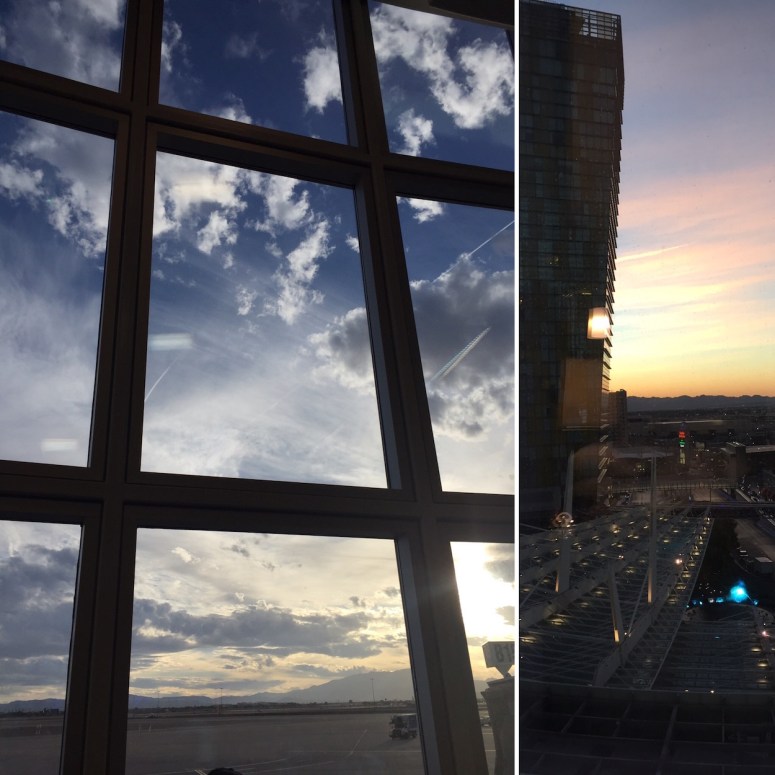
They have some nice skies in Las Vegas

I’m thinking this will be a pretty short post. I just returned to New Orleans late Monday night, after spending most of the prior week at the Las Vegas Convention Center. Another trade show. I had lofty thoughts of writing something about impermanence—the fleeting nature of both Las Vegas and trade shows—but I’m too tired for that now.

The trade show began on a Saturday. As I dressed myself in the designated team clothing early Saturday, one thought prevailed: I’m getting too old for this shit. I’m too permanent for this impermanence.

The stark contrast with the prior Saturday didn’t help my state of mind. Just one week before, I had finished my swim before 8am and spent the rest of the day on the beach.

If you’ve ever been to Las Vegas, you will know that six days is a long, long, time to spend there. Especially when you’re spending all your time between the Strip and one of the convention centers. When I lived in Los Angeles, I visited Las Vegas many times, for both work and fun. I learned then that three days was about the max I could handle.

Combined with working through the weekend, it’s fair to say I left there beyond weary. I am only just now beginning to feel my old chipper self resurface. Which is good, because I’m going to need my chipper self. The weeks ahead are filled with a big company event and another trade show.

Whenever things get as busy as they are right now, I always think of the saying “Life is what happens when you’re busy making other plans.” I worry about what I’m neglecting, or what I’m missing, while I’m consumed with making a living. Writing has been pushed out to the margins of my life right now, and that makes me uneasy.

The other persistent thought is this: I know there’s some lesson in this busy-ness. But I’m too harried to perceive what it might be. I think I have to wait for this impermanent busy-ness to pass.

Here’s the good news: with work and stuff, I missed the last presidential debate. From what I hear and read, I’m pretty happy about that. The bad news is: work doesn’t really let up until right after the election.

Wait, maybe that’s good news, too.

Setting

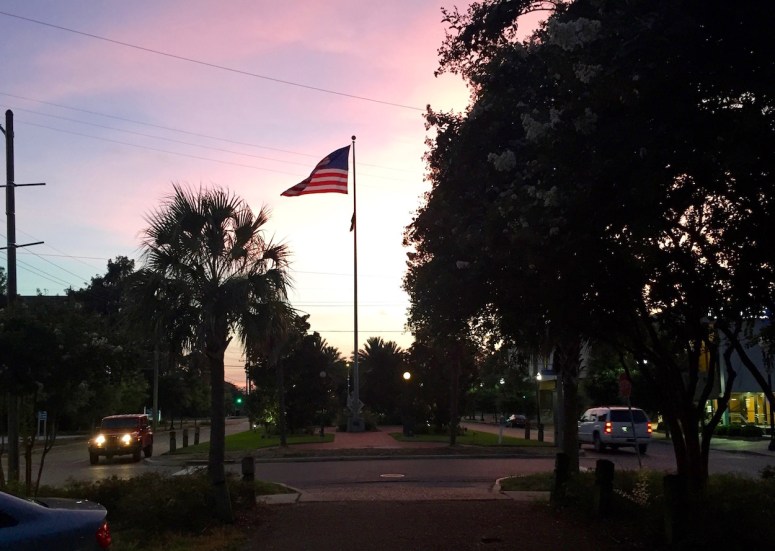
The neutral ground on Harrison Avenue. Some pivotal moments in the story happen on this street.

They say, “Write what you know.” I’m not quite sure who they are, but that saying seems to be one of those maxims everyone’s heard of.

But what does that mean when it comes to fiction? Especially science fiction, fantasy, or paranormal fiction? Because I’ve never known anyone who’s manifested a supernatural ability. Or, if I do know someone with that type of ability, they’ve kept it hidden from me.

In a lot of ways, this is what I’m aiming for in The Incident Under the Overpass: what would it be like if someone I knew, or someone I could relate to, suddenly discovered they had supernatural powers? The whole magical realism thing.

It made the process of scribing this story more about writing what I might know. So grounding the story in the very real setting of New Orleans just seemed to make sense. It’s where I was born, it’s where I’ve lived for the past thirteen years, and it’s what I know. Since only my imagination knows the characters and the plot, there’s the setting to provide a certain “real” palette.

Some places in the book are real, physical, locations with their real, proper, names. Redd’s Uptilly Tavern, for example. There are two scenes set in this bar, and it’s a place Husband Tim and I know well.

Other places are stand-ins for real life locations. And others are a mixture of both. Like Lacey’s home—the exterior is a house in my neighborhood that I pass often while running. But I don’t know the occupants, and I’ve never been inside, so the interior is purely imagined.

Speaking of running, the overpass that inspired the title (and the opening chapter) continues to intrigue me. Every time I run underneath it, I contemplate those picnic tables that sit unoccupied and in shadow for most of their existence. Coming to life during those rare Brigadoon weekends when someone hosts a family reunion or a barbecue or a crawfish boil.

Crawfish boils. Something unique to this region, like the term “neutral ground.” Everyone from around these parts knows what a neutral ground is. But what about all those far-away readers that I’m hoping to reach? That’s why I’m really glad my Fabulous Editor Shelley is not from New Orleans. I used the term neutral ground in the manuscript, and got a very earnest note back stating that she didn’t know what it meant, and Google searches were unhelpful, and was it a sidewalk?

So I was challenged to come up with an artful way to explain within the story that a neutral ground is the same thing as a street median, the strip dividing the roadway. The etymology has something to do with divisions between the French and Spanish settlers of the city a long time ago, I think, but I didn’t go into that. Suffice it to say that the term takes on utmost importance during Mardi Gras, to know which side of the street to look for your parade-float-riding friends.

And, as an aside to far-away readers who may be interested in this novel and won’t be able to attend the August 27 Book Launch Party (at Redd’s, of course), it is available for pre-order on Amazon . . . 🙂

One parting thought: as I still struggle with bouts of anxiety over this whole book launch, a comforting thought has occurred to me. Maybe I’m taking this whole thing too seriously. (‘Ya think?) In a sense, this is a very serious deal to me—I’ve invested a lot into this story (time, money, sweat equity), and I’ve got a true yearning to write full-time. But in the end, I’ve produced something meant as entertainment, a diversion from reality. Maybe, keeping that end in mind, I should just lighten up a bit.