Quarter Report

anne_mcclane-oct5

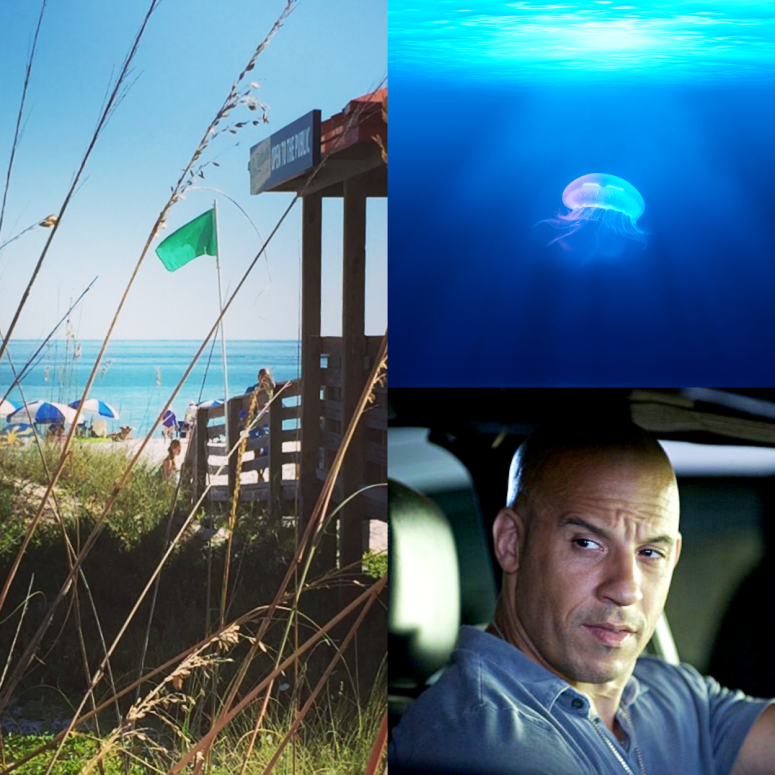
I’ve written before about how I admire The Fast and the Furious’ Dom Toretto, and his ability to live his life a quarter mile at a time. And so we come to the last quarter of 2016, a year in which, by my account, it’s been easier to focus on each day, or quarter mile, as it comes. Because expectations any further out are likely to be blown out the water.

Water is a theme, here. In that Vin Diesel-y post from April, I wrote how I awoke at the stroke of midnight on April 1, 2016, the dawn of the second quarter. Oddly enough, the same thing happened on October 1, 2016, the dawn of the fourth quarter. While it seemed noteworthy that my phone read 12:00 on the nose the first time I awoke, it was not so unusual that I woke up several more times that night. Because I had pre-race jitters. I was due in the Gulf of Mexico in a few hours, as part of a triathlon relay team.

As much as I would love to write that the swim ahead of me was a quarter mile, 600 yards is actually closer to a third of a mile. Sure, I could take some literary license, but I tend to agonize over details, and it doesn’t feel right to fudge this one.

It was not my first time doing this race, the Santa Rosa Island Triathlon in Pensacola. I had done it once before, with the same team, four years ago. Or sixteen quarters ago.

I was excited—open water swims are a pretty big deal to me. I swim frequently, but not in open water. The stakes and the risks are too high. It’s a little like trick-or-treating.

Let me explain. As a kid, I wouldn’t go around on some random night soliciting candy. That’s almost asking for a trick. Instead, the activity is saved for a special occasion—Halloween—when everyone else is dressed up funny, hitting the streets, and begging for treats. Stakes lessened, risks mitigated.

Same for open water races. Everyone else is dressed funny, hitting the water, scaring away the man-eating sea creatures. And there are plenty of folks on jet skis and paddleboards to watch over you, and come to your rescue if needed.

All signs pointed to my swim being trick-free the day before the race. The water was clear and calm, and the flags were green. But then this happened the morning of the race, as I walked to the start:

A race volunteer, standing at the water’s edge, told me there were a lot of “moon jellyfish” in the water.

“What’s a moon jellyfish?” I asked.

“Really big, round, jellyfish. But they have short tentacles, so you should be fine,” he answered.

Great… I thought. Hope I’m not allergic to jellyfish stings.

Turns out, I’m not. I’m pretty sure I avoided the big ones, but I did finish the swim feeling itchy from the trillions of other tiny living things in the water.

So that’s the trick part. But there’s a treat, too. The best way for me to describe it is with a movie quote. At the end of The Hunt for Red October, Sean Connery’s Captain Marko Ramius quotes a poem:

And the sea will grant each man new hope, as sleep brings dreams of home.

(A side note—Captain Ramius credits Christopher Columbus with the quote. But that’s a fiction—the Internet tells me the screenwriter, Larry Ferguson, wrote it for the movie). Anyway, whoever came up with it, it’s memorable and rings true. Because I come away with a sense of renewal every time I emerge from the surf; snotty and salty and covered with microscopic primordial creatures.

Renewal ain’t always pretty.

That feeling is the reason why I’ll do another open water race, hopefully sooner rather than later. I may attempt to live my life a quarter mile (or third mile, or even a full mile) at a time. But some quarter miles are more meaningful, more engaging, than others. Those are the ones I’m seeking.

P.S. – my time improved from the last time I did this race, and my team members crushed their ride and run, respectively. We placed 3rd in Coed teams! And yes, there were more than three Coed teams. 🙂

Another year on: Twenty years’ prescience

What follows is a very early posting on this blog, from one year ago:

I am a New Orleans native, and a New Orleans-based writer. I had been back here (from Los Angeles) just shy of two years when Katrina hit ten years ago. I wasn’t writing much, back then.

It feels a bit obligatory to do a Katrina post marking the tenth anniversary. And as my second post ever. But if I had started this blog back in June, then maybe this would have been the tenth post. The truth of the matter is, I stumbled across what I’m about to share in April. Sharing it now (as opposed to then) feels more timely.

My dad died fifteen years ago, in October of 2000. Five years before Katrina. Mom just died, nine months ago. My siblings and I have been going through their house in Metairie. Back in April, my sister Julie and I spent a long weekend going through the office (a former bedroom converted into an office).

Dad, circa 1950
Dad, circa 1950

This one filing cabinet in that room had reams of my father’s stuff still in it. Drafts of the book he wrote about his advocacy efforts on behalf of my brother Stephen, who has autism. Articles and references of his military service. Pre-World War 1 flight logs belonging to my grandfather. And this: a letter he wrote after finishing a tour of duty with the New Orleans Office of Emergency Management. My dad was, among many other things, a Colonel in the Louisiana National Guard.

We found this letter in a folder with a hand-written label, “1987 Hurricane Exercise.” I suspect he saved it, thinking that a Katrina-like storm was an eventuality, not a remote possibility. I remember Mom saying, in the fall of 2005, that she was glad Dad was spared being witness to it all.

So, here’s the letter. (Thank you, niece Cece, for making it digital.) The bold formatting is my doing, in case you want to skim through to the really salient bits.

May 4, 1987

CAO | Room 9E01, City Hall | New Orleans, Louisiana 70112

Dear              :

My tour of duty as an Army Reserve Individual Mobilization Augmentee to the city’s Office of Emergency Management ended on April 19. On that day, I was transferred to the Retired Reserve.

However, I cannot leave my assignment in good conscience without sharing with you some of my thoughts and recommendations. These are generally based on my observations during the past three years and specifically on the recently completed hurricane exercise.

  1. Our citizens are woefully unprepared for the devastation of a major disaster. We can greatly assist them by coordinating a city sponsored education program to teach them to make personal preparation and/or evacuation plans. This could be done with minimal expense using city prepared public service announcements, interviews, news releases, appearances on radio and television talk shows, providing speakers at civic club meetings (Rotary Club, Chamber of Commerce, etc.), neighborhood organizations, and schools. The potential is limitless for educating the public and personal preparedness is the key to survival in an emergency. We can do much in this area.
  2. I was shocked to learn that not all the Sewerage and Water Board’s pumping stations have 100% independent back up electrical power. I urge the city to use whatever persuasion it has over the agency to encourage S & WB to include failsafe back up power for all its facilities in its capital budget as soon as possible.
  3. During these past three years, I have observed both examples of outstanding cooperation and appalling disinterest on the part of city agencies during actual emergencies and exercises. The lack of full participation by the New Orleans Police Department during the recent exercise is symptomatic of what I perceive as a longstanding attitude of that organization.

It is my opinion that the Police Department wants to “do its own thing.” However, it is the responsibility of OEM to coordinate the activities of the many and varied municipal and non-city organizations during an emergency, including the Police Department. Any organization acting on its own is a waste of resources and counterproductive. The Police Department is a major player in any emergency; it is imperative that they join the city’s team.

  1. The recent exercise demonstrated how vulnerable the city is if we rely solely on telephone communication. A state of the art radio communication center with the capability to network with all city, state, and nine parishes is essential.
  1. The Office of Emergency Management is woefully understaffed. To function at an acceptable level, at least two additional staff members are needed – a communications specialist and a planner. I have pointed out the need for communication equipment in the preceding paragraph. The same need applies to personnel.

A planner is essential to write, revise, review, update, and coordinate the emergency plans of all city agencies and other, as well as the integration of plans within the nine parish area.

I want to thank you and the city for the opportunity to have been of service in Emergency Management. As a native of the city, I consider it a privilege to have helped in some small way. Emergency Management has made progress and I am proud to have been a part of it.

Respectfully yours,

Signature

Gerard J. Mialaret

It was very much like my father, to not go quietly into retirement and remain silent. And to be the gadfly in this manner, via a letter. And save it in a folder to be unearthed during the archaeological digs his children would conduct once he was gone.

He received a reply within a week, from the City’s Chief Administrative Officer. It was short, a few paragraphs. This one paragraph captures the gist of it:

“I appreciate you sharing your concerns with me. I have shared your communication with many other individuals in City Hall and have requested their careful review of the matters that you have called to our attention.”

History bears out that their “careful review,” and whatever action it spurred, was inadequate. And Dad picked his battles. If he didn’t have other, bigger items on his agenda, he might not have let this rest with one letter.

But the lesson I take from this, really the way of being I learned from my father, is don’t be silent. Especially when you can see the potential harm in doing nothing. The world needs gadflies.

Setting

The neutral ground on Harrison Avenue. Some pivotal moments in the story happen on this street.

They say, “Write what you know.” I’m not quite sure who they are, but that saying seems to be one of those maxims everyone’s heard of.

But what does that mean when it comes to fiction? Especially science fiction, fantasy, or paranormal fiction? Because I’ve never known anyone who’s manifested a supernatural ability. Or, if I do know someone with that type of ability, they’ve kept it hidden from me.

In a lot of ways, this is what I’m aiming for in The Incident Under the Overpass: what would it be like if someone I knew, or someone I could relate to, suddenly discovered they had supernatural powers? The whole magical realism thing.

It made the process of scribing this story more about writing what I might know. So grounding the story in the very real setting of New Orleans just seemed to make sense. It’s where I was born, it’s where I’ve lived for the past thirteen years, and it’s what I know. Since only my imagination knows the characters and the plot, there’s the setting to provide a certain “real” palette.

Some places in the book are real, physical, locations with their real, proper, names. Redd’s Uptilly Tavern, for example. There are two scenes set in this bar, and it’s a place Husband Tim and I know well.

Other places are stand-ins for real life locations. And others are a mixture of both. Like Lacey’s home—the exterior is a house in my neighborhood that I pass often while running. But I don’t know the occupants, and I’ve never been inside, so the interior is purely imagined.

Speaking of running, the overpass that inspired the title (and the opening chapter) continues to intrigue me. Every time I run underneath it, I contemplate those picnic tables that sit unoccupied and in shadow for most of their existence. Coming to life during those rare Brigadoon weekends when someone hosts a family reunion or a barbecue or a crawfish boil.

Crawfish boils. Something unique to this region, like the term “neutral ground.” Everyone from around these parts knows what a neutral ground is. But what about all those far-away readers that I’m hoping to reach? That’s why I’m really glad my Fabulous Editor Shelley is not from New Orleans. I used the term neutral ground in the manuscript, and got a very earnest note back stating that she didn’t know what it meant, and Google searches were unhelpful, and was it a sidewalk?

So I was challenged to come up with an artful way to explain within the story that a neutral ground is the same thing as a street median, the strip dividing the roadway. The etymology has something to do with divisions between the French and Spanish settlers of the city a long time ago, I think, but I didn’t go into that. Suffice it to say that the term takes on utmost importance during Mardi Gras, to know which side of the street to look for your parade-float-riding friends.

And, as an aside to far-away readers who may be interested in this novel and won’t be able to attend the August 27 Book Launch Party (at Redd’s, of course), it is available for pre-order on Amazon . . . 🙂

One parting thought: as I still struggle with bouts of anxiety over this whole book launch, a comforting thought has occurred to me. Maybe I’m taking this whole thing too seriously. (‘Ya think?) In a sense, this is a very serious deal to me—I’ve invested a lot into this story (time, money, sweat equity), and I’ve got a true yearning to write full-time. But in the end, I’ve produced something meant as entertainment, a diversion from reality. Maybe, keeping that end in mind, I should just lighten up a bit.