Anne McClane is a New Orleans native who spent sixteen years out west before finding her way home to embrace the mysteries of the Mississippi River Delta. She has many years experience in publicity, public relations, and marketing, which has provided a fine primer for writing about the speculative, abnormal, and outrageous.
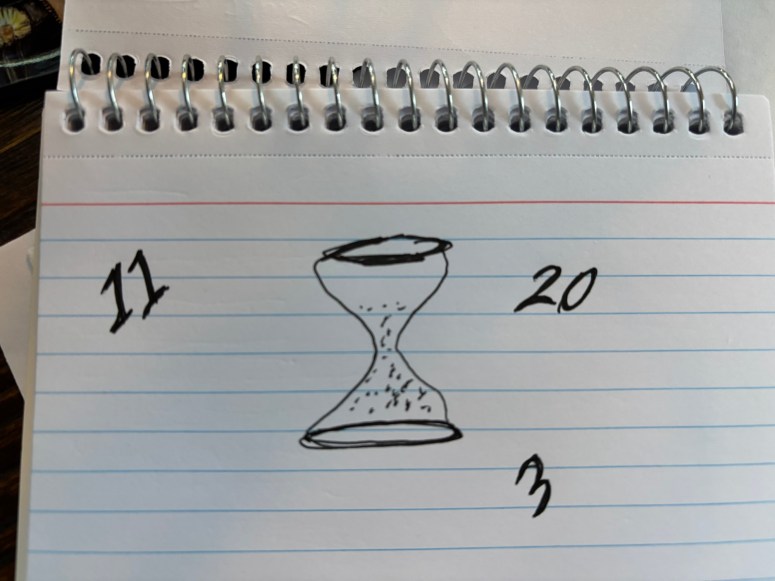
My version of an hourglass sorta looks like 2 colliding black holes.
Recently looked up bullet journaling, because a character I created for the short story listed below uses one. And because my last week of January was used up composing said short story, I’m posting a pseudo-bullet-journal entry here.
Read The Road by Cormac McCarthy. Asked Google how many times the word “gray” was used in the novel. Google’s AI-assisted answer: a lot.
Entered the NYC Midnight short story challenge. My assigned genre was political satire.
Learned the language spoken in Greenland is Kalaallisut.
Clocked 11 hours on my manuscript in January, first time I’ve reached that milestone in many years.
I’ve only recently started keeping track, for accountability, so I can’t actually pinpoint the last time I’ve dedicated that much time to writing.
Tim and I celebrated 20 years of marriage this month.
Also celebrated a 3-year streak on my version of Morning Pages this month.
Writing-wise, I’m feeling pretty good with how this year has begun. See you later!
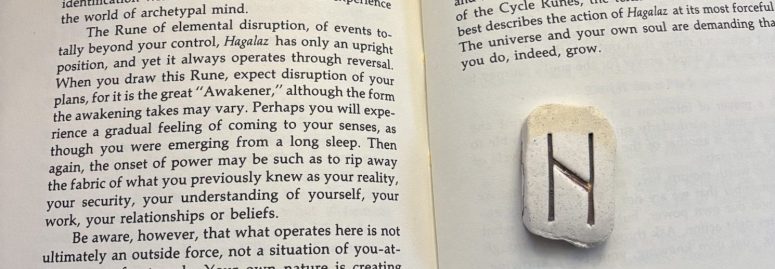
January 1, 2025, began with Hagalaz. It’s a rune that indicates hail, or “disruptive natural forces.” As a way to cope with the anxiety this induced, I got the idea to log the disruptions I witnessed over the 52 weeks of this past year.
What I wound up with is a rabble close to 2,600 words, too long to post here, as well as too encoded in my personal lingua to offer up untranslated.
Instead, herewith a few disruptions / observations grouped around writing, reading, and my life in general.
Got re-engaged with a dusty manuscript. It’s not so dusty anymore.
Participated in my first NYC Midnight writing challenge. A scary story in 400 words or less.
Made a great connection through A Writing Room, and also attended some of their really good workshops.
Found out I’m a Class Member of the lawsuit against Anthropic, claiming they infringed protected copyrights. Via my first novel, The Incident Under the Overpass.
Reading:
Read Brave New World for the first time. Trying not to regret that I didn’t read it earlier in my life, instead I’m just grateful that I have this reference for the rest of my life. (I posted on Substack about it).
LOVED Amalie Howard’s Taming of the Dukesseries. Devoured these and loved every regency-saucy bit. Ending the year and starting the new one with her earlier work, The Beast of Beswick.
Rounding out my favorite reads of the year: Orbital (Samantha Harvey), Lincoln in the Bardo by George Saunders (highly recommend the audiobook with its 166-person cast!), and The Day of the Jackal (Frederick Forsyth)
Other notables: Aflame (Pico Iyer), The Beauty in Breaking (Michele Harper), All the Colors of the Dark (Chris Whitaker), The Perishing (Natasha Deón), Tropic of Cancer (Henry Miller), Plum Island (Nelson DeMille), India Holton’s “Love’s Academic” series, The Hunt for Red October (Tom Clancy), Lord of the Flies (William Golding)
And last but not least, titles in the public domain: Shakespeare’s King Lear and As You Like It, Home to Harlem by Claude McKay, St. Francis of Assisi (G.K. Chesterton), Bartleby, the Scrivener (Herman Melville), Mansfield Park (Jane Austen)
Life in General
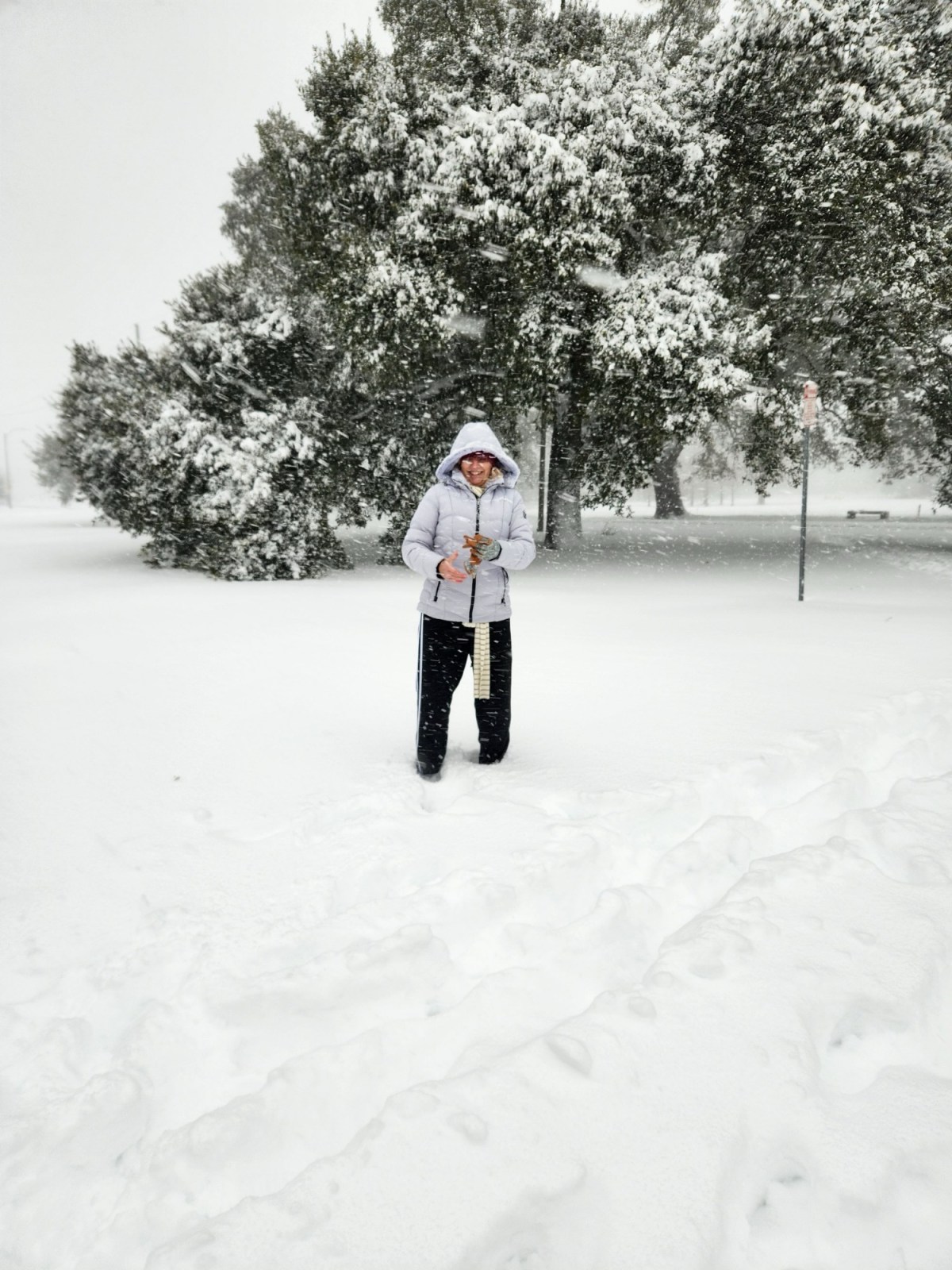
Witnessed a once-in-a-century snowstorm in New Orleans at the start of the year.
Made remarkable trips to Paris, Chicago, Bermuda, New Mexico, and Amsterdam.
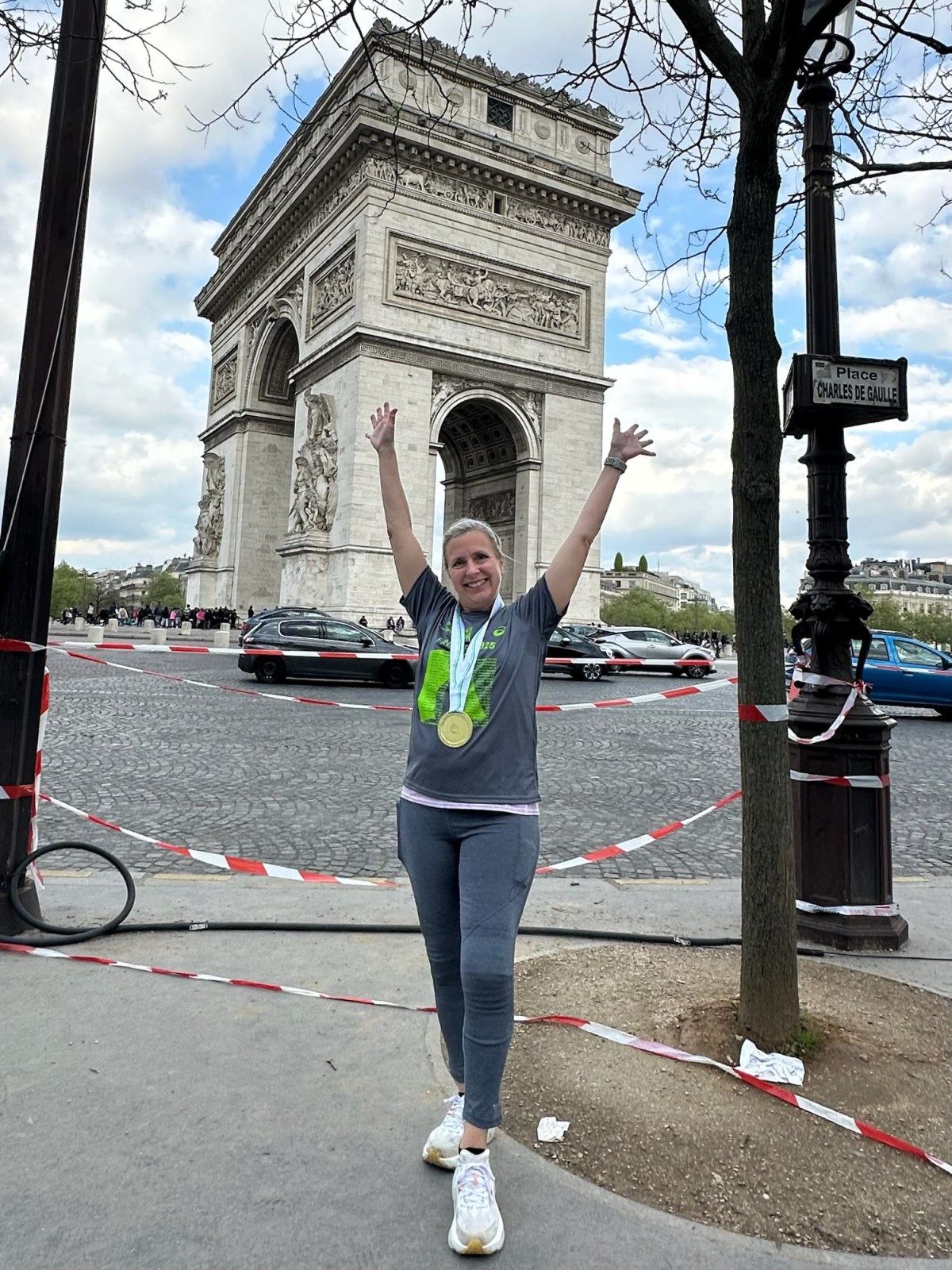
Ran my first races outside the U.S.: the Paris marathon in April and the Damloop by Night in Zaandam, Netherlands.
So, turns out this post is heavily weighted toward my past year’s reading list. There were certainly other disruptions, but the ones shared here feel theme-appropriate for this space. And opening your mind to the power of a good book is one of the best kind of disruptions I can think of.
Happy New Year!
Snow in City Park, January 2025Arc de Triomphe, April 2025
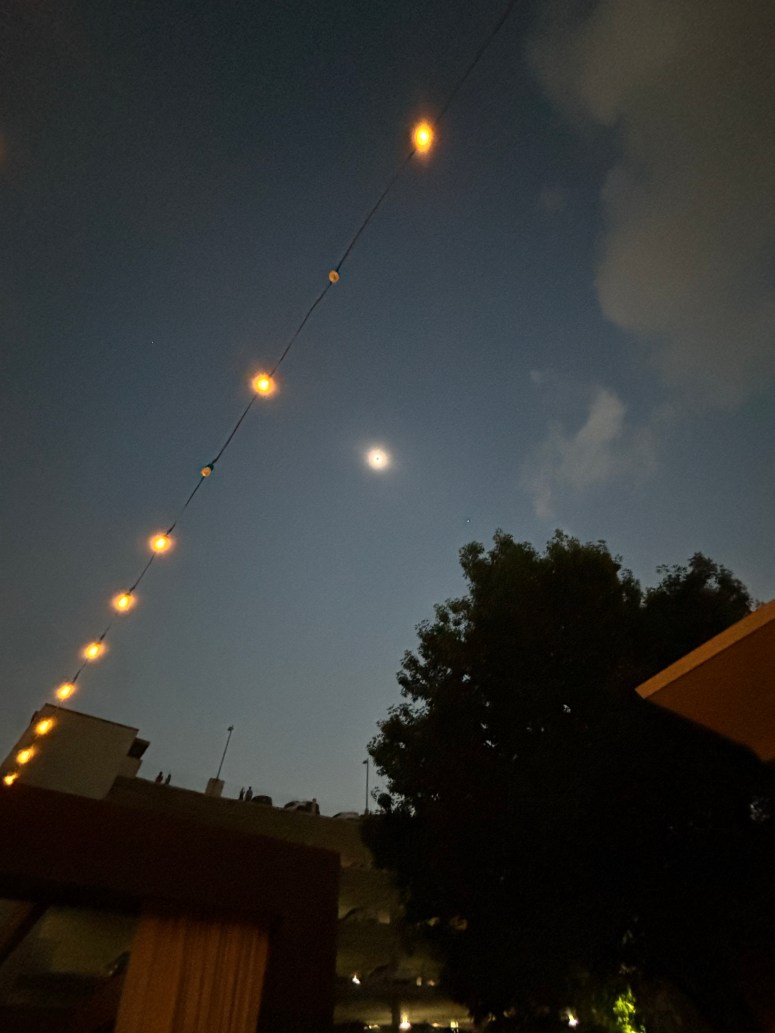
Today marks another new moon, meaning it’s been one month since I traveled to see the eclipse. It was a fun and memorable trip to Dallas, but the memory of the eclipse itself is indelible. Maybe the biggest thing that sticks with me is the twilight.
The twilight of a total solar eclipse is utterly singular. Singular in that it only lasts for minutes at most, singular in the quality and shape of the light, singular in rarity of the occurrence. So is it irony (or is it just me trying to establish a hook) that the origin of the word twilight ties to the concept of double, not single? The word is from late Middle English, and the “twi” means two, as in twice. (The Latin word for twilight is “crepusculum,” the origin for crepuscular, a fabulous ten-dollar word. Sounds like a good hook for some other post.)
2 of 2 total solar eclipses that I’ve witnessed. Dallas, TX, April 8, 2024
But I’m going to stick with the “twi/two” theme. According to vocabulary.com, “the prefix twi- might be a clue that twilight happens twice a day, or it could mean “half,” as in the half-light of this time.” I’ve never read Stephenie Meyer’s Twilight series, so I don’t know if she spends any part of the story pondering the origin of the word. Pity, if not. I’ve found a good deal to ponder.
There’s two for place and time: the two eclipses that have graced North America, in 2017, and then again in 2024. For astronomy, there’s two heavenly bodies that make eclipses on Earth possible: the moon and the sun. Personally, I’ve traveled two times, and taken time off from work, to witness these events.
And then, here’s where I really got caught up in all this twice-thinking — You Only Live Twice. The song, the score, the movie. I could go off on a million tangents, about both the score and the movie (about elements of each that are just brilliant, offset by elements that have aged very poorly; about Robbie Williams’s “Millennium;” about the fake lake; about James Bond and the spy genre). But I won’t. I’ve been chewing on those tangents for the past month, they are what’s kept me from finishing this post.
So, I’ll conclude with the song. The link below is the version that I’m guessing was the one that got played on the radio. I think it’s aged exceedingly well. Nancy Sinatra’s vocals, the lyrics, are worth a listen if you’re not familiar.
Any tangent evoked by this song tends to lead me to beautiful places. I hope it’s the same for you.
Continuing my Eclipse Series, here’s a post I published in anticipation of the last eclipse, in 2017. Under the title “Total Eclipse of the ’80s.” Thought the stuff about saving the April 8, 2024 date was kinda funny (or prescient). And realizing I have to add “New Moon on Monday” to my eclipse playlist on Spotify. Side note: my ear worm for this 2024 eclipse has been “You’re So Vain” by Carly Simon.
In less than a week, I’ll be in Nashville to witness the total eclipse. Yes, I am that into the idea that I actually took the day off from work, purchased a plane ticket, and booked a hotel. (It’s been impossible to reserve a rental car, so I’m hoping the cab/ride share options in Nashville are plentiful). I even managed to coerce my friend Beth into the whole scheme. (Husband Tim opted out of this run. But I’ve already asked him to “save the date” of April 8, 2024 – that’s when the next eclipse will be visible from the U.S. Watch out for us in seven years, Dallas.)
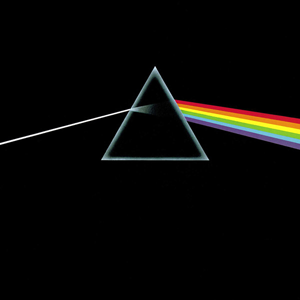
And I’ve been living with total eclipse brain. The lyrics to Bonnie Tyler’s “Total Eclipse of the Heart” have been going through my head non-stop. (Once upon a time there was light in my life / But now there’s only love in the dark). And this eclipse falls on a Monday, during a new moon. So, there’s Duran Duran’s “New Moon on Monday” (I light my torch and wave it for the / New moon on Monday). Also Pink Floyd’s “Eclipse,” the last song on TheDark Side of the Moon.* Problem with that one, though, is that it always intermingles in my head with “Brain Damage,” the song right before it.
So there’s Roger Waters’ voice knocking around my noggin, singing “The lunatic is in my head / The lunatic is in my head / You raise the blade, you make the change / You rearrange me ‘til I’m sane.” Thanks for that, Roger. Didn’t need you to help me feel loonier than I already do.
I could spend some time on the relation of the moon to lunacy, how the Latin word for moon (Luna), led to the word for moon-struck (lunaticus). But I won’t.
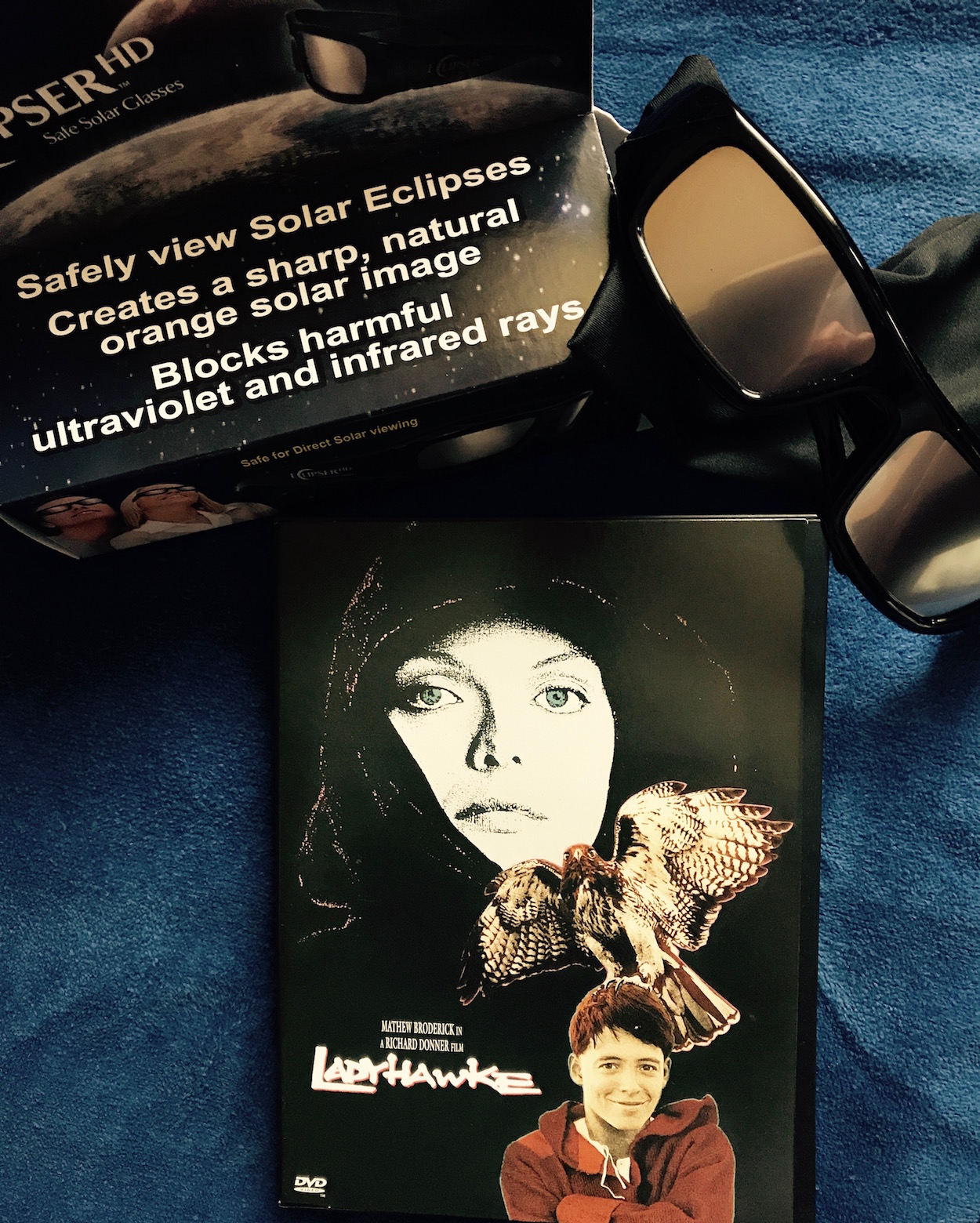
Instead, I’ll focus on my most memorable eclipse from a movie. And that would be Ladyhawke.
For those of you who have been paying attention, this movie has come up before in this space. In a post about Lent, and in another one about my family. Because, truth is, I love Ladyhawke. Sure, one could argue that the Alan Parsons Project soundtrack dates the movie; but I would argue right back that it cements it into a certain Zeitgeist, the heady days of the mid 1980s. When movies could still be unapologetic about their cornball aspects.
In Ladyhawke, Navarre (Rutger Hauer) is this kind of masterless Samurai (but it’s set in medieval France, so he’s not really a Samurai), and Isabeau (Michelle Pfeiffer) is his star-crossed love. They’ve been cursed by an evil Catholic bishop (John Wood) to live half-lives as animals. Isabeau spends her days as a hawk, and Navarre spends his nights as a wolf. So they never get to see each other.
But that’s where the eclipse comes in! The drunk monk Imperius (Leo McKern) foresees the coming eclipse, and, with the help of Philipe Gaston (Matthew Broderick) convinces Navarre and Isabeau to confront the evil bishop as humans, together, during a total eclipse.
It’s really a grossly underrated movie, in my opinion. Richard Donner directed it, it’s got this lights-out cast, and the setting is to die for.
And to conclude, if looked at a certain way, who is the real hero in Ladyhawke? The eclipse!
*Yes, I realize Dark Side of the Moon pre-dates the ’80s. But I first listened to it in the ’80s, so it gets lumped in there.
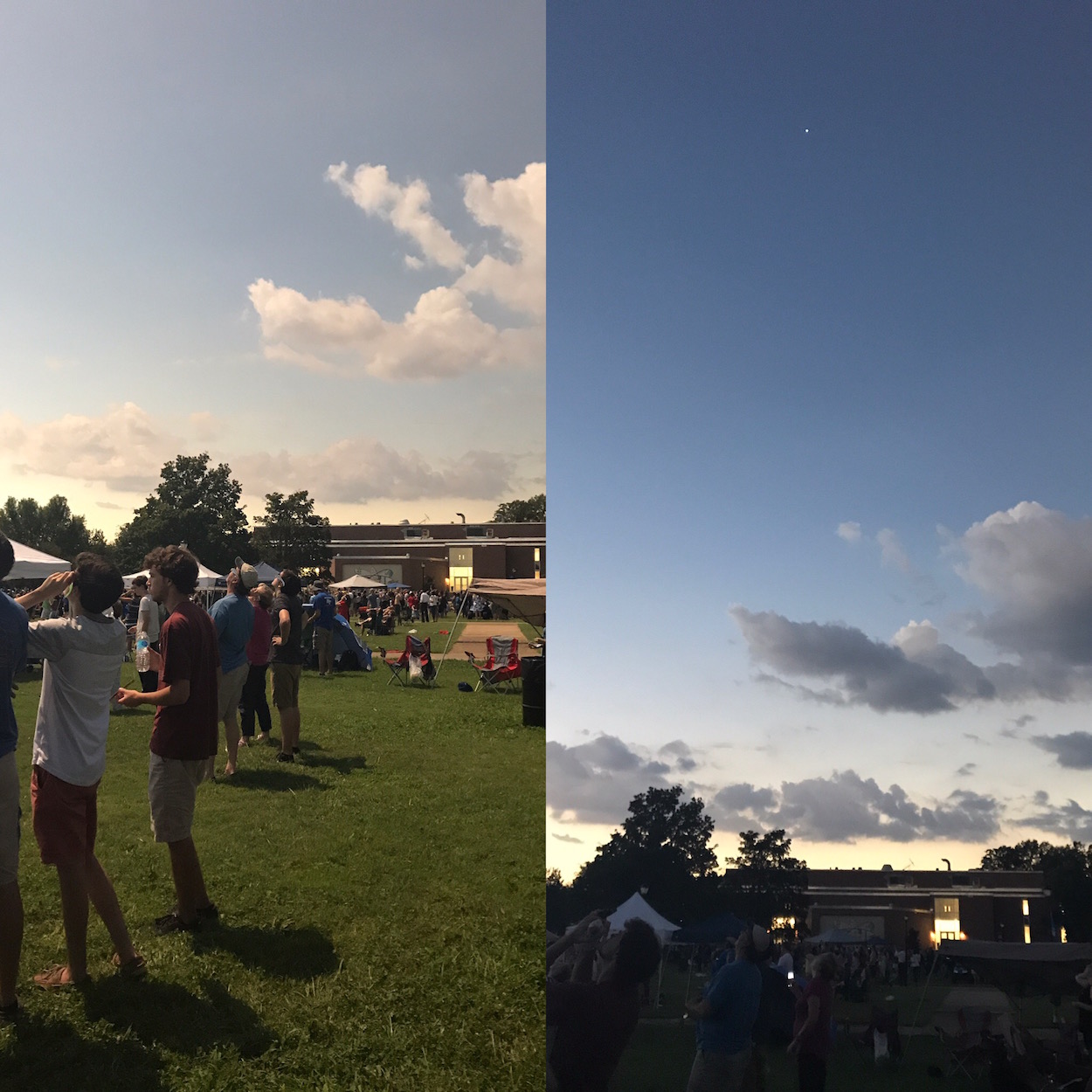
1:28 pm versus 1:29 pm. That’s Venus on the upper right.
Hello! Thought I would reach out ahead of next week’s total solar eclipse. I published this post in 2017, under the title “The Great American Eclipse: One Minute in Murfreesboro.” Next week in Dallas, I think totality will last more than two minutes. Looking forward to comparing the experiences.
So, I had the rare opportunity to witness Monday’s total solar eclipse. I traveled with a friend more than 500 miles northeast of our homes in New Orleans to Murfreesboro, Tennessee, just south of Nashville.
I had noticed early on in my research that The Volunteer State was referring to this celestial event as “The Great Tennessee Eclipse.” I’m not sure how the other states hosting the total eclipse felt about this appropriation. But for my part, I thought Tennessee put on a pretty good show.
We found ourselves in Murfreesboro because it was the only place in the greater Nashville area that had a hotel room at a non-extortionary rate. In digging around the Internet, I discovered that Murfreesboro not only houses the affordable and clean Candlewood Suites, it is also home to Middle Tennessee State University (MTSU). I thought a University might be a good place to catch an eclipse.
Turns out, NASA must have thought so, too, because MTSU was “an official NASA viewing site for the greater Nashville area.” Their eclipse event was held on a big lawn on the campus, ringed by a new science building, older science buildings, and the library. They had set up a stage, with musical acts from a student-run record label (Nashville is Music City, after all). The buildings were open to the public, in case the viewers might want to escape the pre-eclipse heat. They had telescopes set up around the lawn, and big screens showing the eclipse in real time.
And about an hour before total eclipse time, faculty from the Physics and Astronomy department took over the stage and talked about the science of eclipses, and invisible parts of the sun’s atmosphere that become visible, and lots of other cool stuff. I liked that there were professionals, who knew what they were talking about, commentating to the crowd.
When the light started to dim, they pointed out that Venus had become visible in the Southern sky. When totality finally arrived, they instructed when it was okay to remove the special solar eyewear, and look directly at the sun. And when that minute had passed, when we needed to put our special eyeglasses back on.
But here’s the thing about that minute, that minute of eclipse totality. (Totality was longer in other places, but a minute is what we got in Murfreesboro. I’ll take it.) I can honestly state that I’ve seen nothing else in nature to compare it to.
While corresponding with Husband Tim around the time of the eclipse, I wrote: “Can’t describe it.” To which he responded: “You’re a writer.”
Touché. My response back? “Can’t describe it YET.”
Herewith my attempt: there are the pictures at the top of this post, showing the difference in the light. And there are words: incredible, awesome, amazing – all overused, and thus, lacking in true descriptive power. Awe-inspiring and phenomenal do a slightly better job. But still not adequate.
The word that most closely describes the experience for me? It’s gestalt. The German word, which I’ve always taken to mean things coming together to become something greater, greater than just the sum of their parts.
The extreme rarity of the event, the appearance of the night sky at 1:30 in the afternoon, the drop in temperature, and just looking up and seeing a black hole where the sun should be – these all came together to create a very intimate and transcendent moment. Imbued with personal meaning beyond all the mechanics at play.
During totality, and for a few moments after, fireflies lit up around the base of the tree where we stood. I remember seeing fireflies at my father’s camp in the woods when I was very young. Back during a time when I was much closer to magic, and fantasy, and the surreal.
Before Monday, I couldn’t have told you the last time I saw fireflies. All of this gives me the feeling that maybe magic, and fantasy, and the surreal were never really that far away after all. It’s making the time to look for them that remains a top challenge.
It’s been awhile since I’ve written here. Not since I’ve been here. I visit my WordPress dashboard nearly every day. With five years’ worth of weekly posts, there’s some content that folks seem to find their way to. It’s kinda interesting. A post from 2018, Annie…Are You Okay? seems to get a lot of hits. Haven’t really figured out why.
There were some good things to write about in 2022, but I just couldn’t get myself to write them. I started a post about the James Webb Space Telescope in March 2022, but never finished it. For the first quarter of last year, I anxiously followed its journey, first settling in a million miles away from earth, then unfolding all its delicate instruments. That’s another websiteI visit almost daily, awestruck at the images and observations from the farthest reaches of our universe.
And I read Kurt Vonnegut’s Slaughterhouse Five last year. Also awestruck at that. Loved it. Goes up as one of my favorite books of all time. But still not enough to dislodge the massive case of writer’s block I’ve been struggling with the past few years.
But then, this post is not about my writer’s block, or about all the great things I should have written about. It’s about the great experience I had running the TCS New York City Marathon in November 2022.
To set the stage: this was not my first marathon. I ran Los Angeles in 2000, New Orleans in 2005, and Houston in 2010. The highlights of Houston: it was my PR, I ran it in 4:29:29. And I saw former president George H.W. Bush in a secluded location somewhere around mile 18. He was by himself, sorta, (I’m positive Secret Service folks were close behind him) cheering on the runners. Wearing a long black coat, fitting for a former head of the CIA, he was not more than ten feet away. I think I shouted something lame like “Thank you, Mr. President!” Interesting, because his was the first presidential election I voted in. I didn’t vote for him, but I had always liked him.
So, anyway, having run a few marathons before, New York had been on my bucket list for a while. The prospect of running through all five boroughs was just something that sounded so enticing. I guess that sounds kind of wacky, but I think it’s a kind of marathon logic. When you’ve covered 26.2 miles on foot a few times, you see a lot of different parts of a city, and they’re not all memorable. Not every part of NYC was memorable, either, but one of the things that made this race so special to me is that I can make that memorable claim, specific to the city. “I’ve run through all five boroughs of New York City.” More than three months later, it still thrills me to say this. I hope it always will.
There were a lot of things that made this race special, and such an awesome experience. Since my first presidential election was 1988, you can figure I’m no spring chicken anymore. I went into training for this race not knowing how my limbs and ligaments would handle all the miles. I told myself it would be my last marathon, creaky knees and tight hips just needed to get me to the finish line so many miles away just one last time.
However, a funny thing happened. I listened to the advice of physical therapists, and consistently did the exercises they gave me. I did the strength training exercises, targeted for runners, provided by the NY Road Runners Team for Kids. Team for Kids is another big reason this was such a phenomenal experience, but more on them in a bit. The funny thing? I finished the race, in pretty good shape. I wasn’t hobbled at the end, nothing gave out on me.
The actual experience of race day was spectacular, too. The day was unseasonably warm for New York in November, and my wave started at 10:55 am. The temperature was no big deal for me—having trained in all the heat and humidity of a New Orleans summer, I was pretty well conditioned for it. The time of day was likely my biggest obstacle. Because having trained in all the heat and humidity of a New Orleans summer, I was conditioned as an early morning runner. Even on my longest training runs, I was finished before 11:00 am.
I finished the race roughly 20 minutes slower than I was hoping for. (I was hoping to finish in under five and a half hours.) But I have absolutely no regrets about that! While I blame the time of day (and a bit of the heat) for making me slower, I think the timing might have been key to what ultimately made the race my best marathon experience: the crowds. The people who filled the streets of Brooklyn, Queens, the Bronx, and Manhattan were phenomenal. (The only crowds in Staten Island were the other runners at the start of the race, but they were pretty great, too.) I just don’t think the spectators would have been as enthusiastic, or numerous, if I had encountered them at 7:00 am. 🙂
And Team for Kids. I could not have had this experience without them, literally. I raised over $3,000 for Team for Kids and got to run the marathon. This was my first time raising that amount of money for an organization, and I don’t think I could have picked a better one.For the last 20 years, they’ve offered free health and fitness programs to children in schools across the country. By teaching goal-setting, perseverance, determination, and teamwork, these youth running programs get kids on track toward a healthy and successful life. I’ve been the beneficiary of all the fringe benefits of running (mental, emotional, physical) for a long time now. I was very happy to be part of an effort to open the door to those benefits for anyone who’s willing to try it out.
So, finally. Maybe the best part of this whole experience is that I want to do another marathon now. While my knees are still creaky and my hips are still tight, that finisher feeling is just too appealing. Lookout, Paris.
Sunrise on the day of the race. Waiting for the ferry to the start line.One of the thousands of thumbs-up I received as I ran the race.
This is the third year I’ve concluded with Dickens. When I wound up 2019 with Great Expectations (I realize how ironic that sounds now), and liked it so much, I made an intention of exploring more Dickens in the fourth quarter of the year.
Last year was David Copperfield, which I enjoyed, but it felt a bit self-congratulatory on Dickens’s part. Certainly more so than Great Expectations.
This year was A Tale of Two Cities. This book is the only Dickens I had read prior to 2019, although that “prior” was close to forty years ago. I remember liking it when I read it in high school, and I remember really liking a TV movie version we got to watch in class. In that rendition, Chris Sarandon played both Sydney Carton and Charles Darnay. I loved him, especially his portrayal of Sydney Carton. When The Princess Bride premiered just a couple of years after I saw that version of A Tale of Two Cities, I was a touch disappointed to see him play such a heel of a character as Prince Humperdinck.
Flash forward to now, when I’ve seen The Princess Bride more times than I can count. I found that old TV movie A Tale of Two Cities streaming somewhere, and watched it last month. I can no longer unsee Chris Sarandon as Prince Humperdinck, especially since his voice sounds exactly the same in his portrayal of all three characters. Although his Sydney Carton certainly has more of a drawl. Another fun fact lost on me back in the mid-80s — Peter Cushing (Grand Moff Tarkin from Star Wars) played Dr. Manette.
But I’m burying the lede. What has bubbled up to me through the sedimentary layers of decades is how much I love the character of Sydney Carton. He’s the reason I liked the book so much the first time I read it, and the TV movie the first time I saw it. He’s the poster child for “damaged goods.” And he knows it, and has no illusions about it. He never tries to redeem himself through multiple, abortive, attempts at self-improvement. Actually, his commitment to keep his damage self-contained, and not inflict his misery upon others, is one of the most heroic things about him. (Is his self-containment why Dickens chose the name Carton?)
No, Sydney Carton’s foregoing any small-scale redemptive attempts during his lifetime, sets up his final act in a huge way. He makes the ultimate sacrifice, but it’s not to win a battle, or save a city, or save the universe (sorry, Iron Man). It’s to save a family — and it’s not even his family. But it’s the family of the woman he loves.
And I can’t think of a character who has a better concluding line / thought than Sydney Carton’s. So I begin this new year, grateful to have explored and rediscovered a love I have held for most of my life. Here’s to far, far better things for all of us.
Hurricane Ida slammed into coastal Louisiana on August 29, about six weeks ago. I’ve had this post drafted for nearly the past month, but haven’t brought myself to finish it. There are a few reasons for this, I think. Like any great procrastinator, I’ve been able to find plenty of other things to do rather than write this. And every time I’d sit down to write, I found that the post-experience had changed. We were very fortunate, and did not sustain any major damage to our home, so “back-to-normal” came sooner for us. For friends whose homes and businesses were devastated, I just feel kind of insensitive writing about what happened to me in particular, when it was not particularly devastating.
So I’ve decided to keep the tale of this odyssey to just the first two weeks after the storm, when pretty much everyone who lives in Southeastern Louisiana had a shared experience of power outages, lines for gas, and the decision of whether or not to evacuate.
I will also include two items of note that are not shared experiences, but are particular to me. 1) August 29 is my birthday. And 2) Ida was my mom’s name.
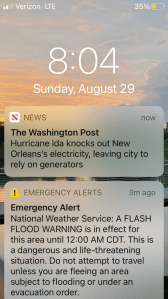
Starting with those two weeks, from August 29 to September 11. We did not evacuate, and lost power in our house in the early afternoon of August 29. The storm blew in, and it was a wild one. We heard a crash outside, and looked to find a pine tree blown down, about two houses down from us. The worst part came in the evening, when my phone told me there was a flash flood warning. The levee failures during Katrina inundated our neighborhood (we did not live here at the time), and all I could do was pray that all the improvements that have happened since that time really did improve the situation.
They apparently did, because we woke up the next morning to wet, debris-strewn streets, but not flooded streets. The next decision became “should we stay or should we go?” We had a vacation in Florida, planned for months, set to begin Sunday, September 5. But we were looking at a long six days until then with no power, no services, and no place to go, since both of our workplaces were experiencing similar issues at a different scale. That made the decision easy. We couldn’t get into our vacation rental any earlier than the 5th, so we booked a hotel nearby our rental and left on Thursday, September 2.
One more detail to add. I waited for seven hours to get gas on Wednesday, September 1. All I care to say about that is that it was a lesson in patience and fortitude, and I hope to beat that time by a significant amount when I run the New York Marathon in 2022.
Our Florida vacation was really nice, definitely one of our nicer beach vacations. But it did have a bit of an Odyssey feel to it, like when Odysseus lives the high life with Circe while having no idea what is going on back at home.
I’ll conclude with those two items of note, mentioned previously. About August 29 being my birthday…I’ve written in this space before about what a bummer it can be. This quote from a post in 2017 about sums it up: “When your birthday falls at the height of the hurricane season, you get used to altering plans.”
And about Ida being my mom’s name. She died in 2014, at the age of 81. Her positive, beneficent, influence was really strong in our family, and still lives on. Thus, when a Hurricane Ida took aim at the places where a good number of her children and grandchildren live, the name of the storm was more than a detail. Ida is not a common name in our time. I’m still scratching my head over how a name I associate with such a gentle human being caused such mass devastation as a storm. Storms and people are very different things, obviously, but I guess they both have the potential for major impact. I’ll take the impact of having had Ida the person as a mom any day (and twice on Sunday).
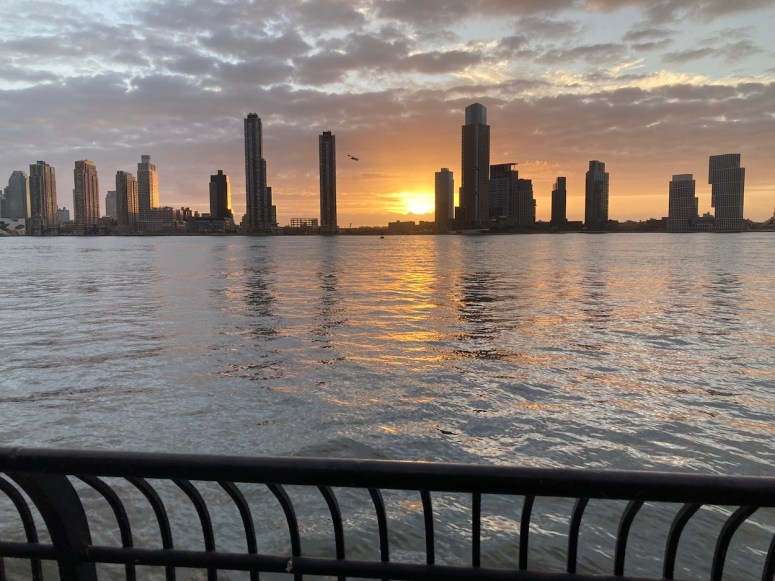
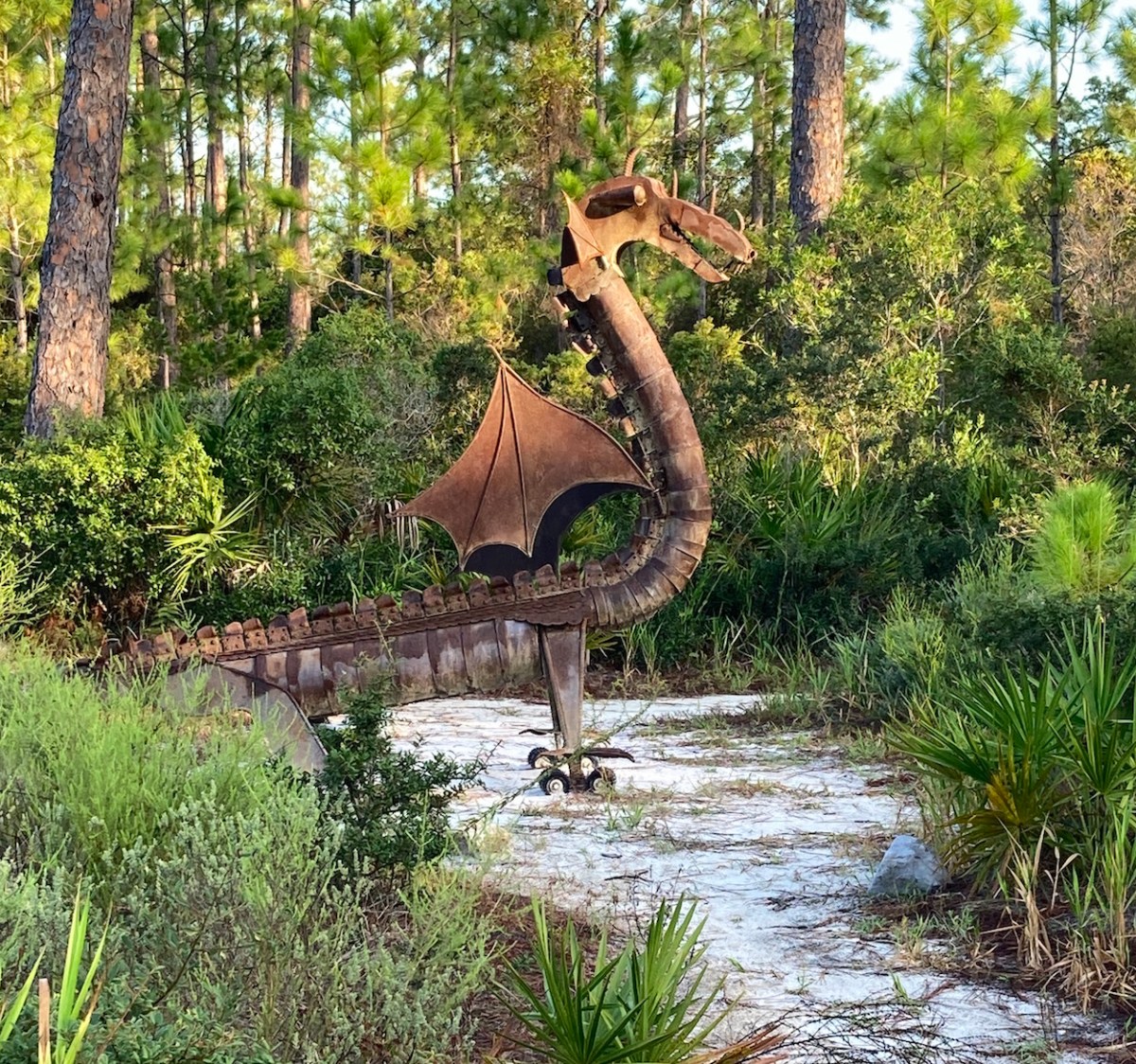
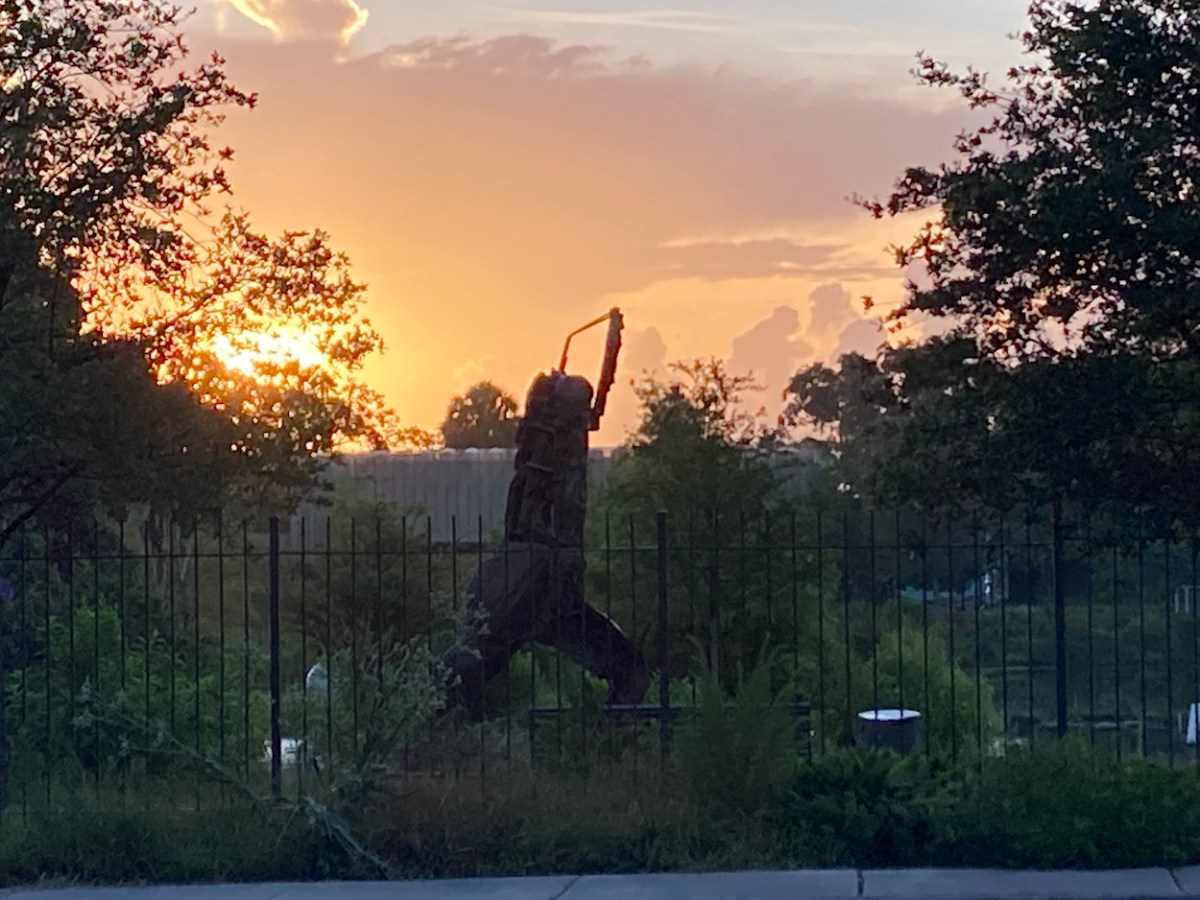
Sunrise over the New Orleans Museum of Art Sculpture Garden, June 29, 2021. The sculpture could be inspired by The Iliad, but I don’t think it is.
I recently finished The Iliad, and all I can think to say is: thank God for the movie Troy. Being able to picture Brad Pitt, Eric Bana, Brian Cox, and Sean Bean in my mind’s eye as I slogged through the text about Achilles, Hector, Agamemnon, and Odysseus was tremendously helpful. Although, on the few bits with Hector’s wife Andromache, I thought less about Saffron Burrows and more about Charlize Theron, because her character in The Old Guard is named Andromache.
When I write “the few bits with Hector’s wife,” I mean it. The Iliad is very male-centric. Even though they were apparently fighting the Trojan War over a woman (Helen), she does not factor into the story very much. What does factor into the story? LOTS of fighting. And some Olympic-type sports. And the Greek gods behaving like Grade A A*holes. I read a version translated by Alexander Pope, where Zeus, or Jupiter, was referred to as Jove. And Jove gets mentioned everywhere, by jove.
The description of the fighting was pretty evocative, and might be the only thing I really enjoyed about this read. Catch this: “He fell heavily to the ground, and the spear stuck in his heart, which still beat, and made the butt-end of the spear quiver till dread Mars put an end to his life.” What a picture! (Although this time Mars gets the attribution, not Jupiter.)
Spoiler alerts ahead: there are two bits of ancient history that I kept expecting to encounter in The Iliad, but they never came up. The first was the death of Achilles. His death in Troy is foretold throughout the story, but the story ends with Hector’s burial, and Achilles apparently very much alive. According to an article by Philip Chrysopoulos in Greek Reporter: “The death of Achilles is not mentioned at all in The Iliad. His killing by Paris, who had discovered the one weak spot of the Greek warrior, comes from another ancient legend, which says that Paris shot Achilles in the heel with an arrow and killed him.”
The second was the Trojan Horse. It is referenced in The Odyssey (which I’m currently reading), but not in TheIliad. And unless it comes up again in more detail, all the reader finds out is that it was Odysseus who kept everyone quiet when they were hiding in the wooden horse. Given all the visceral action sequences in The Iliad, I would have liked to read a depiction of what happened when they came charging out of the horse.
But while these two Greek classics are not proving to be favorites, I definitely feel I’m benefiting from the experience. Getting a first-hand sense of these stories, foundational to so much of western thought, seems to be having a clarifying effect on me. That’s it for now!
“…having done with the triumphs of youth, lost herself in the process of living, to find it, with a shock of delight, as the sun rose, as the day sank.”
— from Mrs. Dalloway by Virginia Woolf
Virginia Woolf’s Mrs. Dalloway is my most engaging read yet this year. Out of the eighteen serials I’ve read on the Serial Reader app, it might be my favorite. Great Expectations comes close, but can’t match the synchronicity I experienced. I never recognized as much of myself in Pip as I did in Clarissa Dalloway. The fact that I’m the same age as Mrs. Dalloway in the novel certainly helped foster this feeling.
That can seem pretty loaded, to say that I identify with a privileged, middle-aged, woman living in excessive comfort in early 20th century London. But that’s not what I mean by stating “I see myself in Clarissa Dalloway.” And I’m pretty positive Virginia Woolf’s intention was not to glorify Mrs. Dalloway’s privilege.
To me, the whole point is that there is so much more to everything, and everyone, than the categories we put them in.
I had a similar experience many years ago when I read Jane Austen’s Persuasion. I remember strongly identifying with the protagonist, Anne Elliot. Not only did we share a name, we were the same age. Not yet 30 years old, I was at a point in my life where I wasn’t excited about my future prospects. Something needed to change — I needed to change — to course-correct my life. What I took from Persuasion was that if things could change for a 27-year-old woman in the Regency period, there was no reason why I couldn’t shake things up for myself at the fin de 20th siecle.
Clarissa Dalloway is at a different stage of her life, (as am I). Now it’s not so much about changing your life, as it is making sense of it. And what Virginia Woolf accomplished so masterfully in the novel is capturing the multi-facetedness of life, of perception, of everything. Reading Mrs. Dalloway was like being hit with, and comprehending, a brilliant stream from the multiverse. Not only do we understand how Clarissa Dalloway perceives things, we understand how she is perceived, chiefly through the characters of Richard Dalloway, Peter Walsh, and Sally Seton.
And what can I say about the other anchor for the story, the Great War veteran Septimus Warren Smith? Suffering from PTSD and rapidly losing his grip on reality, reading his scenes was difficult, to put it mildly. Clarissa Dalloway does not know him, but knows his doctor, Sir William Bradshaw. When she learns of Smith’s death from Bradshaw, she is profoundly affected, and the story comes back around to itself in the most amazing way. It was one of the most convincing depictions of humanity’s interconnectivity I’ve encountered.
I didn’t go into Mrs. Dalloway with high hopes. I read Woolf’s Night and Day first, and didn’t care much for it. There was only one character I really liked, Mary Datchet, and she kinda gets the narrative shaft. Night and Day was published six years before Mrs. Dalloway, so I guess it just goes to show how writers can develop. Something else I can hope to identify with.
To conclude: my recent interest in Virginia Woolf relates to her novel Orlando. I read it in college, and remember being very intrigued with how time is treated in the story. I plan to re-read it this year, and Night and Day and Mrs. Dalloway were a sort of grounding in Woolf. Tying it back to time, the striking clocks were another thing I loved about Mrs. Dalloway. So I’ll leave you with this, right after Clarissa learns about Septimus Warren Smith:
The clock was striking. The leaden circles dissolved in the air. He made her feel the beauty; made her feel the fun. But she must go back. She must assemble. She must find Sally and Peter. And she came in from the little room.







 Anne McClane